Tuesday, August 20, 2013

Aftershock (2012) Blu-ray review


Eli Roth is a man who wears many hats. He writes. He produces. He directs. He acts. Hell, recently he even lent his name to a major Vegas attraction when his 24/7 spook house, the eponymous Eli Roth’s Goretorium, opened last year. His constant media exposure and rampant self-promotion have led the media to essentially christen him king of the Splat Pack, referring to the crop of new millennium directors working in horror. If he isn’t doing promotion for one of his finished films, he can usually be heard spouting quotes about all of the ideas he has for upcoming projects. The guy has more jobs than Damon Wayans in a “Hey Mon” skit on In Living Color. And that’s exactly the problem, because despite all of the prestige he enjoys from the media, most horror fans would agree that Roth hasn’t given the genre a truly classic film. Cabin Fever was an auspicious debut that showed promise for the young director, but since then the only memorable offering he’s produced was a fake trailer featured in Quentin Tarantino’s Grindhouse (2007). There’s a lot of sizzle, not a lot of steak.

Which brings us to Aftershock (2012), the Chile-set disaster flick that Roth has been promoting heavily for the better part of a year. Roth leads the film as the generically-named Gringo, an American tourist visiting two of his friends – Ariel (Ariel Levy) and Pollo (Nicolas Martinez, who looks like Chile’s answer to Zach Galifianakis) - who are trying their best to get him laid while on vacation. They visit clubs, they go wine tasting, they play by the pool. The film spends an interminable thirty minutes with these three douchebags, without providing any kind of character development or a reason to care about them once the earthquake finally hits. Once it does, chaos ensues and our leading pack of men, now joined by a trio of women, are thrust into a warzone situation with toppled buildings, marauding prisoners, and the threat of a tsunami that is constantly teased throughout the proceedings.

Since Mother Nature, as the film’s main threat, can’t have a physical incarnation it’s up to the film to provide leading characters we can empathize with so we (the audience) feel something when one of them bites it. As stated earlier, we spend a great deal of time with these guys, but they’re painted as typical archetypes that are impossible to care about. Roth’s Gringo is a stereotypical American, who doesn’t speak the language, spends the entire opening cruising for cooze, and he makes a lot of self-deprecating Jew jokes. Pollo is a dead ringer for Alan from The Hangover (2009), with his thick scruffy beard and amusing t-shirts. Honestly, there’s a club scene early on where ironic hipster shirts seem to get more screen time that our leading men. Was this sponsored by Tee Fury or something? Ariel is kind of the odd man out, adding very little to the film aside from being the boring straight man of sorts. The worst part is that they don’t even seem to all like each other, with Gringo and Pollo going at it enough that you’ll be begging for their deaths to happen pre-quake.

The film’s main conceit is to show how a society can break down during a major catastrophe, but it only does so in very typical ways, like showing how panicked clubbers are willing to trample others to death in order to escape. The real meat of this concept is the escaped prisoners, who stalk the streets looking for women to rape and men to rob. While a somewhat novel idea, the major issue is that the film has already established our leads aren’t really people to care about, which sort of neutralizes the threat of murder. Who cares if they die? The only hint of non-douchebaggery given to Gringo is that he has a daughter he cares about, but since their relationship is barely touched upon that isn’t a credible reason to see him live. And Pollo is a daddy’s boy through and through, using his father’s money to finance his lifestyle of luxury. That’s normally the guy we want to see offed in a horror flick.

Aftershock is more concerned with showcasing the violent aftermath and wanton destruction of Chile instead of proving some emotional depth to make us care about what happens to these characters. It’s a vapid vessel for delivering one gory comeuppance after the next, devoid of the necessary pathos that makes truly classic disaster films work. Some credit can be given for a few practical FX gags that are appropriately gory, but there’s no redeeming the remainder of the film surrounding them.


The image on Starz/Anchor Bay’s blu-ray certainly confirms its low-budget roots. Apparently, director Nicolas Lopez convinced Roth that shooting on Digital SLR cameras would produce an image akin to 35mm. I can’t say it was a successful choice, because the image is very blasé. Lacking in sharpness and fine detail, most of the opening scenes set during the day appear blown out and overly saturated. Surprisingly, things look a bit better once night sets in, which allows colors to pop a bit more against the backdrop of night. Black levels are oppressive and thick, however, with much detail lost within them. The audio fares much better, with a powerful DTS-HD MA 5.1 track that features some absolutely crushing bass. Dialogue is well-balanced in the mix, never lost amidst all the chaos. The rear speakers could have been utilized more to emphasize the citywide terror occurring all around our characters, but this track still manages to get the job done.

In the bonus feature department, things start off with an “International Feature Commentary”, with Eli Roth in L.A. and director Nicolas Lopez in Chile. The wonders of modern technology, right? Anyway, the two go over all the expected details regarding the project’s genesis, writing, location scouting, direction, etc. “The Making of Aftershock” is a brief featurette that runs for around 10 minutes. I’m sorry, but it’s a little hard to take director Lopez seriously when he’s wearing a cat shirt, sports coat, and glasses with rims so thick they look like raccoon eyes. Most of this piece is clips, with very little worthy information gleaned. Finally, there’s a gag called “Shaking Up the Casting Process”, wherein potential actors are brought in and told to change in a dressing room, one which is rigged up to violently shake and simulate a real quake.

Ultimately, Aftershock fails on virtually every level, the clearest being giving the audience characters we feel for in some way. If Eli Roth wants to pop up in his movies as a weed-toting hippie who provides comedic relief for a few minutes, that’s cool. But as a lead he simply cannot deliver the necessary elements. There are countless disaster films already in existence, so unless you absolutely have to see this to satisfy some morbid curiosity I’d recommend avoiding it.

Monday, August 19, 2013

Dark Angel (1990) [a.k.a. I Come In Peace] Blu-ray review


”I come in peace.”
”And you go in pieces, asshole."

Chances are, if you’re able to recall anything about director Craig Baxley’s 1990 buddy cop/alien drug dealer action flick Dark Angel - more commonly known here in the States as I Come In Peace - it’s that exchange of dialogue. But, really, there’s much more worth remembering (and revisiting) now that Shout! Factory has finally given the film a proper release. Roughshod-cop-versus-alien films were in vogue for a few years after Predator (1987) became a hit, paving the way for films like this and Split Second (1992, and also in dire need of a remastered home video release). Baxley, who hails from a family of veteran stunt actors, put a great deal of effort into the film’s action, maximizing the paltry $5 million budget he had to work with so well that it looks like it was shot for $20 million. The resulting film is a unique mix of buddy cop, mobster, and sinister alien visitor subgenres that somehow manages to steamroll through 90 minutes without any noticeable lagging.

Dolph Lundgren stars as Houston cop Jack Caine, the kind of guy who works out of his car and survives on little food and less sleep. When a drug sting goes wrong, leaving his partner dead, Jack is paired up with straight-laced FBI agent Arwood “Larry” Smith (Brian Benben of HBO’s Dream On fame) to bring down the White Boys, a group of white collar criminals who control the city’s drug trade. The group is led by Caine’s old foil, Victor Manning (Howard Sherman, best known to horror fans as “Bub” from Day of the Dead), who blames him for stealing their supply of heroin. But it isn’t Caine Manning should be worried about because the heroin is being used by Talec, a massive, hulking humanoid, as a means to extract endorphins from victims around the city. A spiked tube on his wrist pumps his targets full of heroin, at which point endorphins are released in the brain just as he slams a giant vacuum tube into their heads, sucking them dry. On his trail is an interstellar police officer who tells Caine and Smith that on their planet our endorphins are sold on the black market as a powerful drug. Armed with this knowledge, and a couple of big-ass alien handguns, the two set out to destroy Talec before he annihilates all of Houston.

First off, gotta say I find it very odd that Shout! has chosen to release this film under the international title (which was also used during production) of Dark Angel. While I applaud the geeky lengths they go to in an effort to please fans, releasing a film with a known title under its relatively unknown name isn’t likely to bolster sales. When I informed one of my friends that “Dark Angel” was coming out on blu-ray, he had no clue what movie I was referring to. Once I mentioned its more common moniker, he was instantly excited. Point is, how can those people be reached if they aren’t familiar with the title it’s being sold under? Only the nerdiest fans are aware of this alternate title. Short rant there, but it’s just a bit puzzling. Plus, let’s be honest here, I Come In Peace sounds way cooler, while Dark Angel sounds like the kind of safe, generic title a producer would give it.

One thing the film can’t be faulted for is a dearth of action. Baxley put forth all of his cinematic magic, and years of honing his craft as a stuntman, to produce action that is on-par with any big-screen tentpole audiences could have seen that year. It is truly unremitting, and by the end of the picture you’ll likely feel as fatigued as the two leads. Anything that looks like it could explode in this film, does. Buildings, cars, and people are all annihilated with extreme prejudice, but, man, does it look glorious on screen. Baxley allows the film to really showcase his work, with lots of wide shots and unique camera work to heighten much of the action. Talec, the film’s Evil Alien, uses a CD-looking disc that hones in on human frequencies to slice up many of his victims. But rather than having someone off-screen toss a disc at someone as they fall holding their throat, the camera is “mounted” to the disc, taking us along for the ride as jugular after jugular is shredded. Every explosion in the film is massive, and if you actually consider how much of downtown Houston was being exploded in the film it’s a wonder the military wasn’t called in. Also, those aliens have huge guns and everything they shoot acts like it was wired with C-4.

Like any good buddy cop film, our two leads appear horribly mismatched at first. Dolph’s character is the top cop who doesn’t play by the rules. We’ve all seen this guy a thousand times. Brian Benben is the stereotypically uptight, staunch FBI agent who adheres to the rulebook like it’s scripture. And, of course, they eventually come to a mutual understanding right when they have to. All of this is nothing new, but these two guys just have good chemistry. Not every odd cinematic pairing feels genuine. Maybe I’m being a tad biased because Benben’s breakout role on HBO’s Dream On was one of my favorites growing up, and here he’s teamed with Ivan Drago, but I doubt I’m alone here.

If there’s any complaint about the film, it’s the mostly-pointless White Boys subplot. Yes, it’s kinda funny that there’s a gang of white collar dicks stealing heroin from the cops and blowing up anyplace Caine is spotted, and they’re led by Bub. But it goes nowhere. The only reason for its existence is to give our Evil Alien a place to acquire the large amount of heroin he needs to drug humans. Creating an organization and tying it in to Caine’s partner being killed seems like an obvious and understandable scripting point, but then it just sort of trails off and the film ends with no clear resolution despite the White Boys constantly popping up as a threat.

Whatever you want to call the film (but, seriously, we all know everyone is flipping over that reversible cover art as soon as it’s out of the shrink wrap to display I Come In Peace), Craig Baxley delivered a wildly entertaining, often brutal ride that is finally getting the release it deserves. Matthias Hues is in full-on creep mode as the 6’5” alien drug dealer, Lundgren & Benben have a believable chemistry to keep their relationship interesting, and there’s something or someone being blown up or horribly dispatched every 10 minutes. It’s got all the trappings of the early-‘90s cult classics genre fans can’t get enough of.

Shout! Factory likely used the same HD master MGM prepared for the previously-issued DVD that was part of their Limited Edition (read: burned DVD-r) Collection. As such, the picture looks very cleaned up and polished without featuring any post-processing deficiencies like DNR. There’s a healthy layer of grain present, which provides a more filmic appearance. Fine details are more apparent than ever, although sometimes they are lost to the picture’s rich black levels. Colors appear strong and have a bit of pop to them, and skin tones reveal nice texture and coloration. Hues of blue tend to dominate the color palette. This is clearly a case where the studio commissioned an HD master with minimal tinkering (probably because they simply didn’t feel the film was worth it), resulting in a natural image that benefits from the added resolution. The back cover only lists a stereo track, but rest assured this disc comes packed with a DTS-HD MA 5.1 surround sound track. Still, even with the extra channels most of the soundtrack is relegated to the front and center speakers. Jan Hammer – of Miami Vice fame – provides a pulse-pounding synth score that echoes his work on that popular ‘80s culture staple show. It can get a little bombastic when there’s action to be seen, but more often than not the rear speakers are on standby.

There’s one main supplement here, along with a few minor ones. A 25-minute featurette, “A Look Back at Dark Angel”, features recent interviews with director Craig Baxley, and stars Dolph Lundgren and Brian Benben. Baxley is clearly still exuberant about his work here, talking up every aspect of the production process he can. Did you know that famed screenwriter David Koepp did a rewrite here under a pseudonym? He dispenses with as much information as possible in the runtime, even extending his thoughts into the credits. Dolph and Benben both recall the film with fondness and have a lot of good to say about it. This disc also includes the theatrical trailer (HD) along with a poster & still gallery that runs for about five minutes, featuring production stills, poster art, etc.

As much as we all love to see Shout! give fans ultra-deluxe editions of our favorite films, it’s fantastic when they tackle titles that have never been given the proper respect on home video. Dark Angel is one helluva fun time and if it weren’t for Shout! I don’t know if we’d ever have seen it hit hi-def.


Friday, August 16, 2013

Q: The Winged Serpent (1982) Blu-ray review


 Although his name might not be as well-known as Roger Corman - the king of low-budget genre productions - auteur Larry Cohen deserves every bit as much respect for his endless gumption and total devotion to making the most out of his features. His ability to work on-the-fly and under the gun is exactly the reason why his film Q: The Winged Serpent (1982) exists today. Cohen, who had just been fired from a low-budget production shooting in New York City, didn’t want to waste the room he’d paid for during the production, so instead he hired some actors and banged out the script that would become Q in a mere six days. The conceit for this tale of a modern-day Aztec beast-god nesting in the art-deco spire of the Chrysler Building came when Cohen looked up at the skyline and said to himself, “That’d be the coolest place to have a nest.” Inspiration can come from anywhere when you’re in the Big City.

New Yorkers are losing their heads, literally. Reports of a gargantuan winged creature terrorizing rooftops have the NYPD on high alert, but they just can’t seem to spot the damn thing. Meanwhile, across town, small time crook (and wannabe jazz pianist) Jimmy Quinn (played by Cohen crony Michael Moriarty) is an unwilling participant in a diamond heist (at a store called… wait for it… Neil Diamonds). It goes poorly, leaving Jimmy to run for his freedom all the way up to the top of the Chrysler Building where he finds a huge nest housing the largest cinematic egg since Mothra gave birth. Quinn decides that maybe now would be a good time to give up his life of crime and try going straight for once, but when a couple of his associates come looking for the diamonds he lies and claims they’re hidden at the top of the Chrysler Building. Sure enough, both men leave the rooftop minus a head. Thinking this is his big ticket, Jimmy figures he can use his knowledge of the nest’s location as a bargaining chip with the police, exchanging what he knows for a full pardon on all his crimes in addition to a cool $1 million cash. The way he sees it, this city owes him. Who cares if there’s an ancient behemoth eating residents, all while a mysterious man in a bejeweled mask is making willing human sacrifices to appease the beast?

Cohen started off writing detective dramas, a fact which is evident in many of his films since they almost always feature a subplot involving police procedures. While the film is ostensibly sold as a monster-run-amok tale, the fact is that virtually every big creature feature needs a compelling story to work within. Now, I’ll be the first to admit that Michael Moriarty isn’t exactly the most charismatic leading man, but it’s clear that he has a strong desire to imbue his parts with enough of his quirky charm and dogged resilience that they’re at least memorable. Jimmy Quinn is a lifetime loser; a petty crook with no luck who overlooks the one stable, good thing in his life: his girlfriend, Joan, played (rather terribly) by Candy Clark. He’s so accustomed to being broken down and spat out that once he gets a small amount of power it completely goes to his head. Moriarty’s performance ends up being the film’s highlight, mainly because our eponymous creature is a little less than spectacular when finally revealed.

Q had a stellar poster design. I can still vividly recall seeing the VHS cover art many times as a kid and thinking that it looked impossibly awesome. Emphasize impossible because this is another case of the poster setting such high expectations that they would be hopeless to match on screen. It also doesn’t help when you hire one of the foremost fantasy artists of all-time, the masterful Boris Vallejo, the design your one sheet. Quetzalcoatl looks a lot like a plucked turkey, soaring through the skyline of the Big Apple. The design isn’t necessarily terrible, but compared to the beast the cover implies you’re getting… it just doesn’t even come close. Thankfully, since this <i>is</i> 1982, viewers can enjoy seeing Q brought to life via stop-motion animation. The work done here is impressive for a low-budget production, and Q moves through the air almost seamlessly. Large feathered claws were crafted for scenes where lounging New Yorkers are pulled from rooftops before being torn apart, although their employment usually ends up looking like someone is playing with a giant arcade claw machine attempting to win a prize.

Richard Roundtree and David Carradine both receive top billing as a couple of cops working the Q case. Carradine is given the most to do out of the pair, however, leaving Roundtree to just bark a few orders and act mildly heroic when he finally meets the beast. Carradine’s focus is mainly on investigating the series of human sacrifices occurring around the city – hearts cleanly ripped from chests, skin flayed off bodies… that kind of stuff. It’s a bit underdeveloped as a subplot, but the only real purpose it needs to serve is explaining why an Aztec god is making home in a modern day metropolis.

While many might dismiss the film as a big turkey, I think there’s more than enough of interest occurring within the running time to at the very least entertain viewers. Cohen came up with a unique take on ancient Aztec rituals, and he made sure to populate the film with a few well-rounded characters and familiar faces. Hell, it’s worth watching just for all the glorious NYC skyline porn, since the film was shot entirely on location. Cohen even managed to secure permits to shoot at the top of the Chrysler Building. Fans of old-school monster movies are sure to be pleased.

Shout! Factory’s Blu-ray is an appreciable upgrade over the previously issued DVD from Blue Underground. In fact, I wouldn’t be surprised to learn they simply used the existing HD master that was available since BU is known for quality image restoration. The image enjoys an upgrade in clarity, as well as a boost in color reproduction, while also maintaining a healthy, moderate layer of grain. Night time shots lose much of their detail to darkness, but Cohen (surprisingly) chose to shoot almost entirely in daylight. On the audio side of things, a DTS-HD Master Audio 2.0 stereo track kicks things off. Now, before anyone goes complaining that this is a downgrade from the DTS 6.1 surround sound track found on the DVD, be aware that this film was mixed in mono, so anything those extra channels might have added would likely be newly-created to fill out the soundfield. The stereo track perfectly suits the film, although the dialogue levels are a bit on the low side.

The major bonus feature here is an audio commentary with writer/producer/director Larry Cohen. Whether or not you’re a fan of his films, this is a must-listen track. Cohen talks virtually non-stop right from the get-go, regaling listeners with on-set anecdotes, information on how he achieved some of the film’s more impressive shots, casting, securing permits, and more. He covers all aspects of the production in a clear, direct tone. The disc also includes a theatrical trailer, as well as a teaser, both of which (while looking rather rough) are in HD.
  
Q might not live up to the promise of its poster art, but what films truly do? Cohen delivered a picture that is a hodgepodge of monster activity, crime, extortion, and greed. And he did it all with a single week of pre-production. He makes the most of his time, his actors, and his films. Michael Moriarty struggles a bit, but manages to essentially carry the film on his shoulders. Fans of Cohen’s oeuvre already know what’s in store here, but the uninitiated should (hopefully) find something here to keep them entertained. Shout! Factory’s Blu-ray provides the best presentation Q is likely to receive, and while the bonus features may be minimal the commentary alone makes up for any shortcomings.

Saturday, August 10, 2013

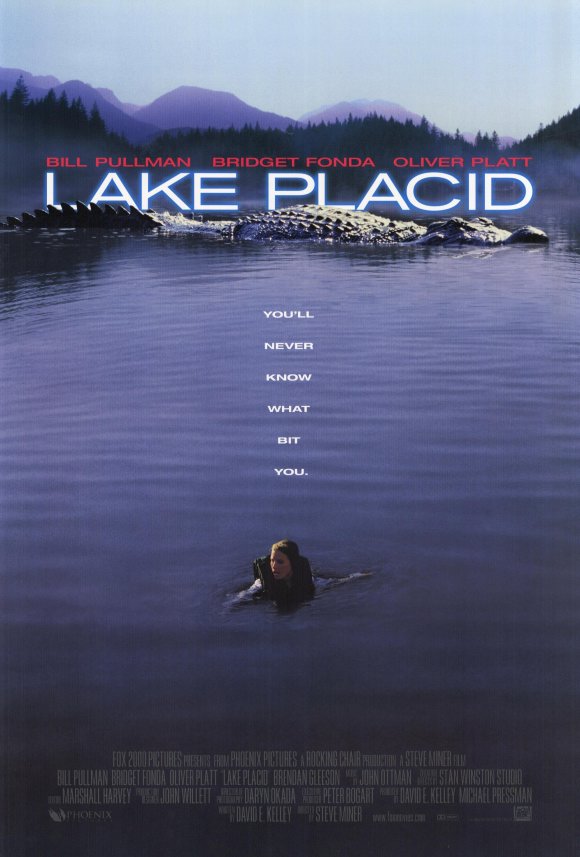
Lake Placid (1999)

I know it can't be true, but sometimes I feel like I'm the only person who loves Lake Placid. I never hear anyone talk about it. There are never any revival screenings showing anywhere. Most people I mention it to either haven't seen it or didn't like it. I suppose part of my warm, fuzzy feelings could stem from the fact that this was the last (and possibly only) film I saw with my now-deceased grandma. Not trying to get all heavy here, but I'm sure most can relate to a personal reflection elevating the quality of a film in their own mind. Me, my grandma, and my brother watched it during the Summer of 1999 in Hawaii, in a tiny, decaying movie theater on the island of Kauai. I don't recall how well my grandma liked it, but this was a woman who considered Rambo: First Blood Part II to be one of her favorite films of all-time, so a good bit of violence and humor was likely right up her alley. Regardless, I've been a fan since that day and I hope that in years to come it garners a bit more love. The only home video release currently available is a decade-old DVD that could look worlds better (although at least it is anamorphic) with a short featurette for a bonus feature. And it deserves better.


Lake Placid, despite what some may consider to be a ridiculous premise, managed to attract a wealth of talent to its cast & crew. The film was written by David E. Kelley, the guy responsible for Ally McBeal. I only caught a few bits of an episode here and there, but I do know it was generally lauded for its sharp writing and wit, both of which are on display here. Horror fans should know the film's director, Steve Miner. You know, the guy responsible for Friday the 13th Part 2 and 3-D, House, Warlock, and Halloween: H20. That pedigree alone would've generate interest from me on any project he was involved with at the time, although I can't say the same now since he hasn't done anything worth watching since this film. The cast features a small ensemble of actors who are adept at playing personalities that clash just as well as they can come together when required - Brendan Gleeson, Bill Pullman, Bridget Fonda, Oliver Platt, and Betty White. All dependable, seasoned actors who run wild with Kelley's acerbic, shrewd dialogue.

And let's not forget the film's biggest star: a 30-foot crocodile designed by the most magnificent man to get into creature design - Stan Winston. Oh, fuck, do I ever miss that guy. Are you a film fan who laments the continual homogenization of on-screen beasts? Blame cancer, because if it hadn't claimed Stan's life all too soon then we'd likely be enjoying his work to this day. We also wouldn't have to suffer through film after film featuring Neville Page's slightly modified designs. Seriously, if you've seen Cloverfield, Star Trek '09, Super 8, or Prometheus you know exactly what I'm talking about. He seems to specialize in amorphous blobs that have few defining features and are almost wholly forgettable as soon as the credits start rolling. Winston created creatures that have defined generations and will ultimately stand the test of time as the some of the best work FX can offer.

 
There has got to be good character interaction in a monster-running-amok film, otherwise it can only be as good as the FX scenes horror fans are waiting for.That's when you get a film like Alligator, starring Robert Forster. Now, don't get me wrong on this because I friggin' love that movie, but how much can you recall outside of the wedding massacre and that scene where the eponymous beast bursts up out of the sewer? Exactly. Other than Forster, I don't even remember who else is in the film. Kelley's script for Placid builds up the humor right from the start, with Gleeson's character exchanging barbs with a beaver tagger (they pay people do to that?). Then Fonda's fish-out-of-water female, Kelly Scott, is thrown into the mix to complain about the wilderness and shriek when moose heads go flying. Pullman's straight man ranger is here to provide logic and as manly a presence as he can muster. Then, finally, Oliver Platt crashes the party as a rich loudmouth with expensive toys and a devotion to his craft as a crocodile expert. He's also the most brash and sarcastic member of the cast, often belittling Gleeson with obtuse, caustic remarks that go over his head. Are these people we care about? To some degree, sure. But mainly they're just types, and that's perfectly fine because they each excel in that role enough to elevate it above a one-note character.

Is there gore? You betcha! Some dude gets half his body chewed off in the opening, along with decapitations, a severed toe, and a fucking badass Bear vs. Croc attack that made my girlfriend squeal with equal parts horror and delight. It isn't gory like some of Steve Miner's '80s horror films, but there's a healthy enough amount to remind people this is still a movie about a large apex predator that rips things to pieces before eating them. Nothing here is gratuitous, so any bloody bits that appear on-screen are earned and not there for the sake of grossing out the audience. Hell, when a guy's toe is found, chewed up on the lake shore, Gleeson says he remembers the man being "taller" when asked if it's the missing beaver tagger. There's enough gallows humor to keep things from getting too heavy, despite the ever-present threat of an ancient reptile eating everything and everyone in camp.

The big beast itself looks rightfully imposing. Winston not only gave this crocodile a fearsome scale, but it looks extremely lifelike. The film does still utilize CGI for moments when a lot of movement, such as during an attack, is required. The replicas that Winston and his team constructed are mainly used for shots of the crocodile floating on the water's surface, or those fleeting glimpses when a tail or a bit of underbelly are shown. The most impressive moments for Winston's work come when Platt's character (foolishly) lands his copter above his watery lair. There's an attack scene where a very large animatronic croc was employed, the results of which look pretty goddamn spectacular for a hulking construction of metal and electronics. It moves a lot like Bruce does in Jaws, and while that kind of effects work is considered dated by some, I happen to think it's at the pinnacle of what artists can achieve. Giving life to inanimate objects and making them scary is a tall order, one which Winston always nailed.

Lake Placid would be a crowd-pleaser if it got some love by receiving a revival screening. The cast nails the tone Kelley's script aimed for, and while it may be mostly devoid of scares (save for one nice surprise at the end) there's enough of a tense atmosphere to satisfy those looking for more than a creature comedy. I'd love to see it get the royal treatment on Blu-ray, but for now all we've got is an aging DVD. Of course, there are always streaming options but I tend to prefer a physical product for my movies. Many uninitiated viewers might be tempted to dismiss this film thanks to the recent sequels (three of them at last count!) that were all D.O.A. Don't, because while it might not be an unheralded classic yearning for a larger audience it's absolutely worth it for all of the reasons illustrated above.

Monday, August 5, 2013

Ninja III: The Domination (1984) Blu-ray review

There is an inherent fear in watching some much-lauded, sleazy cult title for the first time, decades after it first came onto the scene. As an example, I worshiped the ground that Masters of the Universe (1987) was shot upon when I was 6 years old. To think, there was a time in my life when I considered that movie to be the greatest thing I'd ever laid eyes upon. 25 years of refining tastes have made it clear to me just how foolish my young mind was, but I'd be lying if I said I wasn't enjoying the film through rose-tinted lenses every single time I found it on cable. If I showed it to someone who'd never seen it today, they'd probably bail out as soon as Gwildor started talking. Sometimes you just have to see something in the right moment to fully appreciate it, warts and all.

But sometimes, every so often, a film hits your radar that lives up to all of the hype. That film is Ninja III: The Domination (1984).


So, having known nothing about the film before it was announced by Shout! Factory, what appealed to me enough to warrant a blind buy? For one thing, this is a Cannon Films production. If you aren't familiar with their outstanding roster of '80s hits, think of titles like Breakin' (1984), Invasion U.S.A. (1985), Texas Chainsaw Massacre 2 (1986), and Kinjite: Forbidden Subjects (1989). Basically, if you were a fan of break dancing, Chuck Norris, Tobe Hooper horror, and Charles Bronson's late-'80s revenge run, this was the studio of your dreams. Of course, success can't be attributed to a faceless studio, which is where my second point of interest comes in: producers Menahem Golan and Yoram Globus. These two guys were not only responsible for nearly every film under the Cannon Films umbrella, but a host of others as well - pictures like 52 Pick-Up (1986) and Over the Top (1987). Their involvement almost always assures a winner in my book; I don't think I've ever seen a Golan/Globus production that didn't at the very least entertain me. I was already sold on the film purely based on the production studio, producers, and production year. As far as I'm concerned, anything patently '80s is worthy of a viewing. And then I kept reading about how V8 is used as an aphrodisiac, eliciting a completely-out-of-left-field sexual response. Review after review made mention of this, piquing my curiosity since I don't find V8 all that appealing and I figured these reviewers must be making a mountain out of a molehill.


It's like a healthier version of 9 1/2 Weeks.


Nope. This movie is fucking nuts. There's no other way to describe it. Director Sam Firstenberg, he of Breakin' 2: Electric Boogaloo fame, took the approach of packing the film with one moment of insanity after the next, never taking things too seriously, and never allowing it to lag. The opening sets a high bar when an Evil Ninja, who wears an awful lot of mascara, wreaks havoc on a gold course for seemingly no reason at all. At first it seems like a typical low-budget, moderately-choreographed, incredibly cheesy bloodbath... but once Evil Ninja throws a dart into the barrel of a dude's gun, causing it to explode in his face, then that's when shit got real. Evil Ninja keeps his massacre going full steam, plowing through dozens of cops until finally he disappears after getting pumped full of about, oh, 167 bullets of so. He should've considered a career in hip-hop. Too obvious? He reappears to the hottest phone company worker I've seen since some porno back in middle school, at which point he mumbles some ninja words and transfers his soul into Christie (Lucinda Dickey). And now it's an Evil Ninja Possession movie. Super.


Apparently, possession comes with mandatory eyeliner.

Christie's possessed, so now she can do things like fight off a hilariously stereotypical pack of meat-headed thugs who attempt to rape women from an aerobics class in broad daylight, right outside the gym where they are apparently members. And she also kills every cop Evil Ninja's mind remembers from the day he got shot a lot but didn't die. Luckily his memory gets a good jogging because Christie gets hooked up with Billy (Jordan Bennett), local cop and one of the most hirsute leading men since King Kong. Seriously, this guy could shave a design into his chest and it would look like he's just wearing a dark sweater. Christie picks off his buddies one by one until Billy starts to figure out what's up, at which point he brings her to Lo Pan from Big Trouble in Little China for an exorcism. That fails, but it does provide a great excuse for Christie to show off her gymnastic skills. That body wasn't made hard, right?

Sho Kosugi spends the entire film following Christie's bloody wake. He's less concerned with killing her, per se, as he just wants to steal Evil Ninja's corpse, then speak some Good Ninja words to get Evil Ninja's soul out of Christie and back into his somehow-not-decomposing lifeless body. Solid proposal, should work out just great. After a fierce battle through a downtown Arizona industrial complex, Kosugi manages to pull off the plan we all knew he would. Now we get an epic battle of ninja vs. ninja, which, thankfully, manages to bookend the film with nearly as much insanity as it began with. Even if you're a ninja, it takes a lot to kill an Evil Ninja.

Has this review sold you? Shit, it's sold me on watching this for the third time in a month. I really can't get enough, and it only rewards more upon subsequent viewings. Fiery possessed ninja swords clearly dangling from stage wires as it moves through the night air. Jacuzzi orgies with police officers that end in multiple deaths. Ninjas doing ninja stuff. It has every hallmark I'd want from a gooey slice of trashy mid-'80s cinema.

Shout! Factory did a wonderful job on the recent blu-ray release. As a new fan, I can't thank them enough for giving such lavish treatment to a film most studios would be embarrassed to admit is within their ranks. The 1.78:1 1080p/24fps AVC MPEG-4 encode looks stunning, with few deficiencies for such a low-budget film. The print used was clearly in great shape, allowing for excellent clarity and sharp, defined lines. Audio comes in the form of a DTS-HD Master Audio 2.0 stereo track. It gets the job done with a relentless dance/synth score and plenty of terribly awesome '80s forgotten tunes that fans will eat up.


The disc includes a photo gallery in full 1080p, which features some poster art and other ephemera. Unfortunately, the trailer listed on the back isn't included because they were "unable to find suitable elements", or something to that effect. I find that excuse a bit lame since, frankly, I don't think anyone would've cared if they used a trailer that was a little worse for the wear. At least we do get a commentary, with director Sam Firstenberg and the film's stunt coordinator. I haven't had a chance to listen to it yet (sorry, I'm too hooked on just watching the film), but I plan to get to what I hear is a lively and informative track. Also cool: the packaging includes many alternate poster designs on the inner sleeve. Shout! is the only company that uses that space for images aside from, oddly enough, Sony.

Again, I can't really recommend this enough. I'm dying to see it with a crowd (I know L.A. had a screening recently), but even with yourself or one other person it plays like gangbusters. Must be seen to be believed. And if you're thinking of making it a date night, be sure to stock the fridge with V8. You never know.