Showing posts with label shout! factory. Show all posts

Friday, June 26, 2015

Mad Max (1979) Blu-ray review

Long before Mel Gibson was one of the biggest actors in the world, and long before post-apocalyptic films featuring marauding gangs of lunatics were churned out by the dozen, there was Mad Max (1979). In writer/director George Miller’s seminal film, the world hadn’t quite gone to hell yet – that would be saved for the (arguably) best film in the series, Mad Max 2 (1981, a.k.a. The Road Warrior) – but the writing was seared onto the walls. Miller’s dystopian wasteland set a tone and visual palette that has seen more copies than a Xerox machine. And, really, where better to film such a sparse dust bowl future than the Australia of 1979? Half the country is one big desert already. What really gives Mad Max the power of longevity is the strong characterization, with each actor bringing a distinct flair to their respective roles. Additionally, there’s a real sense of danger here – anyone could be a victim at any moment, and even Max’s fate isn’t assured as he attempts to do his job amidst a maelstrom of violence.

Opening “a few years from now…” the film joins in on the hot pursuit of a wanted cop killer, known as the Nightrider (Vincent Gil), who so far has managed to successfully evade the Main Force Patrol (MFP) officers in tow. But he isn’t so lucky when Max Rockatansky (Mel Gibson) gets on his tail, ending with the Nightrider’s fiery death. An energy crisis has left much of the Outback low on fuel and sparsely populated, with motorcycle gangs patrolling the streets and terrorizing citizens. The MFP’s main directive is to keep the highways safe and stop the gangs by any means necessary. Their job is made very difficult, however, due to political red tape and crooked lawyers who lobby hard for their scummy clients. Max’s partner, Goose (Steve Bisley), loses his cool when a suspect he knows is guilty winds up being released due to a technicality. Later on, that same suspect, Johnny “the boy” Boyle (Tim Burns), is egged on by the gang’s leader, Toecutter (Hugh Keays-Byrne), to horribly burn Goose while trapped in a wrecked car they helped demolish. Max is stricken with grief after seeing his partner’s wounds and quits the force. He’d rather spend his days traveling with his wife (Joanna Samuel) and new baby, enjoying the countryside. But when an unexpected run-in with Toecutter and his gang rips Max’s idyllic world right in two, the former MFP officer becomes focused on only one thing – brutal and swift revenge.

If there’s one aspect of Miller’s film that helped make it a massive success (other than Gibson’s laconic, magnetic performance), it’s the stunt work. Mad Max has fast cars, lots of ‘em, and more often than not they wind up in a crumpled heap on the hot asphalt. Adding to the impact of those stunts is the very clear indication that many did not go as planned, but since they had one shot in some instances however the stunt went is how it wound up in the film. When the Nightrider’s car collides with a petrol truck, it’s pretty obvious the car veered off course and didn’t hit the mark, which actually makes the stunt even scarier. And then there are also the numerous motorcycle stunts. During one such stunt, as seen in slo-mo, a wheel smacks the back of the stuntman’s helmet so hard you’d think he died on set. He didn’t, but he was definitely worse for the wear. Miller managed to outdo the stunts seen here when he made this film’s sequel, but for a first-time director this was some big stuff.

It would be interesting to see how today’s audiences – especially those who seem to need every detail of backstory explained ad nauseum - would react to Mad Max were it released today. Aside from the opening scrawl explaining the energy crisis, there’s very little history provided for the MFP, Max or the vicious gangs. I feel this only strengthens the film. Miller provides a solid framework within which these characters operate, and any reasonably sharp viewer should be able to fill in any gaps and make sense of how we’ve arrived at this situation. Just like Max, viewers are thrust into this savage land where danger lurks around every bend in the road. In particular, the Toecutter is an enigmatic force who controls his henchman with a firm grasp despite very little violence on his part. It makes you wonder what his story is. I mean, the guy is called “Toecutter” yet we never see him actually cutting off any toes. This sort of ambiguity would carry on through the series, and Miller always handles it perfectly. Here’s to hoping Max’s resurrection (albeit in a new form) is just as thrilling in Mad Max: Fury Road (2015).

There’s been a great deal of scuttlebutt on the web regarding Scream Factory’s 2.35:1 1080p image. Specifically, whether or not it’s any better than MGM’s previous Blu-ray edition, which was perfectly serviceable but far from perfect. As far as anyone knows the negative has been lost, meaning it would be difficult to improve upon what’s already been released. Unless you’re an obsessive about picture quality and go through a film frame-by-frame analyzing individual hairs and shrubs in the background, chances are you’ll find this edition to be on par with MGM’s release, if not a tad lesser. It does appear that some mild DNR has been applied, leaving skin tones looking occasionally waxy, and the grain structure is… odd; it’s not a visual eyesore but it doesn’t exactly look natural. Still, contrast is generally strong, with good color saturation and appreciable detail in many shots.

There are three tracks from which to choose here – Australian DTS-HD MA 5.1 surround sound or 2.0, as well as the infamous(ly bad) English DTS-HD MA 2.0 dub. The multi-channel Aussie option is your best bet, offering up a dynamic experience featuring great panning of effects and engine roars along with a decent low end during some of the more bombastic sequences. Dialogue has a bit of a reverb thing going on at times, though it never happens often enough to be a problem. Subtitles are included in English.

The audio commentary doesn’t feature the names you’d probably prefer to see – specifically, Miller and Gibson – but it does offer up a perspective from art director John Dowding, director of photography David Eggby, special effects artist Chris Murray and film historian Tim Ridge. Given the jobs of the men involved here, this track offers up a great perspective on the film’s production on a much more technical level. With so many people on the track, the energy remains high and talk stays lively and informative.

“New Interviews with Mel Gibson, Joanne Samuel and Director of Photography David Eggby” (HD) runs for almost thirty minutes. Although nothing too revelatory comes out of these talks, it’s wonderful to hear Gibson speak about the role that launched his career. Mel is candid as ever, brimming with enthusiasm and seemingly stoked to be talking about this seminal film so many years later. Samuel has some great anecdotes about her casting, while Eggby discusses the film’s wild stunt work and dangerous environments.

“Mel Gibson: The Birth of a Superstar” (SD) is a featurette that was included on the previous MGM special editions and covers Mel’s career, from his humble beginnings in Australia right up to his massive career in Hollywood. There’s a lot of gushing and glad-handing, with talk of what makes Mel different from other stars.

“Mad Max: The Film Phenomenon” (SD) is another carryover, obviously focusing on Miller’s film and how it set off a chain reaction of productions centering on post-apocalyptic/dystopian future films.

Two theatrical trailers are included, along with TV spots and a large still gallery, all in HD.

Monday, August 26, 2013

X-Ray (1982)/Schizoid (1980) Blu-ray review


Of all the sub-genres that exist within horror, slashers have traditionally been a fan favorite. Though the subgenre (arguably) kicked off with 1974’s Black Christmas, it didn’t gain traction in cinemas until films like Halloween (1978) and Friday the 13th (1980) became major hits. And so began a “golden age” of sorts for the slasher film, which lasted right up until the mid-‘80s. For all the icons these films have produced, however, there have been countless others that have fallen by the wayside over the years. Shout! Factory has paired up two of them (likely since neither title would sell enough on its own to justify a release) – 1982’s X-Ray, and 1980’s Schizoid – in a fun, delightfully gory little package that should at least have minor appeal to fans of gloriously cheesy ‘80s stalk-and-slash fare.

Barbi Benton was quite the busy, busty Playmate in the ‘70s. Primarily known for her television work, X-Ray was one of only a handful of films she starred in during her career. Here she plays Susan Jeremy, a woman who visits her local hospital for a routine checkup required for a new job. But someone in the hospital has other plans for Susan! A someone who, 19 years earlier, she had scorned when he professed his unrequited love for her. He also killed a fellow child at the time, but apparently the police were really bad at their jobs back then, so he was never caught. Anyway, Susan’s results are faked to show she has a serious illness, leading another physician to strongly recommend she stay the night for further tests. As expected, the killer stalks the hallways of the most abandoned hospital seen on film since Halloween II (1981), brutally killing nurses, patients, and doctors alike with some nasty surgical implements.

Firstly, I have another titling issue with another Shout! release. X-Ray is technically the title of the heavily-cut version of the film, which runs around 77 minutes. This fully uncut version should really be titled Hospital Massacre, which is how it’s recognized on IMDB and Wikipedia. Or if Shout! wanted to get all kinds of crazy, they could’ve gone with the original pre-release title of Be My Valentine, or Else…, which is superior to the first title it had, Ward 13. Whew! So, just in case anyone who actually remembers all of that was concerned, this is indeed the full uncut version, just released under the cut name. Capiche?

Although it would be easy to objectively call the film a bit of a slog to get through, the fact is that it embodies much of what slasher fans love. The threadbare plot exists only to further the murderous rampage of Harold, whose identity is concealed well enough that his reveal is a minor surprise. Every doctor employed here acts like a creep, and every nurse treats Susan like a mental patient who missed her morning dose of pills. Among the small cast of characters is a hospital drunk – a clear red herring – who stumbles around with bottle in hand, while nurses shrug off his antics and remind him to return to his room. Everyone is so indifferent to her claims that I half expected them to reveal everyone was in on the plot to kill her.

The kills here are fairly nasty, with Harold making use of the many hospital tools at his disposal. And his victims make it really easy, too. Seriously, it seems like no one makes any kind of effort to, I don’t know, just turn and run. Most just stand there, apparently so consumed with fear that they’re unable to move. One guy is attacked with a corded surgical saw; a death that could have been avoided if he simply walked another foot or two away so the cord wouldn’t reach. But, again, this is the kind of nonsensical, nasty murdering fans should be expecting here. The film doesn’t skimp on the red stuff, ensuring that everyone’s demise is met with a crimson wave. Hell, Harold even manages to one-up My Bloody Valentine’s Harry Warden with his own take on a wrapped box of chocolates.

What would a slasher be without some gratuitous T&A? Fear not. Benton was a former Playmate, after all. And one of her strange, lecherous doctors is more than willing to insist she strip down for an uncomfortably scintillating exam. Director Boaz Davidson mentions there was a full crew on set that day, and when Benton’s ample assets are pored over it’s easy to see why. X-Ray might not be a great film, or even good by some standards, but as a de facto slasher it’s got enough going for it to satisfy fans yearning for lesser-known ‘80s sleaze.

Schizoid, on the other hand, moves at a positively glacial pace. This 1980 turkey is paired up with a slasher, but in reality this film plays more like a giallo. Killer wears black gloves (nice nod to Argento)? Check. Red herrings a-plenty? Check. Overly-complicated plot? Sadly, no. This one is mostly mundane. Klaus Kinski – don’t get too excited, he isn’t playing crazy here – is Dr. Fales, a therapist who oversees a group of patients. One by one, the members of the group are being killed. Julie (Marianna Hill), a member of the group, has been receiving threatening letters at her office, where she works as an advice columnist for the local paper. What follows is a slow game of stalk-and-kill, and Julie has to figure out who’s behind it all before she’s next! It could be almost any member of the male cast. Maybe it is Dr. Fales, who despite being a trollish slug of a man beds every nubile female in his group. Or, perhaps Gilbert (a young, mustachioed Christopher Lloyd), the maintenance man who constantly stares at everyone in silent, creepy ways. No? How about Doug (Craig Wassom), Julie’s ex-husband who is clearly still infatuated with her? Oh, wait, I know, it’s got to be Dr. Fales daughter, Alison (Donna Wilkes). You know the one who remains mute for almost half of the movie before spending the second half pitching major fits at the dinner table and brandishing firearms. Maybe in some strange twist Julie is actually sending herself the lette- nah, that’s probably not it.

Despite the undeniable ennui that set in once this film got going, I can’t really say I totally disliked it. This is the kind of shit I grew up with, and despite having never seen this film before I could still appreciate it for what it tries to do. It’s almost laughable how many people are suspects in the cast. Literally half of the main players could be the killer, which is de rigueur for any giallo. And we’ve got quite a cast, too. Kinski is always great fun to watch, but here he’s just a weird old sexual deviant with a therapy practice; he’s not chewing scenery and crapping thunder like the days of old. Donna Wilkes seriously speaks two words in the first 45 minutes, then in the last half of the film she goes right off the rails. She’s also wears some bizarre, noir-ish outfit for the climax. Craig Wassom should be familiar to horror fans as Dr. Neil Gordon from A Nightmare on Elm St. 3: The Dream Warriors (1987). The film also features a young Christopher Lloyd, who looks very different with dark hair and a mustache. This was one of his earliest film credits, though he was already an established name thanks to his work on Taxi (1978-1983). Finally, the great Richard Herd is teamed up with Joe Regalbuto as a couple of cops who are actively investigating the case. This film could have easily fallen completely apart with a lesser cast, but everyone here turns in a good enough performance that the material is elevated.

The ending blows, though. It’s totally weak. I won’t spoil anything except to say that people seem to die in this movie very quickly from what would normally be minor and/or non-life threatening wounds. This is usually the norm for films of this ilk (we’re still years away from torture porn), but it totally kills any impact the finale might have had.

X-Ray sports a widescreen image that generally looks free of debris and damage, though grain is a bit on the thick side - on occasion it borders on noise, but aesthetics such as this tend to lend themselves well to old-school horror. Some scenes have a hazy appearance, almost like there was a little bit of smoke pumped on to the set. Black levels are anemic for the most part, usually never looking consistent or even totally dark. Colors are mostly good, however, and Barbi Benton’s lips look shinier than a freshly waxed car. The DTS-HD MA stereo track gets the job done with a soundtrack that sounds like a cross between Harry Manfredini’s cues for Friday the 13th (1980) and Goldsmith’s work on The Omen (1976). Dialogue sounds clear and is free of any hisses, pops, or crackling.

Schizoid looks a bit better, with far less grain (though it is still very much present) and a nice color palette. Fine details are slightly more apparent than they were on X-Ray, although I wouldn’t call this a sharp image by any means. Closeups do exhibit an appreciable amount of detail, though. Black levels are more rich and consistent here, too. Audio-wise this is no better than the first half of this double bill, but I will say that I dug the synth-heavy, funky electronic score here more than X-Ray’s derivative tones. Neither disc includes subtitles.

There’s one lone bonus feature on and that’s a 12 minute interview with director Boaz Davidson. The Israeli director (who also helmed The Last American Virgin, also released in ’82) talks about how this was not his typical kind of film, but he couldn’t turn down his hometown producers of Golan & Globus when they asked. He also speaks very highly of Benton’s work, especially her lengthy nude scene. Schizoid doesn’t get much more, as it contains an interview as well – this a 10 minute conversation with actress Donna Wilkes – and the film’s theatrical trailer. The interview is candid, with Wilkes discussing the most pertinent of topics: how big of a perv was Kinski on set. Answer: she got along with him fine, but he was not especially liked the virtually every other female on the crew. This set also includes a DVD copy containing both films and their respective bonus features.

Separately, they’re mediocre. But together, Shout! has provided a package worthy of any horror fan’s collection. Just the pedigree of both films having been released under the Cannon Films label and featuring production by the legendary Israel duo of Golan/Globus should be enough to convince people this is worth a spot on their shelf.

Monday, August 19, 2013

Dark Angel (1990) [a.k.a. I Come In Peace] Blu-ray review


”I come in peace.”
”And you go in pieces, asshole."

Chances are, if you’re able to recall anything about director Craig Baxley’s 1990 buddy cop/alien drug dealer action flick Dark Angel - more commonly known here in the States as I Come In Peace - it’s that exchange of dialogue. But, really, there’s much more worth remembering (and revisiting) now that Shout! Factory has finally given the film a proper release. Roughshod-cop-versus-alien films were in vogue for a few years after Predator (1987) became a hit, paving the way for films like this and Split Second (1992, and also in dire need of a remastered home video release). Baxley, who hails from a family of veteran stunt actors, put a great deal of effort into the film’s action, maximizing the paltry $5 million budget he had to work with so well that it looks like it was shot for $20 million. The resulting film is a unique mix of buddy cop, mobster, and sinister alien visitor subgenres that somehow manages to steamroll through 90 minutes without any noticeable lagging.

Dolph Lundgren stars as Houston cop Jack Caine, the kind of guy who works out of his car and survives on little food and less sleep. When a drug sting goes wrong, leaving his partner dead, Jack is paired up with straight-laced FBI agent Arwood “Larry” Smith (Brian Benben of HBO’s Dream On fame) to bring down the White Boys, a group of white collar criminals who control the city’s drug trade. The group is led by Caine’s old foil, Victor Manning (Howard Sherman, best known to horror fans as “Bub” from Day of the Dead), who blames him for stealing their supply of heroin. But it isn’t Caine Manning should be worried about because the heroin is being used by Talec, a massive, hulking humanoid, as a means to extract endorphins from victims around the city. A spiked tube on his wrist pumps his targets full of heroin, at which point endorphins are released in the brain just as he slams a giant vacuum tube into their heads, sucking them dry. On his trail is an interstellar police officer who tells Caine and Smith that on their planet our endorphins are sold on the black market as a powerful drug. Armed with this knowledge, and a couple of big-ass alien handguns, the two set out to destroy Talec before he annihilates all of Houston.

First off, gotta say I find it very odd that Shout! has chosen to release this film under the international title (which was also used during production) of Dark Angel. While I applaud the geeky lengths they go to in an effort to please fans, releasing a film with a known title under its relatively unknown name isn’t likely to bolster sales. When I informed one of my friends that “Dark Angel” was coming out on blu-ray, he had no clue what movie I was referring to. Once I mentioned its more common moniker, he was instantly excited. Point is, how can those people be reached if they aren’t familiar with the title it’s being sold under? Only the nerdiest fans are aware of this alternate title. Short rant there, but it’s just a bit puzzling. Plus, let’s be honest here, I Come In Peace sounds way cooler, while Dark Angel sounds like the kind of safe, generic title a producer would give it.

One thing the film can’t be faulted for is a dearth of action. Baxley put forth all of his cinematic magic, and years of honing his craft as a stuntman, to produce action that is on-par with any big-screen tentpole audiences could have seen that year. It is truly unremitting, and by the end of the picture you’ll likely feel as fatigued as the two leads. Anything that looks like it could explode in this film, does. Buildings, cars, and people are all annihilated with extreme prejudice, but, man, does it look glorious on screen. Baxley allows the film to really showcase his work, with lots of wide shots and unique camera work to heighten much of the action. Talec, the film’s Evil Alien, uses a CD-looking disc that hones in on human frequencies to slice up many of his victims. But rather than having someone off-screen toss a disc at someone as they fall holding their throat, the camera is “mounted” to the disc, taking us along for the ride as jugular after jugular is shredded. Every explosion in the film is massive, and if you actually consider how much of downtown Houston was being exploded in the film it’s a wonder the military wasn’t called in. Also, those aliens have huge guns and everything they shoot acts like it was wired with C-4.

Like any good buddy cop film, our two leads appear horribly mismatched at first. Dolph’s character is the top cop who doesn’t play by the rules. We’ve all seen this guy a thousand times. Brian Benben is the stereotypically uptight, staunch FBI agent who adheres to the rulebook like it’s scripture. And, of course, they eventually come to a mutual understanding right when they have to. All of this is nothing new, but these two guys just have good chemistry. Not every odd cinematic pairing feels genuine. Maybe I’m being a tad biased because Benben’s breakout role on HBO’s Dream On was one of my favorites growing up, and here he’s teamed with Ivan Drago, but I doubt I’m alone here.

If there’s any complaint about the film, it’s the mostly-pointless White Boys subplot. Yes, it’s kinda funny that there’s a gang of white collar dicks stealing heroin from the cops and blowing up anyplace Caine is spotted, and they’re led by Bub. But it goes nowhere. The only reason for its existence is to give our Evil Alien a place to acquire the large amount of heroin he needs to drug humans. Creating an organization and tying it in to Caine’s partner being killed seems like an obvious and understandable scripting point, but then it just sort of trails off and the film ends with no clear resolution despite the White Boys constantly popping up as a threat.

Whatever you want to call the film (but, seriously, we all know everyone is flipping over that reversible cover art as soon as it’s out of the shrink wrap to display I Come In Peace), Craig Baxley delivered a wildly entertaining, often brutal ride that is finally getting the release it deserves. Matthias Hues is in full-on creep mode as the 6’5” alien drug dealer, Lundgren & Benben have a believable chemistry to keep their relationship interesting, and there’s something or someone being blown up or horribly dispatched every 10 minutes. It’s got all the trappings of the early-‘90s cult classics genre fans can’t get enough of.

Shout! Factory likely used the same HD master MGM prepared for the previously-issued DVD that was part of their Limited Edition (read: burned DVD-r) Collection. As such, the picture looks very cleaned up and polished without featuring any post-processing deficiencies like DNR. There’s a healthy layer of grain present, which provides a more filmic appearance. Fine details are more apparent than ever, although sometimes they are lost to the picture’s rich black levels. Colors appear strong and have a bit of pop to them, and skin tones reveal nice texture and coloration. Hues of blue tend to dominate the color palette. This is clearly a case where the studio commissioned an HD master with minimal tinkering (probably because they simply didn’t feel the film was worth it), resulting in a natural image that benefits from the added resolution. The back cover only lists a stereo track, but rest assured this disc comes packed with a DTS-HD MA 5.1 surround sound track. Still, even with the extra channels most of the soundtrack is relegated to the front and center speakers. Jan Hammer – of Miami Vice fame – provides a pulse-pounding synth score that echoes his work on that popular ‘80s culture staple show. It can get a little bombastic when there’s action to be seen, but more often than not the rear speakers are on standby.

There’s one main supplement here, along with a few minor ones. A 25-minute featurette, “A Look Back at Dark Angel”, features recent interviews with director Craig Baxley, and stars Dolph Lundgren and Brian Benben. Baxley is clearly still exuberant about his work here, talking up every aspect of the production process he can. Did you know that famed screenwriter David Koepp did a rewrite here under a pseudonym? He dispenses with as much information as possible in the runtime, even extending his thoughts into the credits. Dolph and Benben both recall the film with fondness and have a lot of good to say about it. This disc also includes the theatrical trailer (HD) along with a poster & still gallery that runs for about five minutes, featuring production stills, poster art, etc.

As much as we all love to see Shout! give fans ultra-deluxe editions of our favorite films, it’s fantastic when they tackle titles that have never been given the proper respect on home video. Dark Angel is one helluva fun time and if it weren’t for Shout! I don’t know if we’d ever have seen it hit hi-def.


Friday, August 16, 2013

Q: The Winged Serpent (1982) Blu-ray review


 Although his name might not be as well-known as Roger Corman - the king of low-budget genre productions - auteur Larry Cohen deserves every bit as much respect for his endless gumption and total devotion to making the most out of his features. His ability to work on-the-fly and under the gun is exactly the reason why his film Q: The Winged Serpent (1982) exists today. Cohen, who had just been fired from a low-budget production shooting in New York City, didn’t want to waste the room he’d paid for during the production, so instead he hired some actors and banged out the script that would become Q in a mere six days. The conceit for this tale of a modern-day Aztec beast-god nesting in the art-deco spire of the Chrysler Building came when Cohen looked up at the skyline and said to himself, “That’d be the coolest place to have a nest.” Inspiration can come from anywhere when you’re in the Big City.

New Yorkers are losing their heads, literally. Reports of a gargantuan winged creature terrorizing rooftops have the NYPD on high alert, but they just can’t seem to spot the damn thing. Meanwhile, across town, small time crook (and wannabe jazz pianist) Jimmy Quinn (played by Cohen crony Michael Moriarty) is an unwilling participant in a diamond heist (at a store called… wait for it… Neil Diamonds). It goes poorly, leaving Jimmy to run for his freedom all the way up to the top of the Chrysler Building where he finds a huge nest housing the largest cinematic egg since Mothra gave birth. Quinn decides that maybe now would be a good time to give up his life of crime and try going straight for once, but when a couple of his associates come looking for the diamonds he lies and claims they’re hidden at the top of the Chrysler Building. Sure enough, both men leave the rooftop minus a head. Thinking this is his big ticket, Jimmy figures he can use his knowledge of the nest’s location as a bargaining chip with the police, exchanging what he knows for a full pardon on all his crimes in addition to a cool $1 million cash. The way he sees it, this city owes him. Who cares if there’s an ancient behemoth eating residents, all while a mysterious man in a bejeweled mask is making willing human sacrifices to appease the beast?

Cohen started off writing detective dramas, a fact which is evident in many of his films since they almost always feature a subplot involving police procedures. While the film is ostensibly sold as a monster-run-amok tale, the fact is that virtually every big creature feature needs a compelling story to work within. Now, I’ll be the first to admit that Michael Moriarty isn’t exactly the most charismatic leading man, but it’s clear that he has a strong desire to imbue his parts with enough of his quirky charm and dogged resilience that they’re at least memorable. Jimmy Quinn is a lifetime loser; a petty crook with no luck who overlooks the one stable, good thing in his life: his girlfriend, Joan, played (rather terribly) by Candy Clark. He’s so accustomed to being broken down and spat out that once he gets a small amount of power it completely goes to his head. Moriarty’s performance ends up being the film’s highlight, mainly because our eponymous creature is a little less than spectacular when finally revealed.

Q had a stellar poster design. I can still vividly recall seeing the VHS cover art many times as a kid and thinking that it looked impossibly awesome. Emphasize impossible because this is another case of the poster setting such high expectations that they would be hopeless to match on screen. It also doesn’t help when you hire one of the foremost fantasy artists of all-time, the masterful Boris Vallejo, the design your one sheet. Quetzalcoatl looks a lot like a plucked turkey, soaring through the skyline of the Big Apple. The design isn’t necessarily terrible, but compared to the beast the cover implies you’re getting… it just doesn’t even come close. Thankfully, since this <i>is</i> 1982, viewers can enjoy seeing Q brought to life via stop-motion animation. The work done here is impressive for a low-budget production, and Q moves through the air almost seamlessly. Large feathered claws were crafted for scenes where lounging New Yorkers are pulled from rooftops before being torn apart, although their employment usually ends up looking like someone is playing with a giant arcade claw machine attempting to win a prize.

Richard Roundtree and David Carradine both receive top billing as a couple of cops working the Q case. Carradine is given the most to do out of the pair, however, leaving Roundtree to just bark a few orders and act mildly heroic when he finally meets the beast. Carradine’s focus is mainly on investigating the series of human sacrifices occurring around the city – hearts cleanly ripped from chests, skin flayed off bodies… that kind of stuff. It’s a bit underdeveloped as a subplot, but the only real purpose it needs to serve is explaining why an Aztec god is making home in a modern day metropolis.

While many might dismiss the film as a big turkey, I think there’s more than enough of interest occurring within the running time to at the very least entertain viewers. Cohen came up with a unique take on ancient Aztec rituals, and he made sure to populate the film with a few well-rounded characters and familiar faces. Hell, it’s worth watching just for all the glorious NYC skyline porn, since the film was shot entirely on location. Cohen even managed to secure permits to shoot at the top of the Chrysler Building. Fans of old-school monster movies are sure to be pleased.

Shout! Factory’s Blu-ray is an appreciable upgrade over the previously issued DVD from Blue Underground. In fact, I wouldn’t be surprised to learn they simply used the existing HD master that was available since BU is known for quality image restoration. The image enjoys an upgrade in clarity, as well as a boost in color reproduction, while also maintaining a healthy, moderate layer of grain. Night time shots lose much of their detail to darkness, but Cohen (surprisingly) chose to shoot almost entirely in daylight. On the audio side of things, a DTS-HD Master Audio 2.0 stereo track kicks things off. Now, before anyone goes complaining that this is a downgrade from the DTS 6.1 surround sound track found on the DVD, be aware that this film was mixed in mono, so anything those extra channels might have added would likely be newly-created to fill out the soundfield. The stereo track perfectly suits the film, although the dialogue levels are a bit on the low side.

The major bonus feature here is an audio commentary with writer/producer/director Larry Cohen. Whether or not you’re a fan of his films, this is a must-listen track. Cohen talks virtually non-stop right from the get-go, regaling listeners with on-set anecdotes, information on how he achieved some of the film’s more impressive shots, casting, securing permits, and more. He covers all aspects of the production in a clear, direct tone. The disc also includes a theatrical trailer, as well as a teaser, both of which (while looking rather rough) are in HD.
  
Q might not live up to the promise of its poster art, but what films truly do? Cohen delivered a picture that is a hodgepodge of monster activity, crime, extortion, and greed. And he did it all with a single week of pre-production. He makes the most of his time, his actors, and his films. Michael Moriarty struggles a bit, but manages to essentially carry the film on his shoulders. Fans of Cohen’s oeuvre already know what’s in store here, but the uninitiated should (hopefully) find something here to keep them entertained. Shout! Factory’s Blu-ray provides the best presentation Q is likely to receive, and while the bonus features may be minimal the commentary alone makes up for any shortcomings.

Monday, August 5, 2013

Ninja III: The Domination (1984) Blu-ray review

There is an inherent fear in watching some much-lauded, sleazy cult title for the first time, decades after it first came onto the scene. As an example, I worshiped the ground that Masters of the Universe (1987) was shot upon when I was 6 years old. To think, there was a time in my life when I considered that movie to be the greatest thing I'd ever laid eyes upon. 25 years of refining tastes have made it clear to me just how foolish my young mind was, but I'd be lying if I said I wasn't enjoying the film through rose-tinted lenses every single time I found it on cable. If I showed it to someone who'd never seen it today, they'd probably bail out as soon as Gwildor started talking. Sometimes you just have to see something in the right moment to fully appreciate it, warts and all.

But sometimes, every so often, a film hits your radar that lives up to all of the hype. That film is Ninja III: The Domination (1984).


So, having known nothing about the film before it was announced by Shout! Factory, what appealed to me enough to warrant a blind buy? For one thing, this is a Cannon Films production. If you aren't familiar with their outstanding roster of '80s hits, think of titles like Breakin' (1984), Invasion U.S.A. (1985), Texas Chainsaw Massacre 2 (1986), and Kinjite: Forbidden Subjects (1989). Basically, if you were a fan of break dancing, Chuck Norris, Tobe Hooper horror, and Charles Bronson's late-'80s revenge run, this was the studio of your dreams. Of course, success can't be attributed to a faceless studio, which is where my second point of interest comes in: producers Menahem Golan and Yoram Globus. These two guys were not only responsible for nearly every film under the Cannon Films umbrella, but a host of others as well - pictures like 52 Pick-Up (1986) and Over the Top (1987). Their involvement almost always assures a winner in my book; I don't think I've ever seen a Golan/Globus production that didn't at the very least entertain me. I was already sold on the film purely based on the production studio, producers, and production year. As far as I'm concerned, anything patently '80s is worthy of a viewing. And then I kept reading about how V8 is used as an aphrodisiac, eliciting a completely-out-of-left-field sexual response. Review after review made mention of this, piquing my curiosity since I don't find V8 all that appealing and I figured these reviewers must be making a mountain out of a molehill.


It's like a healthier version of 9 1/2 Weeks.


Nope. This movie is fucking nuts. There's no other way to describe it. Director Sam Firstenberg, he of Breakin' 2: Electric Boogaloo fame, took the approach of packing the film with one moment of insanity after the next, never taking things too seriously, and never allowing it to lag. The opening sets a high bar when an Evil Ninja, who wears an awful lot of mascara, wreaks havoc on a gold course for seemingly no reason at all. At first it seems like a typical low-budget, moderately-choreographed, incredibly cheesy bloodbath... but once Evil Ninja throws a dart into the barrel of a dude's gun, causing it to explode in his face, then that's when shit got real. Evil Ninja keeps his massacre going full steam, plowing through dozens of cops until finally he disappears after getting pumped full of about, oh, 167 bullets of so. He should've considered a career in hip-hop. Too obvious? He reappears to the hottest phone company worker I've seen since some porno back in middle school, at which point he mumbles some ninja words and transfers his soul into Christie (Lucinda Dickey). And now it's an Evil Ninja Possession movie. Super.


Apparently, possession comes with mandatory eyeliner.

Christie's possessed, so now she can do things like fight off a hilariously stereotypical pack of meat-headed thugs who attempt to rape women from an aerobics class in broad daylight, right outside the gym where they are apparently members. And she also kills every cop Evil Ninja's mind remembers from the day he got shot a lot but didn't die. Luckily his memory gets a good jogging because Christie gets hooked up with Billy (Jordan Bennett), local cop and one of the most hirsute leading men since King Kong. Seriously, this guy could shave a design into his chest and it would look like he's just wearing a dark sweater. Christie picks off his buddies one by one until Billy starts to figure out what's up, at which point he brings her to Lo Pan from Big Trouble in Little China for an exorcism. That fails, but it does provide a great excuse for Christie to show off her gymnastic skills. That body wasn't made hard, right?

Sho Kosugi spends the entire film following Christie's bloody wake. He's less concerned with killing her, per se, as he just wants to steal Evil Ninja's corpse, then speak some Good Ninja words to get Evil Ninja's soul out of Christie and back into his somehow-not-decomposing lifeless body. Solid proposal, should work out just great. After a fierce battle through a downtown Arizona industrial complex, Kosugi manages to pull off the plan we all knew he would. Now we get an epic battle of ninja vs. ninja, which, thankfully, manages to bookend the film with nearly as much insanity as it began with. Even if you're a ninja, it takes a lot to kill an Evil Ninja.

Has this review sold you? Shit, it's sold me on watching this for the third time in a month. I really can't get enough, and it only rewards more upon subsequent viewings. Fiery possessed ninja swords clearly dangling from stage wires as it moves through the night air. Jacuzzi orgies with police officers that end in multiple deaths. Ninjas doing ninja stuff. It has every hallmark I'd want from a gooey slice of trashy mid-'80s cinema.

Shout! Factory did a wonderful job on the recent blu-ray release. As a new fan, I can't thank them enough for giving such lavish treatment to a film most studios would be embarrassed to admit is within their ranks. The 1.78:1 1080p/24fps AVC MPEG-4 encode looks stunning, with few deficiencies for such a low-budget film. The print used was clearly in great shape, allowing for excellent clarity and sharp, defined lines. Audio comes in the form of a DTS-HD Master Audio 2.0 stereo track. It gets the job done with a relentless dance/synth score and plenty of terribly awesome '80s forgotten tunes that fans will eat up.


The disc includes a photo gallery in full 1080p, which features some poster art and other ephemera. Unfortunately, the trailer listed on the back isn't included because they were "unable to find suitable elements", or something to that effect. I find that excuse a bit lame since, frankly, I don't think anyone would've cared if they used a trailer that was a little worse for the wear. At least we do get a commentary, with director Sam Firstenberg and the film's stunt coordinator. I haven't had a chance to listen to it yet (sorry, I'm too hooked on just watching the film), but I plan to get to what I hear is a lively and informative track. Also cool: the packaging includes many alternate poster designs on the inner sleeve. Shout! is the only company that uses that space for images aside from, oddly enough, Sony.

Again, I can't really recommend this enough. I'm dying to see it with a crowd (I know L.A. had a screening recently), but even with yourself or one other person it plays like gangbusters. Must be seen to be believed. And if you're thinking of making it a date night, be sure to stock the fridge with V8. You never know.

Sunday, July 14, 2013

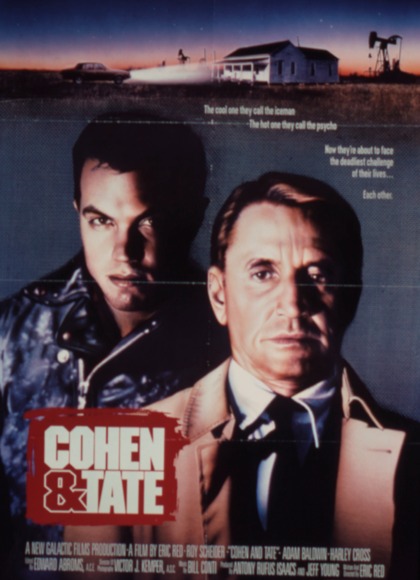
Cohen & Tate (1989)


Discovery is such a grand thing. As a fan of cinema, there are few emotions more enticing – or exciting – as coming across some rarely-seen gem from a bygone era of filmmaking. Those feelings can sometimes be compounded to a degree when you learn that a favorite writer or director was responsible for producing this work. Such was the case with “Cohen & Tate” (1989), written and directed by Eric Red, who is responsible for two cult classics in the horror genre – “The Hitcher” (1986) and “Near Dark” (1987). Red more or less vanished from film right around 1996 – after writing and directing the little-seen werewolf picture “Bad Moon” – and only recently resurfaced to write and direct a film called “100 Feet” (2008). But that work he did on those two horror films was enough to insure his name would be remembered by genre fans. So, what’s he doing writing a mob movie? Truthfully, although the film could ostensibly be called a “mob movie”, it’s more akin to some of the cat-and-mouse activity found in “The Hitcher”. Personally, despite a knowledge of Red and just about all of the films he’d written or directed I had never even heard so much as a whisper about “Cohen & Tate”. Luckily for fans, Shout! has resurrected the film on Blu-ray, and while it may not be a forgotten classic it certainly is a cut well above average.

An opening scroll informs viewers that young Travis Knight (Harley Cross) is under the Federal Witness Protection Program after witnessing a mob killing in Texas. He and his family attempts to go about their lives as FBI agents watch over them, but when one of the agents turns informant and alerts the mob to where they’re hiding Cohen (Roy Scheider) and Tate (Adam Baldwin) are sent in to kill everyone and kidnap Travis. The only hope he has is the fact that these two hit men – Cohen, an aging enforcer with a steely, cool demeanor; and Tate, a hot head who shoots first and doesn’t bother with questions – hate each other. Travis employs every trick he can to turn them against each other in the hope that they’ll wind up killing themselves and he can escape.

Truthfully, the plot here is very simple. The script, which was loosely adapted from O. Henry’s 1910 short story “The Ransom of Red Chief”, covers less than a day in real time. Cohen & Tate have a 4-5 hour drive back to Houston, where the mob heads want to have a “meeting” with Travis. In that scant amount of time, Red skillfully defines all characters very clearly in order to set up the rivalry between the three. We know that Travis is desperate, and despite knowing his parents have been killed he must become extremely resourceful in order to survive. Tate is an absolute, a hulking brute with a crude sense of humor and an itchy trigger finger. But Cohen, he’s the wild card. There are glimpses behind his demeanor, those few moments when you expect him to turn into a geriatric protector and shrug off this life of crime. He knows how his life in this business will end. But Cohen never takes the easy bait, leaving the audience guessing as to whether or not he actually cares about helping the kid or if he really just wants to kill Tate because he can’t stand him.

Eric Red said he wrote the role of Cohen for Scheider because he had a tendency to play there rogue samurai-type characters that lived by a certain code. A look at Scheider’s filmography confirms that this role fits in with his oeuvre. Roy as Cohen is cold and calculating, using one bullet to kill whereas Tate would have used a set of brass knuckles and a four shotgun blasts. But he never plays the elderly hitman looking to do some good in his life before he gets out. He only sides with Travis’ hatred of Tate because he also hates Tate. Even if he were to kill Tate, he’d still deliver Travis to the mob waiting to snuff him out just as quickly. It all plays out like a deranged buddy-cop flick, except these two only have one shared moment of levity thanks to a bad joke; the rest of their relationship working together is all condescension and bad vibes.

Adam Baldwin made this film almost immediately after “Full Metal Jacket” (1987), and it can be easy to draw parallels to Tate from his character, Animal Mother, in Kubrick’s picture. Both are driven by an unquenchable thirst to kill, with little regard for human life. It’s just a game to them. Red gives Tate one minor moment when he breaks down, revealing a fractured side to his impenetrable brutality. Unlike Cohen, however, there is never one iota of sympathy felt for Tate. He’s a danger to everyone in the film, his reluctant partner included. Many of the standoffs between Cohen, Tate, and Travis have a Sergio Leone quality to them. Eric Red has stated that he was influenced by “The Good, The Bad, And The Ugly” (1968), and with so much tension and ocular close-ups those influences are clearly evident.

Harley Cross manages to impress as nine-year-old Travis Knight. It’s tough placing such an onus on a child actor. Viewers tend to forget that child actors, especially in a film like “Cohen & Tate” which takes place almost exclusively at night, have to work long, grueling hours in less-than-favorable conditions. Maintaining composure and keeping up energy after long takes when you’re so young can sometimes cause a performance to suffer. Not here. Cross convincingly plays Travis with a sharp wit, a savvy youngster who understands the stakes and slyly pits these two mismatched partners against each other. He’s not the most believable at crying, but he does know how to think quickly on his feet as the situation dictates.

“Cohen & Tate” was heavily cut for its theatrical release, losing out on a great deal of brutal bloodshed. Most of the cut gore would have been found during the opening massacre at the farm house, and then later on during the climax. In fact, the neutered climax as seen in the film looks abnormally tame when compared to the uncut footage, which thankfully has been included here as an extra feature. I think this is a film that is deserving of a greater audience – even more so since it was barely seen during its limited theatrical release – and Shout! Factory’s Blu-ray is the perfect way to get it out there.