
Showing posts with label man in suit. Show all posts
Showing posts with label man in suit. Show all posts
Sunday, October 20, 2013
Men In Suits (2013)

Saturday, July 20, 2013
GODZILLA-THON #1 - Gojira (1954)
Godzilla fever has been running high thanks to Gareth Edwards' upcoming 2014 reboot invading Comic Con this weekend, so it seemed like as good a time as any to re-watch all of Toho's 28 entries in the historic franchise.

For a bit of backstory, I'm essentially the definition of a dyed-in-the-wool Godzilla fan. As far back as I can remember, I've been fascinated with big monster movies, or daikaiju for the initiated. I've got the worn-out VHS tapes to prove it. I would curate my own movie marathons, piling up my store bought (and bootlegged) Big G tapes to ready myself for an entire day of nerding the fuck out. All at the age of 6. Few things made me happier than watching man-in-suit movies until my eyelids gave out and I was carried off to bed. I owned every single film Toho had released up to that point - this would've been around 1987/88 - which explains why my favorite G films come from the earlier Showa era of the series. In fact, aside from Godzilla 1985 I didn't see any Heisei era films until the mid-to-late '90s. This is partly due to Toho doing a shitty job of giving them proper VHS released in America... and partly due to my entering high school and maintaining a social life.
But I digress. The point I'm getting at here is that despite all of my constant Godzilla-thons, I never watched the original film much. I watched it plenty to know it well enough. The black & white presentation never bothered me as a kid. I gravitated towards the more monster-heavy entries in the series, like 1974's Godzilla vs. Mechagodzilla. Plus, let's face it - Toho might've done a commendable job on the suit itself but that puppet used for close-up shots hardly looked menacing. And this was also the American-edited 1956 version, called Godzilla, King of the Monsters, which eschewed virtually all of the somber mood and nuclear subtext of the Japanese version in order to give Perry Mason, er, Raymond Burr screen time as our man on the ground, journalist Steve Martin. Clearly, this was before the time of the Steve Martin, but the name confusion did turn up when the character was reprised for Godzilla 1985. There, they just called him "Steve" or "Mr. Martin", never a combination of the two. It isn't a bad film - especially to the non-critical mind of a kid - but since the original version was lovingly restored around 2004 people seem to deride it more than usual.
Back to the marathon. Criterion put out a sexy new edition of Gojira (1954) on Blu-ray. This edition fully blows the Classic Media Blu-ray release out of the water, with an improved picture (CM's release was 1080i), better audio, and a minor wealth of bonus material. Now, it should be noted that they didn't license any of the features found on the 2-disc DVD Classic Media released, so fans who own that edition would be wise to hang on to it. But if all you're concerned with is the a/v presentation, look no further than Criterion.

The film itself is clearly superior to the heavily-edited American version. As I stated earlier, the tone is much more serious and somber. Godzilla is an obvious allegory for the undersea nuclear testing being done around that time (and even more obviously, the bombing of Hiroshima and Nagasaki). He is presented as a force of nature, an unstoppable beast who only leaves the sea when his food source has been depleted due to deep-sea explosions. As gripping as the monster footage is, the story is compelling and humanistic. Professor Yamane (Takashi Shimura) desperately wants to study the beast, hoping that through science we can learn how Godzilla is impervious to atomic testing and conventional weaponry. But the military just wants to kill it, a task they continually fail at completing. They have to enlist the aid of Dr. Serizawa (Akihiko Hirata), a scientist who has developed a device - the Oxygen Destroyer - that can essentially liquefy oxygen, killing whatever is in its wake. He's reluctant to offer his aid, however, since he knows that as soon as his experiment is revealed men will want to harbor it for nefarious purposes. The pathos bleeds off the screen, elevating what could have easily been a simple monster-runs-amok film into something emotional and poignant.

Much - if not all - of the film's success is thanks to the triumvirate of technical innovation: director Inoshiro Honda, producer Tomoyuki Tanaka, and special effects supervisor Eiji Tsuburaya. Without delving too deeply into history that can be found elsewhere, it was Tanaka's idea to film the movie. The script went through many changes, as did the final design for Godzilla, which at one point was to be a monster with a mushroom cloud-shaped head (!). Finally, on their third attempt to create a useable sculpture, did Tsuburaya & Tanaka settle on the now-classic look. They still needed to put a man in that 200-lb. rubber suit, though. Enter Haruo Nakajima, who wore the bulky behemoth under stage lights with temperatures inside reaching 130 degrees Fahrenheit. He reportedly had a cup of sweat drained from the suit daily. The stiff rubber forced a more reptilian - and, thus, less human - style of movement because Nakajima was so restricted. Rumor has it the suit could stand on its own once he was out! Sounds like grueling work, but he took it all in stride without complaining. Nakajima did almost all of the suit work during the Showa era.

It's been said that a good score can dramatically help any movie, and the impressive orchestration of Akira Ifukube certainly does just that. This is the man who composed a large majority of Godzilla's most memorable themes. This score reciprocates the somber tone meant for the film, making it unique among his work on other Godzilla films since the mood never reached the emotional depths of this first picture. Ifukube would go on to score for Godzilla the rest of his career, finally stepping down after handling duties on Godzilla vs. Destroyer in 1995. Let's not forget he also gave the Big G his trademark roar, something achieved by rubbing a resin-coated glove over a contrabass string. Simple, effective, incredibly memorable.
I liken this inaugural Godzilla film to Rocky (1976) - hang on a sec, lemme finish - in that this was the launch pad used to gauge reaction and then plot ahead. Everyone seems to forget that Rocky loses in the first film, much like the Big G loses (even worse, really... he dies) here. But as Prof. Yamane said in the film, perhaps there are more of Godzilla's species out there, waiting to be woken up from continued testing.
Lucky for us, he was right.

For a bit of backstory, I'm essentially the definition of a dyed-in-the-wool Godzilla fan. As far back as I can remember, I've been fascinated with big monster movies, or daikaiju for the initiated. I've got the worn-out VHS tapes to prove it. I would curate my own movie marathons, piling up my store bought (and bootlegged) Big G tapes to ready myself for an entire day of nerding the fuck out. All at the age of 6. Few things made me happier than watching man-in-suit movies until my eyelids gave out and I was carried off to bed. I owned every single film Toho had released up to that point - this would've been around 1987/88 - which explains why my favorite G films come from the earlier Showa era of the series. In fact, aside from Godzilla 1985 I didn't see any Heisei era films until the mid-to-late '90s. This is partly due to Toho doing a shitty job of giving them proper VHS released in America... and partly due to my entering high school and maintaining a social life.
But I digress. The point I'm getting at here is that despite all of my constant Godzilla-thons, I never watched the original film much. I watched it plenty to know it well enough. The black & white presentation never bothered me as a kid. I gravitated towards the more monster-heavy entries in the series, like 1974's Godzilla vs. Mechagodzilla. Plus, let's face it - Toho might've done a commendable job on the suit itself but that puppet used for close-up shots hardly looked menacing. And this was also the American-edited 1956 version, called Godzilla, King of the Monsters, which eschewed virtually all of the somber mood and nuclear subtext of the Japanese version in order to give Perry Mason, er, Raymond Burr screen time as our man on the ground, journalist Steve Martin. Clearly, this was before the time of the Steve Martin, but the name confusion did turn up when the character was reprised for Godzilla 1985. There, they just called him "Steve" or "Mr. Martin", never a combination of the two. It isn't a bad film - especially to the non-critical mind of a kid - but since the original version was lovingly restored around 2004 people seem to deride it more than usual.
Back to the marathon. Criterion put out a sexy new edition of Gojira (1954) on Blu-ray. This edition fully blows the Classic Media Blu-ray release out of the water, with an improved picture (CM's release was 1080i), better audio, and a minor wealth of bonus material. Now, it should be noted that they didn't license any of the features found on the 2-disc DVD Classic Media released, so fans who own that edition would be wise to hang on to it. But if all you're concerned with is the a/v presentation, look no further than Criterion.

The film itself is clearly superior to the heavily-edited American version. As I stated earlier, the tone is much more serious and somber. Godzilla is an obvious allegory for the undersea nuclear testing being done around that time (and even more obviously, the bombing of Hiroshima and Nagasaki). He is presented as a force of nature, an unstoppable beast who only leaves the sea when his food source has been depleted due to deep-sea explosions. As gripping as the monster footage is, the story is compelling and humanistic. Professor Yamane (Takashi Shimura) desperately wants to study the beast, hoping that through science we can learn how Godzilla is impervious to atomic testing and conventional weaponry. But the military just wants to kill it, a task they continually fail at completing. They have to enlist the aid of Dr. Serizawa (Akihiko Hirata), a scientist who has developed a device - the Oxygen Destroyer - that can essentially liquefy oxygen, killing whatever is in its wake. He's reluctant to offer his aid, however, since he knows that as soon as his experiment is revealed men will want to harbor it for nefarious purposes. The pathos bleeds off the screen, elevating what could have easily been a simple monster-runs-amok film into something emotional and poignant.

"Chicks dig the patch, right?"
Much - if not all - of the film's success is thanks to the triumvirate of technical innovation: director Inoshiro Honda, producer Tomoyuki Tanaka, and special effects supervisor Eiji Tsuburaya. Without delving too deeply into history that can be found elsewhere, it was Tanaka's idea to film the movie. The script went through many changes, as did the final design for Godzilla, which at one point was to be a monster with a mushroom cloud-shaped head (!). Finally, on their third attempt to create a useable sculpture, did Tsuburaya & Tanaka settle on the now-classic look. They still needed to put a man in that 200-lb. rubber suit, though. Enter Haruo Nakajima, who wore the bulky behemoth under stage lights with temperatures inside reaching 130 degrees Fahrenheit. He reportedly had a cup of sweat drained from the suit daily. The stiff rubber forced a more reptilian - and, thus, less human - style of movement because Nakajima was so restricted. Rumor has it the suit could stand on its own once he was out! Sounds like grueling work, but he took it all in stride without complaining. Nakajima did almost all of the suit work during the Showa era.
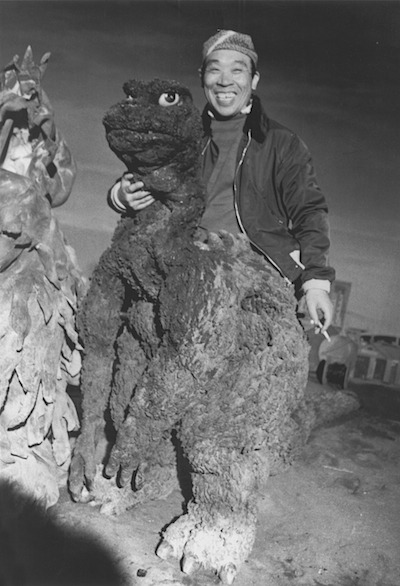
"Godzilla - did the Oxygen Destroyer really kill him... or was it cancer?"
It's been said that a good score can dramatically help any movie, and the impressive orchestration of Akira Ifukube certainly does just that. This is the man who composed a large majority of Godzilla's most memorable themes. This score reciprocates the somber tone meant for the film, making it unique among his work on other Godzilla films since the mood never reached the emotional depths of this first picture. Ifukube would go on to score for Godzilla the rest of his career, finally stepping down after handling duties on Godzilla vs. Destroyer in 1995. Let's not forget he also gave the Big G his trademark roar, something achieved by rubbing a resin-coated glove over a contrabass string. Simple, effective, incredibly memorable.
I liken this inaugural Godzilla film to Rocky (1976) - hang on a sec, lemme finish - in that this was the launch pad used to gauge reaction and then plot ahead. Everyone seems to forget that Rocky loses in the first film, much like the Big G loses (even worse, really... he dies) here. But as Prof. Yamane said in the film, perhaps there are more of Godzilla's species out there, waiting to be woken up from continued testing.
Lucky for us, he was right.
Subscribe to:
Posts (Atom)