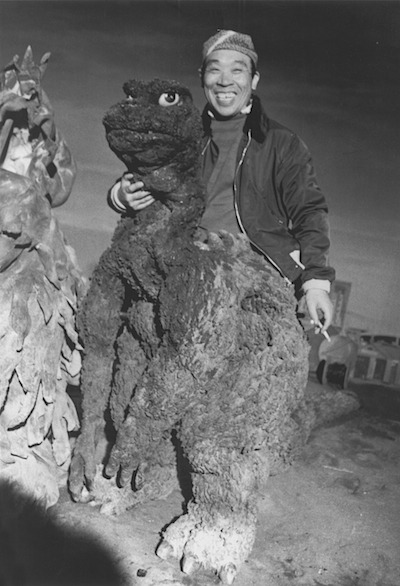
Showing posts with label ishiro honda. Show all posts

Friday, January 17, 2014

GODZILLA-THON #15 - Terror Of Mechagodzilla (1975)


Before bowing out of the '70s and effectively ending his Showa era of films, Godzilla had one last battle to endure. This entry, Terror of Mechagodzilla, would see the return of two of Godzilla's "fathers" - director Ishiro Honda and composer Akira Ifukube. The screenplay was submitted via yet another Toho contest, this time being won by a female contestant named Yukiko Takayama, one of only two women to have written a Godzilla film up to that point (the other being Son of Godzilla). As per usual, her draft was heavily re-written by the studio. This film picks up right after the end of Godzilla vs. Mechagodzilla, giving us one more bout with Godzilla's robotic nemesis, as well as introducing audiences to another kaiju that had a one-and-done appearance, Titanosaurus. Although Toho didn't necessarily want this to be the final Godzilla film of the Showa era, declining revenue and ticket sales, in addition to a nationwide energy crisis, meant that Godzilla would be shelved for nearly a decade. Fans generally agree that he went out on a high note, though, with this film taking on a darker tone than the series had employed in quite some time.

Picking up right after the events of the last film, Terror of Mechagodzilla finds the alien race from the last film - those guys from the Third Planet from the Black Hole - trying to rebuild Mechagodzilla, while also working with the deranged Dr. Mafune (Akihiko Hirata), who has somehow created Titanosaurus, a massive aquatic beast that he wants to unleash upon the world. A fellow marine biologist, named Ichinose, works with Interpol to find the whereabouts of Dr. Mafune. They eventually find his daughter, who turns out to be a cyborg. The aliens hope to use both monsters under their control to wipe out the earth and rebuild anew, but Mafune is erratic and lets Titanosaurus go on a rampage without their consent, and Interpol figures out the beast is sensitive to ultrasonic frequencies. Eventually, Mechagodzilla is repaired and the two titans begin to destroy the city of Yokosuka, but Godzilla arrives in time to do battle with both. The film climaxes in a very traditional sense, with the humans defeating their alien attackers as Godzilla does his best to destroy both enemy monsters to retain his crown as King.

This film marked the final contributions for a couple of the series' most notable people. Director Ishiro Honda came back to give Godzilla his temporary sendoff. This was Honda's eighth feature in the series, and his run was only marred by one truly underwhelming film - All Monsters Attack. He moved away from using some of the most kid-friendly aspects of previous films, maintaining a grim, dark tone throughout this entry. I'd say Terror of Mechagodzilla is every bit as dark as Godzilla vs. Hedorah, only without the social message attached to it. The alien plot line is a little undercooked, since it had just been used in the previous film, but Honda does well in keeping the monster activity peppered throughout the running time so it never lags. There were plans for Honda to come back to the series and direct 1993's Godzilla vs. Mechagodzilla II, but he died before production could begin. There is no doubt, however, that his name will forever be inextricably linked to Godzilla.

Akira Ifukube returns to deliver his first new score for the series since 1968's Destroy All Monsters. Although he was credited as composer on Godzilla vs. Gigan (1972), everything used on that film was stock. His score for Terror of Mechagodzilla is, frankly, fucking exquisite. It can't be properly appreciated within the context of the film, but on its own this is one of his best efforts ever. The music is very synth-heavy and dark, with many low, rumbling keyboard notes anchoring the score. Some of the standout tracks use instruments that haven't been heard previously in any Godzilla score, such as an organ. Ifukube has this amazing ability to craft new music for the series that is unique in its own right, but still fits in perfectly with his compositions as a whole over the course of the series. Themes are reprised with differing instrumentation, suiting the mood of what the scene calls for. After the more playful and light soundtracks that Masaru Sato had been composing, this was a welcomed change of pace to remind viewers the world of Godzilla is not always so fun. I mean, it is to us, but a return to the doom and gloom days was needed.

The MegaroGoji suit was used here again, for the last time, with more changes being made to his facial appearance. This "new" suit, dubbed MekaGyakushuGoji, had a smaller muzzle, with lowered brows and smaller eyes. Quite honestly, it looks very similar to the look he had for Godzilla vs. Mechagodzilla, only with an expression that conveys equal parts humor and horror. He's still got the bulldog face, but it's softened a bit. There was a second Godzilla suit created for Mechagodzilla in disguise that was used in the previous film, and here it's used for Godzilla's final shot as he wades into the ocean and swims away. It's a clunky looking suit, definitely better suited to Mechagodzilla in hiding than a proper Godzilla, but as I've stated many times before Toho liked using old suits for water shots.

The American version of Terror of Mechagodzilla had a few minor trims (including the one shot of nudity in the entire series, which is funny because the boobs you see belong to a mannequin), hich reduced the running time by around five minutes. It received a theatrical release in March 1978 under the title of Terror of Godzilla. The following year, when it had been sold to cable, the film was titled back to Terror of Mechagodzilla and had an additional six minutes of footage added before the title card as a prologue. This new intro utilized footage from Godzilla vs. Monster Zero and All Monster's Attack (which itself contained footage from other movies), serving as an introduction to the character of Godzilla, as well as the alien races that have attempted to destroy him and our world. While totally unnecessary to the film itself, it's a well-edited piece that offers a great overview of some events that led up to this picture.

And so ends Godzilla's Golden Age. Fans can, and will, debate about which era was the best in series - Showa, Heisei, or Millenium - but for my money, nothing beats the unadulterated joy that comes from watching these early installments. Sure, we get a few clunkers along the way, but there's nothing outright unwatchable. Even All Monsters Attack has some merit, though it isn't much. Even with the one or two "bad" entries aside, that leaves thirteen (!) films of our favorite fire-breathing monster, fighting his way through numerous, varied adventures. Very few, if any, characters in cinema have ever enjoyed such a run. But, Godzilla had more or less run his course since his birth in 1954, and a short break from cinema can do wonders for a character. He'd come back almost a decade later, resembling the feared beast he began as, kicking off the Heisei (or Vs.) series that brought back many of his most memorable allies and villains. It's a film that I watched so much on VHS as a kid the tape practically wore out - Gojira (1984). 


Saturday, January 11, 2014

GODZILLA-THON #10 - Godzilla's Revenge (1969)


Director Ishiro Honda, fresh off the success of the monster mash-up melee, Destroy All Monsters, returned the next year to helm this entry, All Monster's Attack (known as Godzilla's Revenge in America). Unfortunately, and quite surprisingly, it would be considered the series' nadir by a majority of fans. The film's biggest issue is that it is unquestionably a children's film, aimed squarely at kids, starring a kid. That isn't a death sentence in and of itself, but the loss of special effect supervisor Eiji Tsuburaya left director Ishiro Honda scrambling to get the effects work finished... himself! Since he was no expert in that field, the work done for this film was minimal, resulting in most of the Godzilla footage shown having been recycled from his previous three efforts. There's a positive message within the film that kids should hear - stand up to bullies, don't back down - but once you've past a certain age any appeal this entry may have had in your halcyon days is likely expired.

Ichiro is a young latchkey kid who spends most of his time alone, daydreaming about a better life. His current life is full of emptiness and bullies, but the bullies hurt the most because they terrorize him and make him feel humiliated. Ichiro's best friend is Shinpei, a toy maker and inventor on the outskirts of town who lets him spend time in his shop. When he gets to be alone, Ichiro fantasizes about being on monster Island, where Godzilla's son, Minilla, is the size of a small child and has somehow gained the ability to speak Japanese. And, uh, he can also change his size according to will. Don't ask. Anyway, Minilla has his own bully - a large cat-faced reptile monster named Gabara (also the name of Ichiro's bully). Try as he might to stand up to Gabara, Minilla always gets his little ass whooped. Luckily, he has Godzilla around to teach him the important monster things, like breathing fire. Ichiro is interrupted from his dreams by a couple of thieves who have stolen 50 million yen, holding him hostage until they can form a plan. Ichiro wills himself back to monster Island to get a final word of advice from Minilla, watching him defeat Gabara (with the help of Big Daddy G) and giving him the confidence to stand up to his own bullies. Ichiro breaks free and alerts the police, who arrest the robbers. The next day, we see Ichiro finally stand up to his schoolyard bullies and take them down, earning the respect of his peers now that he resorts to violence, too. Wait, what was the message again?

The film's biggest detriment is the lack of new Godzilla footage. It's even more frustrating because the fight between Godzilla, Minilla, and Gabara is actually pretty good. Haruo Nakajima, still inside the suit since the original film, had become so adept at maneuvering inside of it that the fight choreography looks impressive. The movements look as fluid as ever, giving Godzilla is bit of grace he had been lacking before. The suit used here appears to be from Destroy All Monsters, which makes sense given how little it was needed for this film. That's another major downside of using stock footage from the three previous films: each suit had a different look. It is glaringly obvious when they switch from '66 to '67 to '69 and then back again. Hell, in some scenes the suit literally changes from shot to shot. No level of editing can change mismatched suits.

The storyline with Ichiro isn't all terrible. Following a kid around isn't an ideal plot for any of these films, especially one where it isn't exactly established whether or not Godzilla exists at all in the real world. But Tomonori Yazaki is a precocious little shit, curious about enough to investigate but he's never really annoying in his actions. He seems fairly reasonable, making his troubles with a school bully weightier because we don't like to see him abused. His lack of friends and a family life is what led to his overactive imagination, giving Minilla the chance to imbue him with some confidence. According to one of the adults at the end, Minilla is a god for children, and he gives them strength just as the gods adults pray to do for them. It's certainly a unique perspective to view these characters from. Thankfully they only went this route for one film.

All the footage we see of Ebirah, Kumonga, and Kamacuras has been recycled from their respective films. The only new footage is also populated by a new monster - Gabara. He's ugly. Oddly enough, other than his weird cat face he sort of looks and sounds like Titanosaurus, an antagonist that won't be seen until 1975's Terror of Mechagodzilla. I can only assume maybe this suit was reused for his design? Either way, I'm grateful Gabara never showed up in another film because he's terrible. Even his special abilities - electrocuting things that he touches - is bizarre. But it does make for a funny scene when he zaps Minilla.

Scoring duties this time around were handled by Kunio Miyauchi. Akira Ifukube would return again later, and to be perfectly honest his talents would have been wasted here. Miyauchi reprises some of Masaru Satoh's themes (or they're literally reusing them here) from previous entries, and whatever work he himself contributed has a brassy sound to it. Not typical for a Godzilla film, but it works well for this installment. It's adventurous, whimsical, even a bit playful. Again, more of the James Bond type of sound that was popular during those days.

The score also gave us "Monster March", an annoying and mildly catchy Godzilla tune as howled by some Japanese youngster.

This would be the final film where Eiji Tsuburaya, one of Godzilla's "fathers" who designed all of the special effects up to this point, would be credited. His involvement here was non-existent, really, with Sadamasa Arikawa handling the set duties since Tsuburaya was too sick to perform. He died the next year, which may be part of the explanation for why Godzilla took that year off from films. Tsuburaya left behind an enduring legacy that will be remembered for generations, gifting us with some of the most memorable monsters to ever grace screens.

Following his most kid-friendly adventure yet, Godzilla would go on to become a savior for all sizes of people when he saved the planet from a flying bob of sludge in the eco-conscious entry Godzilla vs. The Smog Monster. 

GODZILLA-THON #9 - Destroy All Monsters (1968)


The dream team is back, baby! After the diminishing returns Godzilla had been facing for the past couple of years, producer Tomoyuki Tanaka decided to bring back director Ishiro Honda and composer Akira Ifukube for what was intended to be the Big G's last hurrah. The big question was, though: if we're going to do one last film, who does Godzilla face? Gary Oldman from The Professional knows - EVERYONE! Toho threw down the gauntlet here, bringing back many fan favorites, many of which hadn't ever been in a film with Godzilla before. Not only was this just about the coolest idea Toho had ever come up with outside of creating Godzilla, but the inclusion of monsters created for other properties gave fans even more incredible work to marvel at watching. Think of it as The Avengers (2012) of monster movies. The plot would once again involve mind control as executed by an evil alien race, this time all women (!), but the real meat here, the real reason why everyone is tuning in, is for that glorious monster action. And, brother, believe me when I say this pull out all the stops to deliver one helluva time!

Don't ever ask how, but in the year 1999, mankind has managed to wrangle all of the planet's monsters into one location - Monster Island (called Monsterland here). Godzilla, Minya, Anguirus, Gorosaurus, Rodan, Mothra, Kumonga, Manda, Varan, and Baragon. All living on an island that looks like it would be small for any one of them, where we're told food is plentiful and they all get along. Sounds like a bullshit PR piece SeaWorld would've put together. But it's working. At least, it is until communications with the island are lost and the monsters escape to begin attacking world capitals. We soon figure out the Kilaaks are the ones behind it, an alien race composed of all females (and they procreate how?) who wear glittery silver spandex hoodies. The have the monsters under the control of a mind-altering signal, one that is emanating from a location on the moon. Hey, we have a base there now! Capt. Yamabe (Akira Kubo) goes up with a team of his best men to stop the aliens by destroying the signal. It works, but the Kilaaks unleash their most powerful weapon as a last-ditch effort: King Ghidorah. The monsters of the Earth must unite to fight their common enemy, all while humanity fights against the alien invasion.

Alien mind control is used a lot in these films. It's a good way to allow Godzilla, our supposed hero by this point, to cause worldwide destruction without actually looking like the bad guy. His mind was under control, after all. And when he does get his head clear, you can always tell he feels really bad about what he did. This was, however, the first entry to have the aliens use a human appearance as their cloaking device, revealing a more hideous, sci-fi origin when their true selves are exposed. In this case, the Kilaaks are extremely sensitive to cold, so when the temperature drops considerably in their environment they revert back to looking like silver slugs that live in rocks. It's funny later on when the military learns of this, and the commander can only help but grin and say something about how friggin' easy an attack this is going to be now.

We know the returning faces - Godzilla, Minya, Anguirus, Rodan, Mothra, Kumonga - so who are the new guys? Gorosaurus was featured in King Kong Escapes (1967), where he fought Kong. Manda was a chief opponent as an undersea dragon in Atragon (1963). Varan appeared in his own film, produced in 1957. And, finally, Baragon was best known as the opponent to the title star in Frankenstein vs. Baragon (1965). Of all these, only Gorosaurus gets an appreciable amount of screen time, teaming up with Godzilla at the climax to help finish off King Ghidorah. Varan gets little more than two shots during the entire film. This was due to the suit being in such a state of disrepair since the filming of that feature over a decade prior. Baragon was being used on the Ultraman TV series (monsters were often redressed for other programs, Godzilla included), so his appearance was extremely limited here. In fact, the script called for Baragon, not Gorosaurus, to destroy Paris. But in typical Toho fashion, even though the monster change had to be made the script change wasn't, leaving Gorosaurus with not only Baragon's ability to burrow underground, but also his roar and in some cases even his name, since the media refers to him in the film as Baragon.

There were to be two more monsters added to the fray - Maguma (from 1962's Gorath) and Ebirah, last seen fighting Godzilla in Godzilla vs. The Sea Monster, but budgetary concerns caused both to be scrapped from the production. Also of note, there was a brief scene filmed where Godzilla fights with Manda, which makes no sense in the context of the film since both are under the same mind control. The footage is said to be shown at conventions from time to time, though it has yet to show up on any official release. 

Despite their being an abundance of kaiju, everyone gets a good amount of screen time with the exception of the two previously mentioned monsters. After the introduction at Monster Island, the film does an adept job of cutting back and forth between human/alien drama and monsters causing a melee across the globe. Some of the sets aren't as distinct as others (Godzilla destroys a seaboard that looks nothing like NYC), but for the most part it looks pretty rad to see Gorosaurus demolish the Arch de Triumph, or to see Rodan flattening Moscow. I can vividly recall seeing the extended trailer for this film on my VHS of Grandpa's Sci-Fi Hits, which was hosted by Al "Grandpa Munster" Lewis. The promise of an international incident as carried out by all my favorite monsters looked astoundingly epic to my young brain. Even now, all these hardened cinematic years later, I can say it's an ambitious entry that really put a lot into the story.

Interestingly, director Gareth Edwards, who is helming the upcoming 2014 reboot Godzilla, has expressed a desire to make a sequel to his film something akin to this film. I really do applaud his ambition, but I hope they set that universe up further with a second film before throwing too many names into the mix. Plus, I don't see that being a successful idea unless Toho grants the rights to use other monsters. Right now, Legendary can only use Godzilla.

A final film is never a final film when a series is successful. Even though producer Tomoyuki Tanaka declared this would be Godzilla's final feature film, the success it enjoyed meant another movie was in the works, this one coming out just a year later. Only to call it a new film is almost disingenuous considering almost all of the fights are culled from stock footage. And that's not even to mention the undeniably child-centric tone and core message about bullying and standing up and... oh, Christ, is there anything good to be said about Godzilla's Revenge? 


Wednesday, January 8, 2014

GODZILLA-THON #6 - Invasion Of Astro-Monster (1965)


Toho kept the Big G on a roll by releasing another entry almost exactly a full year later, this time bringing back familiar elements that were popular in the last one. Namely, King Ghidorah, Rodan, and the use of an alien race for a plot device. That last feature would go on to become ubiquitous in the series, with nefarious alien races plotting our doom through various means right on up to Godzilla: Final Wars (2004). The core team of director Ishiro Honda, producer Tomoyuki Tanaka, and special effects supervisor Eiji Tsuburaya remained together for this film before briefly disbanding, and then finally returning for the last big melee, Destroy All Monsters (1968). This entry, titled Invasion Of Astro-Monster (1965) in Japan and Godzilla vs. Monster Zero (1970) in America, is the last to display a sense of continuity from the previous entry, as the follow-up Godzilla vs. The Sea Monster completely ignores the events of this film. Though that's the least of its problems. But I digress.

A new planet has been discovered in our solar system - Planet X - and two astronauts (Nick Adams and Akira Takarada) have been sent on a cosmic journey to explore it. Before you have time to marvel at the efficiency of the Japanese government to execute such a mission with surgical precision in scant time, they land and are greeted by the people of Planet X, known as Xians. They, um, have a unique look, with visors that Levar Burton would envy, black skull caps, and what look like yoga mats wrapped around their necks. They certainly accomplished making them look fucking weird, I'll give 'em that. Anyway, these guys have to live underground because the surface is patrolled by Monster Zero (their name for King Ghidorah). What they propose is that we sign off on a Monster Loan, wherein they would drop into Earth, wake up Godzilla (Monster One) and Rodan (Monster Two), cart them up into space to their planet so they can fight off Ghidorah again, and then send them back before living in eternal bliss. Why Glenn and Fuji (our two astronauts) agreed is questionable since these guys look really sketchy. But I guess a slow space death was likely taken into consideration. Oh right, and the fact that they promise to give us the cure to cancer. The Xians arrive (or, should I say, rise from a nearby lake they hid in at some point), and two of their flying saucers play wakey-wakey-eggs-and-bakey with Godzilla and Rodan, scooping them up using an egg-thing made of energy. The trip to space is apparently quick for these guys, and in no time Godzilla and Rodan (who luckily don't need to worry about adapting to a foreign atmosphere in any way) kick the ever-loving shit out of Ghidorah. Godzilla is so proud of his work he even does a little dance.

 
 But you knew these Xian dudes were up to no good. Right after they send our astronauts back home, a crowd assembles so they can all listen to the miraculous cure for cancer we were promised. The tape is cued up, everyone is waiting with baited breath, someone hits plays, and... we get a message from the Xians that more or less says "Haha, fuck you, thanks for the free monsters. And by the way, we're coming back right now with all three of them to destroy your planet." Whoops. So, now Godzilla and Rodan, under the spell of a mind-control device, start wreaking havoc around town alongside a mean-as-usual King Ghidorah.

This is the part where the slightly cute but ultimately stupid subplot focusing on Fuji's sister and her bumbling, inventor would-be fiance, Tetsuo, comes into play. We're told the Xians are extremely sensitive to a certain sound, which is why the Xians bought Tetsuo's stupid device that is supposed to scare off attackers by emitting an ear-piercing sound. The device is used, Xians start to literally drop out of the sky, and the mind-control ray is shattered. Godzilla and Rodan snap back, realize what's going on, and promptly hand Ghidorah his golden space ass once again. Man, these guys would have made a killer WWF tag team.

Godzilla didn't get much of a major facelift this time around, with only minimal alteration made. This new suit, dubbed Daisensogoji, enlarged the eyes a little to give him a more friendly appearance, along with dorsal plates that were reduced in size ever so slightly. The guy's our hero, can't have him looking too unfriendly for the masses. Godzilla has a fairly consistent look over the course of these last three films, one that is continually reference as being among fans' favorite. We can thanks Eiji Tsuburaya once again, as it becomes obviously by the next film that when his presence isn't on the set, the quality immediately sees evident decline.

Akira Ifukube's score reprises many of the key themes he created for the series, with not much variance to give it a distinct feel specific to the film. That's not a knock in any way, however, since all of his music for the series has been inimitable. Oddly enough, he didn't even supply my favorite score for the series (which will be revealed when we get there), but those arrangements he produced are so iconic it's nearly impossible to think of Godzilla and not hear it.

The American version, titled Godzilla vs. Monster Zero (a better title, btw), was released in 1970 on a double bill with War of the Gargantuas. The film was only cut by three minutes, making it fairly faithful and respectful top the Japanese version. As usual, a lot of Ifukube's score was shuffled around or just replace outright. Oddly enough, some shots of Godzilla's foot stomping houses and huts were removed. Usually these versions want all the monster action they can get, sometimes even adding more in the case of Mothra vs. Godzilla, but here they trimmed it out. No matter, since the Classic Media DVD contains both cuts. And you know which one to watch.

After this, it goes downhill a bit when we get to King Ko... er, Godzilla vs. the Sea Monster (1966). Trust me, that gaff makes perfect sense when you know the story. 

Monday, January 6, 2014

GODZILLA-THON #5 - Ghidorah, The Three-Headed Monster (1964)


 What's this? Another Godzilla film in 1964? Yep. King Kong can't be the only monster to get two films in one year (King Kong and it's sequel Son of Kong hit in '33... and they were stop-motion!). Toho, seeing flashes of dollar signs after King Kong vs. Godzilla proved to be a huge international success, jumped right into production on another entry in the Godzilla series after he finished battling Mothra just a few months earlier. This entry, Ghidorah, the Three-Headed Monster, would be significant for a number of reasons, featuring many firsts not seen in a Big G picture up until now. Chief among those would be the introduction of Ghidorah (renamed "Ghidrah" for U.S. audiences because...?), the eponymous flying dragon that would go on to become Godzilla's most formidable foe. In fact, Ghidorah proved to be so popular as a villain that he (it?) even appeared in non-Godzilla properties, such as Rebirth of Mothra (1996) and one of its sequels. This was also the first entry to feature Godzilla taking on multiple monsters, as he winds up fighting Rodan, larva Mothra, and King Ghidorah, though eventually everyone just decides to gang up on Ghidorah and beat his ass back into space. The entry was the first time use a central plot focused on aliens infiltrating Earth for nefarious, nebulous purposes. Alien races would go on to be used in numerous sequels in the series, being employed frequently right up through Toho's (currently) final Godzilla film, Godzilla: Final Wars (2004). And, as a minor first that would be capitalized upon later, Godzilla is less the villain and more an anti-hero who begrudgingly helps the Earth by teaming up to defeat Ghidorah. From here on out, virtually every film in the series would have Godzilla in this role, with only a few exceptions. These firsts weren't just important because they introduced characters and themes that would recur throughout the series' history; they also were the reason why many fans consider this film one of the best Toho produced during the Showa period.

Although the canon of the series got progressively more muddled as time went on, the early entries maintained a timeline that tended to follow each sequel respectfully. At the end of the last picture, Godzilla, having just been the target of a Mothra larva bukkake fest, was vanquished to the sea. Here, that exactly where he rises from before scuttling with Rodan and destroying an ocean liner. The human element to the plot focuses on a Martian (or Venusian, depending on which cut you're watching) princess who is the target of an assassination plot by men wearing garish mid-century outfits. The princess publicly makes bold predictions, correcting prophesying that Rodan would rise from a crater neat Mt. Aso, and Godzilla would rise from the sea. Oh, and there's also a last-minute mention of a cosmic creature named King Ghidorah that decimated her people on Mars and now he's landed on Earth in the form of a meteoric egg getting ready to hatch, oh, right about now.

The story for most Godzilla sequels is practically latent, since the real reason everyone watches these is for the monster porn. There have been at least a dozen highly memorable allies and villains across G's long career, and this film puts together some of the top talent by including fan favorites Rodan (whose name is actually Radon, a contraction of pteranodon) and Mothra - both of which had solo outings years prior - along with King Ghidorah, a then-new kaiju that quickly rose up the ranks to be the fans' favorite adversary for all benevolent monsters. As usual, the action is sporadic until the film has around 15 minutes left, at which point it becomes a full-on kaiju slugfest with Godzilla, Rodan, and Mothra (in larva stage) teamed up to pummel Ghidorah. Shockingly, the only time Godzilla ever uses his atomic breath is during a skirmish with Rodan, never on Ghidorah. Instead, he just chucks a lot of rocks at him. Come to think of it, he does that to Rodan, too. And he did it to Mothra in the last film. The guy has atomic breath that can fuck everything in its path up... and he throws rocks. Still, there's really nothing more enjoyable (to me) than watching all these glorious Golden Age characters, brought to life by men in suits, duking it out.

As usual, changes were made to the existing Godzilla suit, dubbed Mosugoji by fans, though this time around they were relatively minor, leading to this new suit to be dubbed Mosugoji II. The head piece had become damaged during the last film, meaning effects supervisor Eiji Tsuburaya had to reinforce the mouth and rebuild the sculpt a bit. The result is on-par with Mothra vs. Godzilla in terms of quality, delivering one of the best looks G has ever enjoyed. As a point of trivia, there is one scene where the old suit is used: just as Godzilla makes his entrance from the depths of the ocean. Toho preferred to use older suits for any water or effects shots, when possible, so the old suit makes a quick (and literal) pop-up before being retired for the new one.

The version of this film I grew up watching as a kid was, unsurprisingly, the American edit. If you bought it on VHS back in the '80s, that was all you had available to watch. And do you think a 6-year-old kid knew, or cared, either way? Exactly. Plus, despite the fact that AIP butchered Akira Ifukube's score, removing nearly all of it from their version of the picture, they did a fair amount of judicious editing by removing some of the subplot material. Subplot meaning anything not featuring Godzilla. The resulting version runs around eight minutes shorter than Toho's cut, which, really, is the best version to watch. Also, I can't confirm it now but it sounds like they used a newer dub for the English cut, and not an old AIP dub track that at least holds some kitsch factor. New dubs sound like shit on these old films. Classic Media's DVD contains both versions of the film, and unsurprisingly the Japanese edit not only looks and sounds better, but you're getting the full picture to boot.

Ghidorah, the Three-Headed Monster went on to become one of the most lauded entries in the series, even garnering a few accolades from American critics, who are never an easy sell with these movies. Godzilla had begun his turn to defender of the Earth and... :shudder:... friend to children everywhere. Eiji Tsuburaya said he enjoyed making these pictures so kids could enjoy them, a philosophy producer Tomoyuki Tanaka also favored, so it was bound to happen eventually. Not that he ever got too cuddly or anything, Godzilla's Revenge aside. But before the series was to move on to other foes for the Big G to conquer, there was still one more bout with Ghidorah on the table...

Wednesday, July 31, 2013

GODZILLA-THON #4 - Mothra vs. Godzilla (1964)

No, unfortunately this film does not pit Godzilla against the malevolent shape-shifting alien beast that headlined John Carpenter's 1982 film. Rather, this was the first example of Toho digging through their monster roster and picking a worth opponent for Big G to rumble with in Japan. After the incredible success of pitting him against King Kong, Toho quickly went to work on penning a sequel. Intended to be given the lazy title of Continuation: King Kong vs. Godzilla, the project never made it past the early planning stages. Oddly enough, a super-sized version of Frankenstein's monster was once again submitted as a possible foe for Godzilla until Toho rejected that script (a script I'd love to read) and decided on Mothra, who had just headlined her own eponymous film in 1961. This is often considered to be one of the best films in the series period, as well as featuring one of the best Godzilla suits. I agree on both counts.

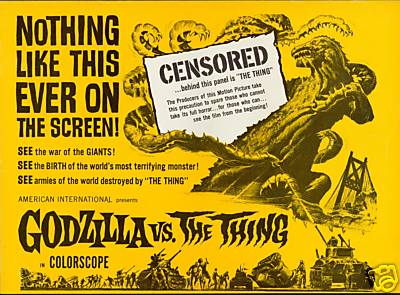
It's true, there is "nothing like [that] ever on the screen" because nothing in the movie has tentacles.

So, what's up with the vague, ambiguous title of Godzilla vs. The Thing? That title was only used for the American theatrical release, though, as all of the home video versions I can recall went by Godzilla vs. Mothra. To make it even more (slightly) confusing, the Japanese title is Mothra vs. Godzilla. I'm not exactly sure why Toho started putting their leading monster in the secondary title position. Godzilla doesn't even enjoy top billing until 1966's bout with Ebirah. I'm not complaining about this; it just seems a bit odd. But it could also be that the Japanese aren't as particular about this kind of thing like American film marketing. I've watched the Japanese version on Classic Media's outstanding DVD before, but having grown up on the English-dubbed version it's nearly impossible not to long for that version and that one only. The funny thing (no pun intended, really) is that I'd only ever seen it as Godzilla vs. Mothra, but this AIP print comes with the vs. The Thing title.


Amazingly, the American version hardly messes with the Japanese cut much. Usually, the American distributors will consider entire re-shoots around SPFX footage, or at the very least they'll trim the film down to the bare essentials to maximize monster time. Here, they not only leave the film almost totally intact, but they actually added a new scene of Godzilla being showered with missiles. The Frontier Missile sequence, featuring the American military taking control of the war against Godzilla, is full of great man-in-suit footage. Just as it sounds, it basically Godzilla stomping around while the military tries in vain to take him out. Of course, we know he ends up demolishing everything in his way because that's kinda his thing, but the fact that the U.S. got additional footage that the Japanese market didn't is pretty huge. This version was also released a scant 4 months after its Japanese debut, whereas all previous films had taken at least a year (or more) to be readied for stateside consumption.

The film's plotting doesn't deviate too far from the now-standard Godzilla formula. As per usual, G wakes up from hibernation - here he's buried underground and appears from beneath a quaking plot of land - and he just starts stomping Japan into the ground. Unlike in previous films, here he doesn't have any commute since his sleeping quarters were conveniently located in a coastal city. Just before Godzilla wakes, though, a giant egg had washed up on the beach. A massive egg capable of providing omelets for half the population. But this egg contains some special larva, the offspring of Mothra. You  know Mothra - giant moth, worshiped by native islanders and adored by two diminutive princesses who have a penchant for singing her praises constantly. My dad heard that song so many times when I was a kid that he can still sing it (albeit mockingly) to this day. Some businessmen try to buy the egg and set up an amusement park around it, completely ignoring the fact that it's an egg, which means it will either hatch something or rot away in the sun. Either way, not exactly a sound business model for generating revenue. It also doesn't help that one of the main dudes in charge looks like Hitler's long-lost Japanese brother.


With Godzilla on the move, and the fate of Mothra's egg in question, our fearless heroes/heroine - this time around it's a couple of journalists - call upon the tiny twins, known as Shobijin, to get Mothra to the mainland. Only problem is, Mothra has seen better days. She's an active senior looking forward to a few golden years before packing up her cocoon and jettisoning off the Moth Heaven. It's not meant to be, however, and soon Mothra is headed to Japan for a one-on-one showdown with Godzilla. And the Big G, being rightly pissed off for no apparent reason, promptly smacks her ass down. Oh noes! There goes any hope for saving Japan... unless a lot of tribal song and dance can get Mothra's egg to hatch! Of course, it does and out pop twins. I always liked Mothra's larva when I was younger. They seemed like such unlikely adversaries for Godzilla, but managed to hold their own impressively well considering they were literally just born and have virtually no defenses outside of tail biting and shooting silly string-like webbing from their mouths. 

A monster's humiliation, immortalized in plastic for all to see.

One area in which the film gets consistent props is for the suit design. This one, intended to be different from the Kingoji suit used against King Kong, was dubbed (appropriately enough) the Mosugoji. Godzilla's was given a less reptilian appearance, in addition to enjoying less bulk (battling a big ape must be a killer workout), a smaller snout, and an overall visage that is more menacing and "evil" versus the "big dinosaur" look he got last time around. Out of all the suits Godzilla films employed during the Showa era, I would have to agree that this one is among the best. Slight modifications were made for the next two subsequent films, after which Godzilla got some revamps that - quite honestly - made him look like a giant Sesame Street character. 
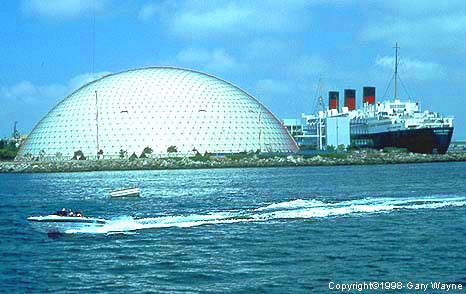
To end on a somewhat amusing anecdote, growing up in Southern California my father always used to point out the massive hangar which houses the Spruce Goose because it resembles Mothra's egg from far away. We lived about 50-ish miles from Long Beach, and on a clear day it looked just like that giant egg was sitting by the shore, waiting to hatch. All these years later I still think that every time I see it while driving. 


Friday, July 26, 2013

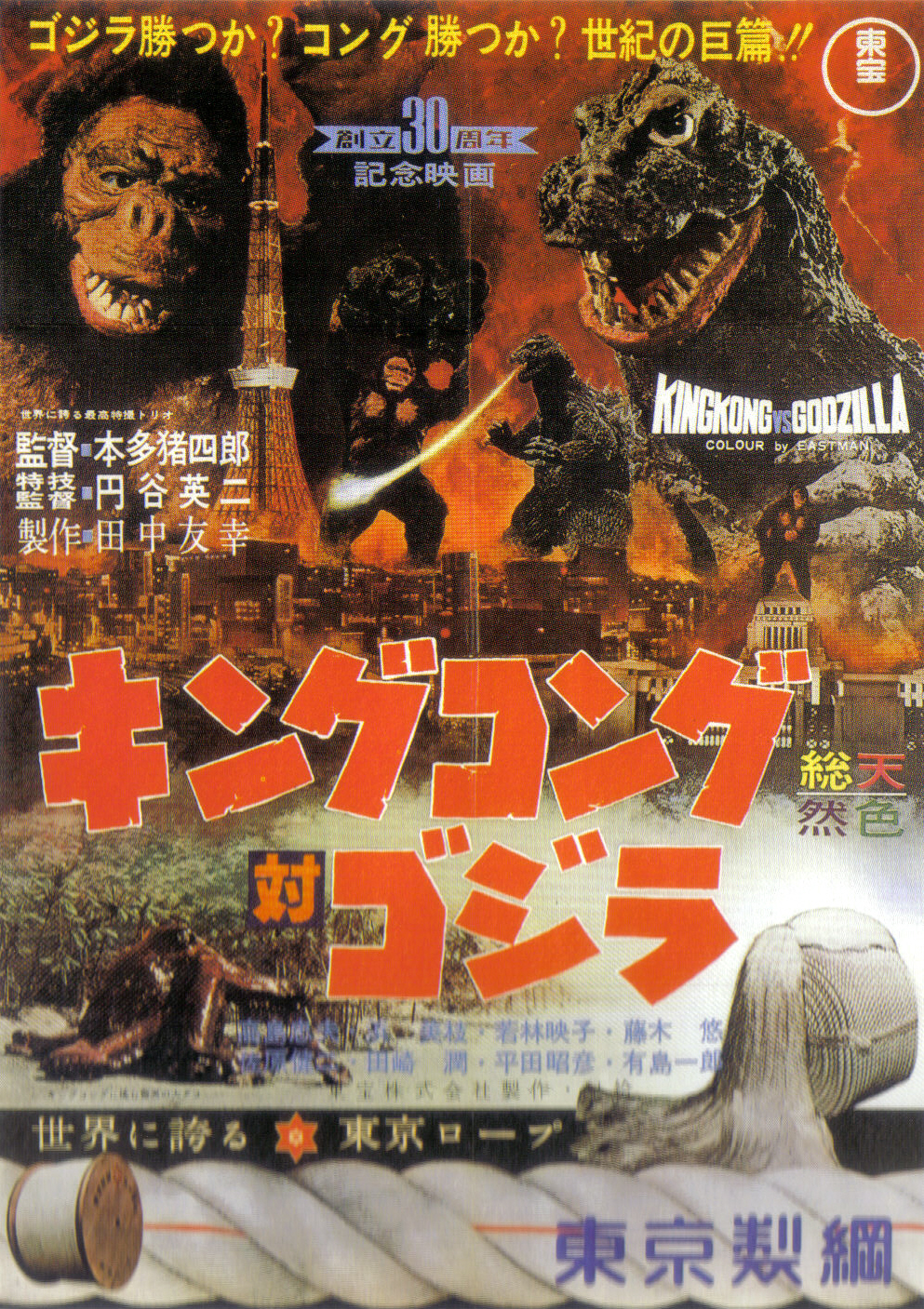
GODZILLA-THON #3 - King Kong vs. Godzilla (1962)

When we last saw our favorite grey-skinned (he's not green, people!) monster, he was en route to becoming a Godzilla popsicle after a lengthy, drawn-out mountainous bombing covered him in ice, which is where he remained for 7 years until Toho decided to revive him for a match against the ultra popular American monster, King Kong. Oddly enough, the Big G wasn't Kong's originally intended adversary. It was going to be... Frankenstein's monster? Yep. The film started out as an idea by stop-motion pioneer Willis O'Brien - the man responsible for bringing Kong to life in his 1933 debut - who wanted to pit Kong against a giant-sized Frankenstein's monster. RKO, the company that owned the character, was all for it... except for the fact that they were no longer a production company. So, one of O'Brien's business buddies decided to do him a solid and shop it overseas, eventually earning the interest of Toho who saw it as a potential vehicle for Godzilla. Unfortunately for O'Brien, his "buddy" cut him out of the deal and took the project to Japan on his own. Although he gets no credit, the only reason this film exists is because of his original concept.


This was one of my favorite movies as a kid, no question. Pitting my two most favorite monsters against each other was genius to my 6-year-old brain. Who cares if the scale on Kong is ridiculously off. He's what, 25, maybe 30 feet tall max? And here he's sprouted to over 100 feet because... he eats red berries on Farrow Island? Yep. There are red berries - which look an awful lot like lychee fruit dyed red - on a remote island in the South Pacific. Kong eats these berries, the juice has made him huge. There is also a large octopus on the island, almost as big as Kong, and it too enjoys drinking the juice from these berries. There are natives on this island as well. They eat these berries. They are normal-sized humans. The things you don't think about when you're young, right? I guess the berry juice magic only works on animals.

With few exceptions, Godzilla films have never been known for their intricate plotting or strong scripts. This isn't an exception to that rule, but the conceit behind getting these two together works pretty damn well. Godzilla, fresh from his cryo-slumber in an ice casket, is awake and rightfully pissed off. And what does G do when he's mad? Yep, time to smash the crap out of Japan. Japan, understandably, does not want this. They figure the best way to combat a big beast is with an equally large beast, so they ship Kong's furry ass over to Japan in order to have him fight Godzilla. The method by which they get the two together is wholly improbable - giant balloons would not lift a 3000-ton ape. Laughable as it is, he sure knows how to make an entrance.

That's the thing here, too - this is the first Godzilla film aimed towards a broader audience. Special effects supervisor Eiji Tsuburaya wanted to make both monsters more family friendly. Don't forget, Godzilla - and to a lesser degree, Kong - was still considered a villain in 1962. By making both monsters slightly more anthropomorphic they seemed less scary to small children. That's why they do things like playing hot potato with a massive boulder. The Godzilla suit was once again redesigned, this time with no ears, three toes on each foot instead of four, and his dorsal fins were enlarged. Many fans consider this to be one of the best suits the series has seen, a distinction I tend to agree with. He looks like more like a dinosaur, and I was a dino-obsessed kid. The Kong suit is, uh... well, frankly, it looks like shit. Half the time. The suit used for longer shots has a more furrowed brow and recessed eyes, giving it a more "hardened" look. The close-up suit just flat out blows. His teeth look like they're all about to exit his mouth in different directions, the eyes are bugged out making him look like a pug/ape hybrid; it's just a terrible design through and through, which is surprising given that Tsuburaya was such a major fan of Kong's 1933 debut. I'll admit that there is a little bit of charm to the guy ape's mug, however, he is unquestionably the ugliest Kong ever committed to film. Yes, even uglier than female Kong and her big third-world ape titties in King Kong Lives.

"Break these chains... of love!"
As with almost every Godzilla film up to this point, King Kong vs. Godzilla had an American version that cut out many scenes and changed some of the film sequences around. They inserted the character of Eric Carter (played by a good looking son of a bitch named Michael Keith), a U.N. reporter who would call on his colleagues around the world to get updates on Godzilla and Kong's respective paths of destruction. Having seen both versions of the film, I've gotta say that I love the U.S. version. And, yes, that would still be the case if I could get these damn rose-tinted glasses off. For one thing, the concept of using a world reporter at the U.N. gives the film a more global, epic feel. I also have a hard-on for vintage '60s Americana news reports and space exploration videos. All of the footage shot with Carter feels like you're watching an old forgotten broadcast. Much of Akira Ifukube's score was replaced by stock library cues that had been used in older films, this was in an effort to give the music a more "Westernized" feel.
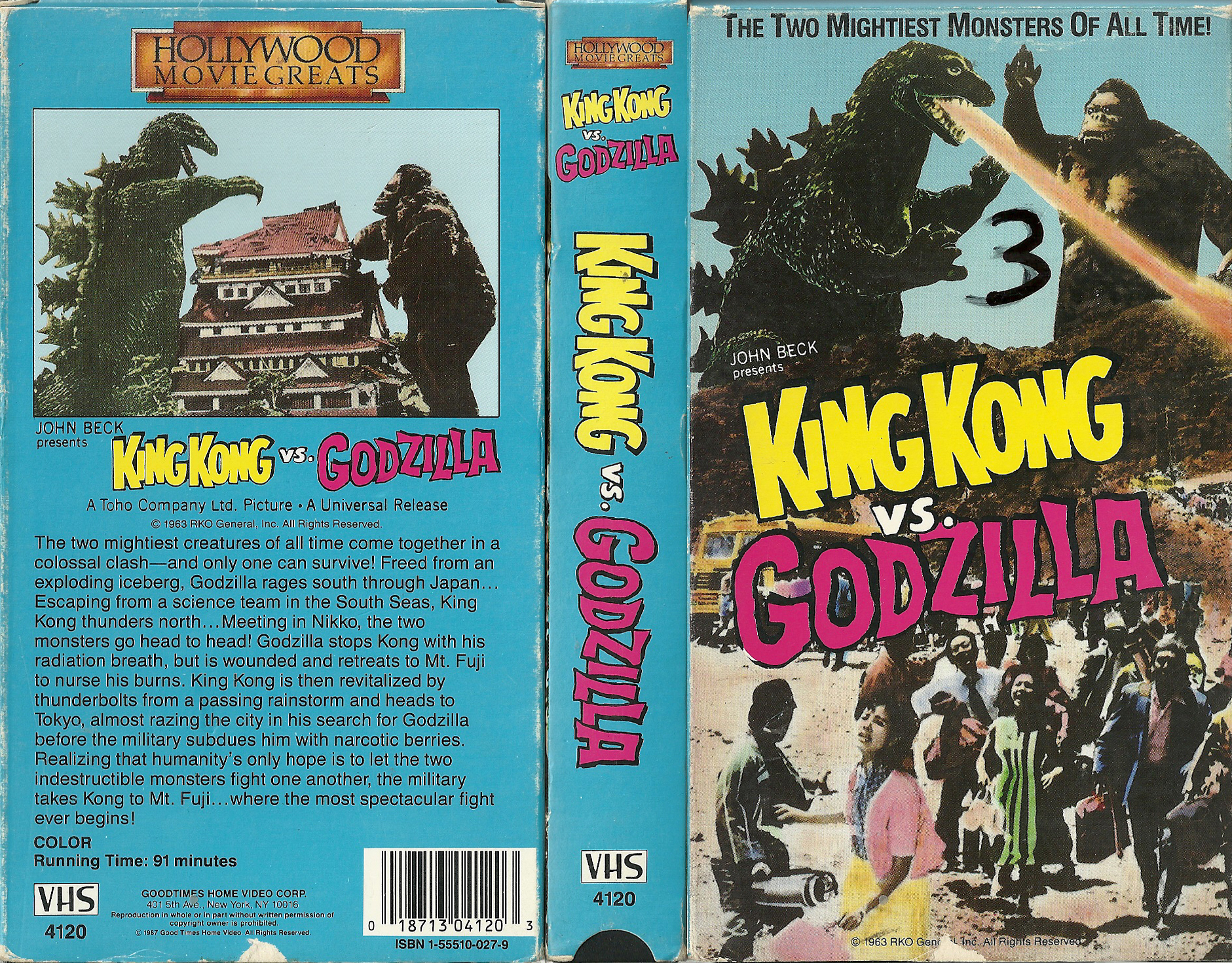
The film does have quite a few distinctions to its name. It was the first time that either Godzilla or King Kong were shot widescreen (the film was done in scope 2.35:1 ratio) and in color. Additionally, the film remains the most-attended Godzilla film of all-time, with over 12 million admissions in Japan. My first experience watching it came from the old Goodtimes VHS, a tape that I still own because I think it's important to retain some Luddite qualities so you can appreciate what once was every now and then. 


Despite the constantly-told apocryphal tale, there are NOT two endings for the film. A popular rumor started by Spacemen magazine in the '60s claimed that if you saw the film in Japan, Godzilla would win; but viewing it in American would yield a victory for Kong. Not so. In both versions Kong is the winner, although, really, it's pretty ambiguous. It's a satisfying ending for fans of both monsters because neither can claim true victory - they both end the film alive and slightly bruised. King Kong was much more popular internationally than Godzilla at this time, so it was always intended for him to win the bout. This film did get Toho to thinking that pitting there was something to this pitting-Godzilla-against-monsters thing, which ultimately led to the series continuing on as he faced a roster of current and new Toho creations.


Saturday, July 20, 2013

GODZILLA-THON #1 - Gojira (1954)

Godzilla fever has been running high thanks to Gareth Edwards' upcoming 2014 reboot invading Comic Con this weekend, so it seemed like as good a time as any to re-watch all of Toho's 28 entries in the historic franchise.


For a bit of backstory, I'm essentially the definition of a dyed-in-the-wool Godzilla fan. As far back as I can remember, I've been fascinated with big monster movies, or daikaiju for the initiated. I've got the worn-out VHS tapes to prove it. I would curate my own movie marathons, piling up my store bought (and bootlegged) Big G tapes to ready myself for an entire day of nerding the fuck out. All at the age of 6. Few things made me happier than watching man-in-suit movies until my eyelids gave out and I was carried off to bed. I owned every single film Toho had released up to that point - this would've been around 1987/88 - which explains why my favorite G films come from the earlier Showa era of the series. In fact, aside from Godzilla 1985 I didn't see any Heisei era films until the mid-to-late '90s. This is partly due to Toho doing a shitty job of giving them proper VHS released in America... and partly due to my entering high school and maintaining a social life.

But I digress. The point I'm getting at here is that despite all of my constant Godzilla-thons, I never watched the original film much. I watched it plenty to know it well enough. The black & white presentation never bothered me as a kid. I gravitated towards the more monster-heavy entries in the series, like 1974's Godzilla vs. Mechagodzilla. Plus, let's face it - Toho might've done a commendable job on the suit itself but that puppet used for close-up shots hardly looked menacing. And this was also the American-edited 1956 version, called Godzilla, King of the Monsters, which eschewed virtually all of the somber mood and nuclear subtext of the Japanese version in order to give Perry Mason, er, Raymond Burr screen time as our man on the ground, journalist Steve Martin. Clearly, this was before the time of the Steve Martin, but the name confusion did turn up when the character was reprised for Godzilla 1985. There, they just called him "Steve" or "Mr. Martin", never a combination of the two. It isn't a bad film - especially to the non-critical mind of a kid - but since the original version was lovingly restored around 2004 people seem to deride it more than usual.

Back to the marathon. Criterion put out a sexy new edition of Gojira (1954) on Blu-ray. This edition fully blows the Classic Media Blu-ray release out of the water, with an improved picture (CM's release was 1080i), better audio, and a minor wealth of bonus material. Now, it should be noted that they didn't license any of the features found on the 2-disc DVD Classic Media released, so fans who own that edition would be wise to hang on to it. But if all you're concerned with is the a/v presentation, look no further than Criterion.


The film itself is clearly superior to the heavily-edited American version. As I stated earlier, the tone is much more serious and somber. Godzilla is an obvious allegory for the undersea nuclear testing being done around that time (and even more obviously, the bombing of Hiroshima and Nagasaki). He is presented as a force of nature, an unstoppable beast who only leaves the sea when his food source has been depleted due to deep-sea explosions. As gripping as the monster footage is, the story is compelling and humanistic. Professor Yamane (Takashi Shimura) desperately wants to study the beast, hoping that through science we can learn how Godzilla is impervious to atomic testing and conventional weaponry. But the military just wants to kill it, a task they continually fail at completing. They have to enlist the aid of Dr. Serizawa (Akihiko Hirata), a scientist who has developed a device - the Oxygen Destroyer - that can essentially liquefy oxygen, killing whatever is in its wake. He's reluctant to offer his aid, however, since he knows that as soon as his experiment is revealed men will want to harbor it for nefarious purposes. The pathos bleeds off the screen, elevating what could have easily been a simple monster-runs-amok film into something emotional and poignant.

"Chicks dig the patch, right?"

Much - if not all - of the film's success is thanks to the triumvirate of technical innovation: director Inoshiro Honda, producer Tomoyuki Tanaka, and special effects supervisor Eiji Tsuburaya. Without delving too deeply into history that can be found elsewhere, it was Tanaka's idea to film the movie. The script went through many changes, as did the final design for Godzilla, which at one point was to be a monster with a mushroom cloud-shaped head (!). Finally, on their third attempt to create a useable sculpture, did Tsuburaya & Tanaka settle on the now-classic look. They still needed to put a man in that 200-lb. rubber suit, though. Enter Haruo Nakajima, who wore the bulky behemoth under stage lights with temperatures inside reaching 130 degrees Fahrenheit. He reportedly had a cup of sweat drained from the suit daily. The stiff rubber forced a more reptilian - and, thus, less human - style of movement because Nakajima was so restricted. Rumor has it the suit could stand on its own once he was out! Sounds like grueling work, but he took it all in stride without complaining. Nakajima did almost all of the suit work during the Showa era.

"Godzilla - did the Oxygen Destroyer really kill him... or was it cancer?"

It's been said that a good score can dramatically help any movie, and the impressive orchestration of Akira Ifukube certainly does just that. This is the man who composed a large majority of Godzilla's most memorable themes. This score reciprocates the somber tone meant for the film, making it unique among his work on other Godzilla films since the mood never reached the emotional depths of this first picture. Ifukube would go on to score for Godzilla the rest of his career, finally stepping down after handling duties on Godzilla vs. Destroyer in 1995. Let's not forget he also gave the Big G his trademark roar, something achieved by rubbing a resin-coated glove over a contrabass string. Simple, effective, incredibly memorable.  

I liken this inaugural Godzilla film to Rocky (1976) - hang on a sec, lemme finish - in that this was the launch pad used to gauge reaction and then plot ahead. Everyone seems to forget that Rocky loses in the first film, much like the Big G loses (even worse, really... he dies) here. But as Prof. Yamane said in the film, perhaps there are more of Godzilla's species out there, waiting to be woken up from continued testing.

Lucky for us, he was right.