Showing posts with label mothra. Show all posts

Tuesday, February 25, 2014

GODZILLA-THON #25 - Godzilla, Mothra and King Ghidorah: Giant Monsters All-Out Attack (2001)


First off, kudos to the Millennium series for finally nailing a poster. The art for the last two entries was about as bland as the series had ever gotten, so seeing a return to form automatically gives me additional hope.

The easiest way to forget how...well, forgettable the last two Godzilla movies were is simple: watch Godzilla, Mothra and King Ghidorah: Giant Monsters All-Out Attack. The Japanese clearly hate brevity as much as Godzilla hates making a quiet entrance, so from here on out it'll be referred to as GMK. Once again, the Millennium series is rewriting history, bestowing upon G yet another new origin story to go along with his new look and the new looks of his co-starring monsters. Writer & director Shusuke Kaneko came to the series as a veteran of Godzilla's "competition", the titanic terrapin, Gamera. Kaneko helmed all three of the Heisei era Gamera films for Daiei Films. If I haven't mentioned it before, I'll say it again but I have only seen, like, one Gamera movie that I can kinda recall. I did watch a few of them as a kid, but very little of those viewings stuck with me. As a kaiju fan I sort of feel like it's my duty to remedy that, so at some point I'll be buying all of Shout!'s DVD releases and more than likely reviewing them here. My point in all of that was to say I don't know what type of sensibility Kaneko brought with him to the series. Maybe Gamera is steeped in all of this ancient mythology and ritual that pervades GMK.

In this universe, Godzilla appeared once in 1954 and died as the result of the Oxygen Destroyer. When a monster the Americans mistakenly think is Godzilla attacks New York City (one of the best lines in the series for obvious reasons), the Japanese Self-Defense Forces (JSDF) meets to discuss the possible return of the real Godzilla. A nuclear submarine goes missing shortly thereafter, and a glimpsed Godzilla is the culprit. Meanwhile, a truck driver who survived a recent earthquake claims to have seen Godzilla as the monster responsible, but it was really Baragon. And some kids who were partying at a lake are nearly killed by larva Mothra making landfall. An old man who appears wise on these matters determines that Godzilla is the physical embodiment of the soldiers killed during the Battle of the Pacific in World War II; their souls lashed to Godzilla's skeletal remains making him whole once more. The only way to defeat him is by summoning the Guardian Monsters - Baragon, Mothra, and King Ghidorah. We already know Baragon is ready for action since he was the first monster spotted, and judging by his lack of a credit in the film's lengthy title it's safe to assume he won't be winning the battle. But, man, does Godzilla ever stomp a mudhole in his ass before decimating his corpse with a blast of atomic fire. The military sends whatever they can at Godzilla. Nothing has any effect whatsoever, except maybe pissing him off more. Mothra, newly hatched from her cocoon, finally gets in on the action along with a fresh-off-ice King Ghidorah. The pair battle it out with Godzilla in the city, losing quite spectacularly. In fact, Ghidorah gets beaten so badly that Mothra has to sacrifice her life in order for it to absorb her energy and be revived. This leads to a massive melee between the now fully-grown King Ghidorah against Godzilla, once again ending in Ghidorah being destroyed. With all the guardians defeated, the only person left to face Godzilla is the JSDF captain who's commandeering a submarine with missiles capable of blasting a gaping hole in Godzilla... which one does, and when G goes to fire off his atomic breath - POOF - he vaporizes instantly. But that big heart of his keeps on beating, deep in the ocean depths.

This film drew a lot of controversy amongst fans due to Godzilla's portrayal, which is wholly different than any iteration that had preceded or followed. He's looks like a pissed off demon, more or less; brought to life by the dead. To emphasize this, director Shusuke Kaneko had his eyes made up with no pupils, giving Godzilla a blank, horrific visage. That wasn't nearly the only change to his look, though. The Millennium Goji design was entirely scrapped. Godzilla had a modern, stylized appearance that retained his essential features. The black-and-bone dorsal spines were back, looking more like his classic spines and less like the aggro design used for the last two films. His color was back to charcoal black; no more green. The suit itself, dubbed the SokogekiGoji, was intended to be a modern interpretation of the classic '54 design with cues taken from the Heisei series suits, too. I think Kaneko really nailed the appearance, making this the most ferocious, menacing Godzilla seen in the series, period. He's an evil beast, practically indestructible and able to outmatch and outwit any foe with relative ease. The movements of Godzilla are much more aggressive than usual, especially his quick stride which leaves a wake of devastation due to his hefty, thick legs.

Some fans also had concerns with Kaneko's reinterpretation of Godzilla's classic foes Mothra, King Ghidorah, and Baragon. In order of ire, Baragon got a nice contemporary facelift to his design, but fans rightly complained about a lack of any heat ray powers. The only power Baragon does have is his ability to burrow, which isn't too helpful against a hyper-aggressive Godzilla. Mothra has a more angular design, with more pointed wings and elongated legs. Her coloration is also more vivid than ever before, with a kaleidoscope of color under the wings. Her super power this time around is the ability to fire these tiny pellets that apparently have the effect of knocking Godzilla right the fuck out. Finally, we get to King Ghidorah, who underwent more changes than either of the other two. He's smaller. He's not very powerful. He gets his ass handed to him three times. Ghidorah's heads have been updated, but it's not for the better. This new design doesn't elicit the same sense of sheer terror the Ghidorah of old could muster up; this guy just looks like Godzilla could wipe the floor with him. And he does. Once Ghidorah is revived for the second time, he comes back as a fully-grown 1,000 Year-Old Dragon... not that it does much good against Godzilla.

Again, I really didn't have a problem with any of these changes. We're on the TWENTY FIFTH movie in the series; a little shake up of the status quo is a good thing. It certainly helped this entry stand out as one of the most original and inventive of the series. It shows more ambition than most entries can claim, too.

On the topic of ambition, did you know Kaneko originally wanted the three guardian monsters to be Varan, Anguirus, and Baragon. As usual, Toho wasn't seeing enough dollar signs with any of these choices so they insisted Kaneko bring some of the top draws into the fold. Baragon managed to survive the extermination; I wish they'd gone with Anguirus instead. He hadn't been seen in a film since Godzilla vs. Mechagodzilla (1974) - almost 30 years ago. Also, I just got a little sad realizing we never got a Heisei incarnation of him. I would have loved to see him be re-imagined for a more modern series. Speaking of long absences, Varan's last appearance was in 1968's Destroy All Monsters! But, yea, sure, let's just keep on using the same monsters we always fall back on, right Toho?

The film's score was composed by Kow Otani, another noob to the series. His work is easily the best of the Millennium series. There's a mystical quality to the compositions, adding to the rich mythology laid out on screen. It's downright ethereal at times. Electronic beats underscore much of the tension, elevating the action on screen without becoming too techno or robotic. Otani achieves a nice balance by adding in orchestral pieces over his beats, allowing the score to encompass both contemporary and classical cues.

GMK is a solid G film, no question. Godzilla is his perhaps the most menacing he's ever been, raining down fire and death everywhere he turns. More than that, his overall design is just a thing of beauty in an evil, twisted kind of way. The inclusion of multiple monsters puts the film over the top by allowing fans to see numerous battles throughout the course of the film. Godzilla fights each monster at least a couple of times, all of which are done with stellar choreography and realism thanks to modern suit technology.

I'd always considered GMK to be the only star of the Millennium series, but a recent re-evaluation of all these films has proven to me that I was wrong, because the follow-up to this film produced a wonderful one-two punch that, frankly, should have ended the Millennium series as a whole. But then they had to go and make Godzilla: Final Wars, which I have always loathed. I am actually quite anxious to watch it again, however, before that can happen we've got two rounds to go with Mechagodzilla!

Tuesday, January 28, 2014

GODZILLA-THON #19 - Godzilla vs. Mothra (1992)


Quickly moving on after Godzilla vs. King Ghidorah proved to be a box office hit, production ramped up for Godzilla's next battle - his 19th film - this time against another popular adversary: Mothra. Toho didn't want to try introducing new monsters to the series without having some old favorites to headline the cast. So, with Mothra firmly set as the film's co-star, Toho decided to add in a kaiju that had been on the drawing board for a couple years - Battra, the evil version of Mothra. It's described as "black Mothra" in the film, though its appearance is certainly more grotesque than that of Mothra. In addition to bringing back both the larva and fully-formed versions of Mothra (which hadn't been seen 1966's Godzilla vs. The Sea Monster), the film also includes the mini twin princesses, known as the Cosmos here. With all of the essential elements in place, Toho delivered one of the series' most successful films ever, becoming the highest-grossing entry (unadjusted for inflation) and coming in second at the Japanese box office to Jurassic Park.

This is the first film of the series that I have no memories of whatsoever. Although I hadn't seen the previous entry, Godzilla vs. King Ghidorah, until many years after its release (it didn't get a U.S. VHS release until 1998), the books and pictures I saw of that production made me feel like I knew it. This film was the first one to have no childhood link, no memories of a building excitement to finally see the film proper. But it's easy to understand why this was such a hugely successful film for the series. The story itself is admittedly one of the least-engaging of the series, coming across like a half-cocked comedy with flourishes of an Indiana Jones picture. It's really the battles that make this film, with all three kaiju featured prominently, with numerous battles taking place throughout, culminating in a spectacular showdown at a giant Ferris wheel.

The opening of the film is ripped straight from Raiders of the Lost Ark (1981), with an archaeological excavator, Takuya, dashing through an ancient temple after stealing a prized artifact. He's arrested, but offered the chance to be set free if he goes with a group to investigate an island where ruins have been found. He reluctantly agrees. When the group arrives, they find a massive egg and a hidden cave, where they come upon the Cosmos, two diminutive girls who are the protectors of Earth. They are informed that the egg belongs to Mothra, an ancient deity that fought against Battra, the "black" version of Mothra, when mankind tried to control Earth too much. A recent meteor strike has reawakened Godzilla, and the Cosmos fear it has also stirred Battra from its slumber. The egg is taken from the island via a massive platform towed in the ocean, but en route to Japan the ship is intercepted by both Godzilla and Battra. A battle ensues once the Mothra larva hatches, with both Godzilla and Battra getting in some big hits before Mothra retreats when the two titans decide to take on each other. At the ocean's floor, a large fissure opens up and swallows Godzilla and Battra in mid-battle.

Once back on the mainland, the Cosmos are kidnapped by corrupt members of the Diet of Japan. Mothra enters the city to rescue them, but instead finds a waiting army that launches a full-scale assault. Wounded, but not dying, Mothra makes her way to the Diet building and uses her webbing to form a cocoon. While Mothra metamorphoses, Godzilla reemerges from Mt. Fuji, while Battra returns from the sea, now in a final winged form. Mothra hatches in time to battle Battra, a battle she is losing before Godzilla shows up to get it back on with Battra. Unfortunately for Battra, it quickly loses the fight against Big G, but before a death blow can be dealt Mothra gets back into the melee and uses her "special powers" (in quotes because who the hell knows exactly what it is she's doing) to temporarily disable Godzilla. While he's down, she confers with Battra and forges an alliance, both of them seeing Godzilla as the bigger threat. The final battle sees the newly-formed tag team taking on Godzilla at the amusement part grounds, eventually knocking him down and carrying him off before Godzilla bites Battra and blasts it with his atomic breath, mortally wounding it. Mothra drops them both into the sea and heads off into space to stop some meteor that Battra was supposed to handle, but, you know, now it's dead and all...The end.

I found this to be the first entry in the series where I really felt no investment in the storyline. The faux Indiana Jones opening was bad enough, but there are so many moments of bad dialogue and forced humor peppered throughout that it's really hard to find much to like on the human side of things. It comes down to greedy businessmen and corrupt politicians, something that, coincidentally enough, the first Godzilla vs. Mothra (1964) deal with. But that picture had the benefit of '60s charm and sensibility, whereas this has nothing all that enticing.

This was the third time that Megumi Odaka returned as Miki Saegusa, the chick with ESP who seems to have the hots for Godzilla. Seriously, check out how she reacts to him during her run on the series. When she first appeared in Godzilla vs. Biollante (1989), there was something for her to do: trying to get inside Godzilla's mind. When that proved far too difficult (he made her pass out from his will), she came back in Godzilla vs. King Ghidorah (1991) in a diminished role, essentially serving as mental liaison to Godzilla. She knows when he's arriving before anyone else. Here, she mainly helps out in finding the Cosmos and making some minor predictions about Godzilla's movements. I was never terribly fond of her character, seeing little value in someone mentally communicating with Godzilla, but over the course of her character's arc she did kinda grow on me. The series continued to keep familiar faces around during the Heisei era, too, but Miki is the only character to be featured in more than two Godzilla movies. Saegusa has said she'd love to return to the series decades later, as Akira Takarada has, and I say I'd welcome seeing her pop up in a new Toho production twenty years from now. Assuming they're still around and making Godzilla movies then...

Where this picture largely succeeds is in the monster battles. Some films in this series shy away from showing Godzilla until nearly an hour has passed, while others show him early and often. This movie employs more of the latter's formula, with Godzilla glimpsed early on when the huge meteor hits Earth. Fro that point onward, we get a number of battles between all of the principal monsters. I really loved Godzilla's underwater battler with Battra. Cinematographer Masahiro Kishimoto got some amazing wide angle shots that show off the beautiful environment created for these two to do battle. And his work during the climactic battle at the amusement park is, again, replete with outstanding camera work. Once the three-way melee starts going, it rarely lets up for anything else to be shown. And Battra is a formidable opponent for both Mothra and Godzilla, too. The choreography and impressive suit actor work more than make up for any lackluster moments with the human cast.

Godzilla got a minor facelift once again. This new suit ,the BatoGoji, featured changes like golden-hued eyes, pronounced ribbing on the neck, a slightly smaller head, and a minor rearrangement of the dorsal plates. The look is very much in line with Koichi Kawakita's overall design for the Godzilla of the '90s, and I like that he went back and made small, but noticeable, changes for each subsequent film. Honestly, it wouldn't feel like a Godzilla movie if something wasn't changed a little between each entry.

Akira Ifukube returned once again to provide the film's score. I wasn't terribly impressed with his work here, as it features a re-working of some classic themes alongside new compositions that, frankly, aren't nearly as memorable. It's a shame because I really dug what he did for the Godzilla vs. King Ghidorah score. It's not bad by any means. Think of it like Ennio Morricone's oeuvre - he's never done an outright bad score (although, admittedly I haven't heard all 200+ he's done), and even his most "lazy" work is exemplary. But because Ifukube set his own bar so high, it's telling if he doesn't quite reach it. I will give him credit for Mothra's themes here, which are these haunting, ethereal interpretations of her classic melody. They're utterly beautiful.

On a more pressing note: this film is another candidate badly in need of a new Blu-ray release. The current DVD, from Sony/Columbia, is a full frame motherfucker with a shitty 2.0 English dub track (good god!). It is deplorable in every sense of the word. I was fortunate enough to find a decent widescreen DVD bootleg, which appears to have been sourced from the Japanese release. With Godzilla's 60th birthday upon us this very year, I'd say it's high time we get every goddamn movie in stunning HD.

Saturday, January 11, 2014

GODZILLA-THON #9 - Destroy All Monsters (1968)


The dream team is back, baby! After the diminishing returns Godzilla had been facing for the past couple of years, producer Tomoyuki Tanaka decided to bring back director Ishiro Honda and composer Akira Ifukube for what was intended to be the Big G's last hurrah. The big question was, though: if we're going to do one last film, who does Godzilla face? Gary Oldman from The Professional knows - EVERYONE! Toho threw down the gauntlet here, bringing back many fan favorites, many of which hadn't ever been in a film with Godzilla before. Not only was this just about the coolest idea Toho had ever come up with outside of creating Godzilla, but the inclusion of monsters created for other properties gave fans even more incredible work to marvel at watching. Think of it as The Avengers (2012) of monster movies. The plot would once again involve mind control as executed by an evil alien race, this time all women (!), but the real meat here, the real reason why everyone is tuning in, is for that glorious monster action. And, brother, believe me when I say this pull out all the stops to deliver one helluva time!

Don't ever ask how, but in the year 1999, mankind has managed to wrangle all of the planet's monsters into one location - Monster Island (called Monsterland here). Godzilla, Minya, Anguirus, Gorosaurus, Rodan, Mothra, Kumonga, Manda, Varan, and Baragon. All living on an island that looks like it would be small for any one of them, where we're told food is plentiful and they all get along. Sounds like a bullshit PR piece SeaWorld would've put together. But it's working. At least, it is until communications with the island are lost and the monsters escape to begin attacking world capitals. We soon figure out the Kilaaks are the ones behind it, an alien race composed of all females (and they procreate how?) who wear glittery silver spandex hoodies. The have the monsters under the control of a mind-altering signal, one that is emanating from a location on the moon. Hey, we have a base there now! Capt. Yamabe (Akira Kubo) goes up with a team of his best men to stop the aliens by destroying the signal. It works, but the Kilaaks unleash their most powerful weapon as a last-ditch effort: King Ghidorah. The monsters of the Earth must unite to fight their common enemy, all while humanity fights against the alien invasion.

Alien mind control is used a lot in these films. It's a good way to allow Godzilla, our supposed hero by this point, to cause worldwide destruction without actually looking like the bad guy. His mind was under control, after all. And when he does get his head clear, you can always tell he feels really bad about what he did. This was, however, the first entry to have the aliens use a human appearance as their cloaking device, revealing a more hideous, sci-fi origin when their true selves are exposed. In this case, the Kilaaks are extremely sensitive to cold, so when the temperature drops considerably in their environment they revert back to looking like silver slugs that live in rocks. It's funny later on when the military learns of this, and the commander can only help but grin and say something about how friggin' easy an attack this is going to be now.

We know the returning faces - Godzilla, Minya, Anguirus, Rodan, Mothra, Kumonga - so who are the new guys? Gorosaurus was featured in King Kong Escapes (1967), where he fought Kong. Manda was a chief opponent as an undersea dragon in Atragon (1963). Varan appeared in his own film, produced in 1957. And, finally, Baragon was best known as the opponent to the title star in Frankenstein vs. Baragon (1965). Of all these, only Gorosaurus gets an appreciable amount of screen time, teaming up with Godzilla at the climax to help finish off King Ghidorah. Varan gets little more than two shots during the entire film. This was due to the suit being in such a state of disrepair since the filming of that feature over a decade prior. Baragon was being used on the Ultraman TV series (monsters were often redressed for other programs, Godzilla included), so his appearance was extremely limited here. In fact, the script called for Baragon, not Gorosaurus, to destroy Paris. But in typical Toho fashion, even though the monster change had to be made the script change wasn't, leaving Gorosaurus with not only Baragon's ability to burrow underground, but also his roar and in some cases even his name, since the media refers to him in the film as Baragon.

There were to be two more monsters added to the fray - Maguma (from 1962's Gorath) and Ebirah, last seen fighting Godzilla in Godzilla vs. The Sea Monster, but budgetary concerns caused both to be scrapped from the production. Also of note, there was a brief scene filmed where Godzilla fights with Manda, which makes no sense in the context of the film since both are under the same mind control. The footage is said to be shown at conventions from time to time, though it has yet to show up on any official release. 

Despite their being an abundance of kaiju, everyone gets a good amount of screen time with the exception of the two previously mentioned monsters. After the introduction at Monster Island, the film does an adept job of cutting back and forth between human/alien drama and monsters causing a melee across the globe. Some of the sets aren't as distinct as others (Godzilla destroys a seaboard that looks nothing like NYC), but for the most part it looks pretty rad to see Gorosaurus demolish the Arch de Triumph, or to see Rodan flattening Moscow. I can vividly recall seeing the extended trailer for this film on my VHS of Grandpa's Sci-Fi Hits, which was hosted by Al "Grandpa Munster" Lewis. The promise of an international incident as carried out by all my favorite monsters looked astoundingly epic to my young brain. Even now, all these hardened cinematic years later, I can say it's an ambitious entry that really put a lot into the story.

Interestingly, director Gareth Edwards, who is helming the upcoming 2014 reboot Godzilla, has expressed a desire to make a sequel to his film something akin to this film. I really do applaud his ambition, but I hope they set that universe up further with a second film before throwing too many names into the mix. Plus, I don't see that being a successful idea unless Toho grants the rights to use other monsters. Right now, Legendary can only use Godzilla.

A final film is never a final film when a series is successful. Even though producer Tomoyuki Tanaka declared this would be Godzilla's final feature film, the success it enjoyed meant another movie was in the works, this one coming out just a year later. Only to call it a new film is almost disingenuous considering almost all of the fights are culled from stock footage. And that's not even to mention the undeniably child-centric tone and core message about bullying and standing up and... oh, Christ, is there anything good to be said about Godzilla's Revenge? 


Wednesday, January 8, 2014

GODZILLA-THON #7 - Godzilla vs. The Sea Monster (1966)


   Another year, another Godzilla picture back on the big screen. Toho had been steadily churning out Godzilla adventures at a rate of one per year since 1962’s King Kong vs. Godzilla. This time around, though, the series had lost two of its core players. Director Ishiro Honda bowed out, handing directorial duties over to Jun Fukuda, who would go on to helm five films total in the series. Special effects supervisor Eiji Tsuburaya had other commitments that largely kept him off the set for this entry, leaving his duties up to Sadamasa Arikawa. Those changes aren't the major reason why Godzilla vs. The Sea Monster (1966) – or Ebirah, Horror of the Deep if you prefer - is viewed as the first (arguably) weaker film in the Showa series. Nope, the reason it's such a quizzical Godzilla film is because he was never supposed to be the star. The script was originally meant for King Kong – and was to be titled Operation Robinson Crusoe: King Kong vs. Ebirah - which would explain the more curious elements present in this picture. The real question here should be why Toho didn’t just order some rewrites so the film at least paid respect to Godzilla's legacy up to that point, though anyone familiar with Toho’s business practices shouldn’t be too surprised. We get all the familiar trappings of a Kong picture - island setting, natives, prehistoric opponents, female objects of affection, lightning rejuvenation. Oddities aside, the greatest strength of Godzilla vs. The Sea Monster isn’t the eponymous star’s presence; it’s the eclectic cast and their perilous journey to find a sibling lost at sea. Their island excursion plays out like Japanese James Bond, complete with a hidden enemy base, alluring native women, espionage, and a big, bold, brassy score. Complaints about Godzilla’s many sequels lacking a strong human element aren’t entirely unfounded, but this is one entry where the human characters are just as engaging as the Big Guy himself.

When Ryota's (Toru Watanabe) brother goes missing off the coast of some remote island hundreds of miles from mainland Japan, he does the sensible thing by breaking into a cat burglar's yacht with his friends, knocking the guy out, and sailing off in hopes of finding his lost sibling. They run aground on Devil’s Island and come across a militant group, Red Bamboo, which has taken over the place. Natives from nearby Infant Island (home of Mothra) are used for slave labor to produce a yellow fluid that keeps Ebirah, a giant sea shrimp (not a crab or lobster), at bay. Naturally, Ryota's brother, Yata Toru Ibuki), is there toiling away, so he and the boys break him loose. Red Bamboo sends a squadron of their troops after the men, who quickly surmise the best way to combat the troops is to wake up Godzilla, who they found nestled peacefully inside a cave. How did he even get in there? They rig up some wires to a sword, wait for a (convenient) lightning storm and soon a jolt of juice wakes the Big G from his slumber. Godzilla, likely with sleep still in his eyes, jumps right into battle with Ebirah, playing a game of volleyball using a massive rock. Maybe he was too tired for anything but stationary action? Eventually he hops into the sea and dukes it out, but Ebirah scuttles away and escapes.

Godzilla then just kind of hangs around, looking bored until he notices Dayo (Kumi Mizuno) and becomes smitten. His newfound love is interrupted when possibly his greatest cinematic foe shows up to tango: a giant condor. A giant condor he makes short work of in about a minute and change. Red Bamboo tries sending in some fighter jets, all of which meet the same fate as big bird. Sensing they’re about to lose their island stronghold, Red Bamboo’s leaders initiate a self-destruct sequence and hit the high seas… before being literally hit by a recharged Ebirah. The supersized shrimp is ready for another go-round with Godzilla, something it quickly regrets when G rips off his claws and kicks his ass down to the depths. Meanwhile, Ryota and the group manage to escape the island thanks to a surprise visit from Mothra, but the island is about to blow and everyone is worried Godzilla won’t get away in time. So, naturally, the men call out to Godzilla and warn him to leave the island. They're warning Godzilla. About an explosion. And he heeds it. Wasn't he, you know, born in fire and all that? Shouldn't matter. Maybe he just wanted to be polite and follow their advice. He is our friend now, after all.

If there’s a weak aspect here, it’s the fact that Godzilla doesn't show up until there are around 33 minutes left in the film. Prior to that, the only time we see him is when the guys stumble upon him sleeping in a tight cave. Luckily, the hour we spend Godzilla-less is a campy, kitschy romp through the jungle with a gang of colorful characters. Fukuda’s direction shows a heavy influence from James Bond films, but it never feels like a poor derivative. It’s fun and full of energy. Fukuda also wisely ties in this film with themes prevalent in the 1954 original, Gojira, by reintroducing talk of nuclear weapons. Red Bamboo uses their island hideaway as a facility for making nukes, and while the commentary on nuclear weapons isn’t heavy-handed it’s nice to have it included as a plot element. Everyone is aware Godzilla’s origin was nuclear, but few films in the series have directly addressed the impact producing those weapons can have on the planet.

The Godzilla suit used here, dubbed NankaiGoji, is reportedly the exact same one used for Invasion of Astro-Monster (1965). I say "reportedly" because the mouth looks like it's hanging open nearly the entire film, as though some damage had occurred to it and no one bothered to fix it. Toho was never much for taking excellent care of these suits anyway. Eventually, the NankaiGoji would be used as the water stunt suit for the next three sequels. If you’ve ever wondered why Godzilla’s look seems to change during the course of a film, it’s because older suits were used when G had to get his feet wet. Toho didn’t want to risk ruining their hero suits. Ebirah doesn’t get much love despite being one of Godzilla’s earliest kaiju adversaries. I guess a giant shrimp isn’t quite as compelling as a three-headed dragon or a huge colorful moth. The fights between Godzilla and Ebirah are more humorous than threatening, especially since there are no cities or civilians to smash and crush, and Fukuda seems to be having fun making a game out of two behemoths clashing. One cool aspect to their battlers is that this is the first film since the original to show Godzilla underwater, and the first to show him fighting down there. Godzilla takes a while to hit the scene, but once he does it’s more or less 30 uninterrupted minutes of mayhem, all of which culminates in a final fight with Ebirah where Godzilla rips off both its claws and taunts Ebirah by snapping them open and closed. Again, right out of Kong’s playbook but it’s hilarious to see Godzilla be such a jerk.

Monday, January 6, 2014

GODZILLA-THON #5 - Ghidorah, The Three-Headed Monster (1964)


 What's this? Another Godzilla film in 1964? Yep. King Kong can't be the only monster to get two films in one year (King Kong and it's sequel Son of Kong hit in '33... and they were stop-motion!). Toho, seeing flashes of dollar signs after King Kong vs. Godzilla proved to be a huge international success, jumped right into production on another entry in the Godzilla series after he finished battling Mothra just a few months earlier. This entry, Ghidorah, the Three-Headed Monster, would be significant for a number of reasons, featuring many firsts not seen in a Big G picture up until now. Chief among those would be the introduction of Ghidorah (renamed "Ghidrah" for U.S. audiences because...?), the eponymous flying dragon that would go on to become Godzilla's most formidable foe. In fact, Ghidorah proved to be so popular as a villain that he (it?) even appeared in non-Godzilla properties, such as Rebirth of Mothra (1996) and one of its sequels. This was also the first entry to feature Godzilla taking on multiple monsters, as he winds up fighting Rodan, larva Mothra, and King Ghidorah, though eventually everyone just decides to gang up on Ghidorah and beat his ass back into space. The entry was the first time use a central plot focused on aliens infiltrating Earth for nefarious, nebulous purposes. Alien races would go on to be used in numerous sequels in the series, being employed frequently right up through Toho's (currently) final Godzilla film, Godzilla: Final Wars (2004). And, as a minor first that would be capitalized upon later, Godzilla is less the villain and more an anti-hero who begrudgingly helps the Earth by teaming up to defeat Ghidorah. From here on out, virtually every film in the series would have Godzilla in this role, with only a few exceptions. These firsts weren't just important because they introduced characters and themes that would recur throughout the series' history; they also were the reason why many fans consider this film one of the best Toho produced during the Showa period.

Although the canon of the series got progressively more muddled as time went on, the early entries maintained a timeline that tended to follow each sequel respectfully. At the end of the last picture, Godzilla, having just been the target of a Mothra larva bukkake fest, was vanquished to the sea. Here, that exactly where he rises from before scuttling with Rodan and destroying an ocean liner. The human element to the plot focuses on a Martian (or Venusian, depending on which cut you're watching) princess who is the target of an assassination plot by men wearing garish mid-century outfits. The princess publicly makes bold predictions, correcting prophesying that Rodan would rise from a crater neat Mt. Aso, and Godzilla would rise from the sea. Oh, and there's also a last-minute mention of a cosmic creature named King Ghidorah that decimated her people on Mars and now he's landed on Earth in the form of a meteoric egg getting ready to hatch, oh, right about now.

The story for most Godzilla sequels is practically latent, since the real reason everyone watches these is for the monster porn. There have been at least a dozen highly memorable allies and villains across G's long career, and this film puts together some of the top talent by including fan favorites Rodan (whose name is actually Radon, a contraction of pteranodon) and Mothra - both of which had solo outings years prior - along with King Ghidorah, a then-new kaiju that quickly rose up the ranks to be the fans' favorite adversary for all benevolent monsters. As usual, the action is sporadic until the film has around 15 minutes left, at which point it becomes a full-on kaiju slugfest with Godzilla, Rodan, and Mothra (in larva stage) teamed up to pummel Ghidorah. Shockingly, the only time Godzilla ever uses his atomic breath is during a skirmish with Rodan, never on Ghidorah. Instead, he just chucks a lot of rocks at him. Come to think of it, he does that to Rodan, too. And he did it to Mothra in the last film. The guy has atomic breath that can fuck everything in its path up... and he throws rocks. Still, there's really nothing more enjoyable (to me) than watching all these glorious Golden Age characters, brought to life by men in suits, duking it out.

As usual, changes were made to the existing Godzilla suit, dubbed Mosugoji by fans, though this time around they were relatively minor, leading to this new suit to be dubbed Mosugoji II. The head piece had become damaged during the last film, meaning effects supervisor Eiji Tsuburaya had to reinforce the mouth and rebuild the sculpt a bit. The result is on-par with Mothra vs. Godzilla in terms of quality, delivering one of the best looks G has ever enjoyed. As a point of trivia, there is one scene where the old suit is used: just as Godzilla makes his entrance from the depths of the ocean. Toho preferred to use older suits for any water or effects shots, when possible, so the old suit makes a quick (and literal) pop-up before being retired for the new one.

The version of this film I grew up watching as a kid was, unsurprisingly, the American edit. If you bought it on VHS back in the '80s, that was all you had available to watch. And do you think a 6-year-old kid knew, or cared, either way? Exactly. Plus, despite the fact that AIP butchered Akira Ifukube's score, removing nearly all of it from their version of the picture, they did a fair amount of judicious editing by removing some of the subplot material. Subplot meaning anything not featuring Godzilla. The resulting version runs around eight minutes shorter than Toho's cut, which, really, is the best version to watch. Also, I can't confirm it now but it sounds like they used a newer dub for the English cut, and not an old AIP dub track that at least holds some kitsch factor. New dubs sound like shit on these old films. Classic Media's DVD contains both versions of the film, and unsurprisingly the Japanese edit not only looks and sounds better, but you're getting the full picture to boot.

Ghidorah, the Three-Headed Monster went on to become one of the most lauded entries in the series, even garnering a few accolades from American critics, who are never an easy sell with these movies. Godzilla had begun his turn to defender of the Earth and... :shudder:... friend to children everywhere. Eiji Tsuburaya said he enjoyed making these pictures so kids could enjoy them, a philosophy producer Tomoyuki Tanaka also favored, so it was bound to happen eventually. Not that he ever got too cuddly or anything, Godzilla's Revenge aside. But before the series was to move on to other foes for the Big G to conquer, there was still one more bout with Ghidorah on the table...

Wednesday, July 31, 2013

GODZILLA-THON #4 - Mothra vs. Godzilla (1964)

No, unfortunately this film does not pit Godzilla against the malevolent shape-shifting alien beast that headlined John Carpenter's 1982 film. Rather, this was the first example of Toho digging through their monster roster and picking a worth opponent for Big G to rumble with in Japan. After the incredible success of pitting him against King Kong, Toho quickly went to work on penning a sequel. Intended to be given the lazy title of Continuation: King Kong vs. Godzilla, the project never made it past the early planning stages. Oddly enough, a super-sized version of Frankenstein's monster was once again submitted as a possible foe for Godzilla until Toho rejected that script (a script I'd love to read) and decided on Mothra, who had just headlined her own eponymous film in 1961. This is often considered to be one of the best films in the series period, as well as featuring one of the best Godzilla suits. I agree on both counts.

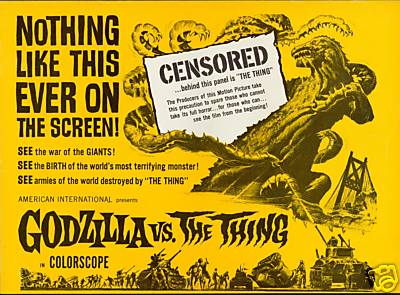
It's true, there is "nothing like [that] ever on the screen" because nothing in the movie has tentacles.

So, what's up with the vague, ambiguous title of Godzilla vs. The Thing? That title was only used for the American theatrical release, though, as all of the home video versions I can recall went by Godzilla vs. Mothra. To make it even more (slightly) confusing, the Japanese title is Mothra vs. Godzilla. I'm not exactly sure why Toho started putting their leading monster in the secondary title position. Godzilla doesn't even enjoy top billing until 1966's bout with Ebirah. I'm not complaining about this; it just seems a bit odd. But it could also be that the Japanese aren't as particular about this kind of thing like American film marketing. I've watched the Japanese version on Classic Media's outstanding DVD before, but having grown up on the English-dubbed version it's nearly impossible not to long for that version and that one only. The funny thing (no pun intended, really) is that I'd only ever seen it as Godzilla vs. Mothra, but this AIP print comes with the vs. The Thing title.


Amazingly, the American version hardly messes with the Japanese cut much. Usually, the American distributors will consider entire re-shoots around SPFX footage, or at the very least they'll trim the film down to the bare essentials to maximize monster time. Here, they not only leave the film almost totally intact, but they actually added a new scene of Godzilla being showered with missiles. The Frontier Missile sequence, featuring the American military taking control of the war against Godzilla, is full of great man-in-suit footage. Just as it sounds, it basically Godzilla stomping around while the military tries in vain to take him out. Of course, we know he ends up demolishing everything in his way because that's kinda his thing, but the fact that the U.S. got additional footage that the Japanese market didn't is pretty huge. This version was also released a scant 4 months after its Japanese debut, whereas all previous films had taken at least a year (or more) to be readied for stateside consumption.

The film's plotting doesn't deviate too far from the now-standard Godzilla formula. As per usual, G wakes up from hibernation - here he's buried underground and appears from beneath a quaking plot of land - and he just starts stomping Japan into the ground. Unlike in previous films, here he doesn't have any commute since his sleeping quarters were conveniently located in a coastal city. Just before Godzilla wakes, though, a giant egg had washed up on the beach. A massive egg capable of providing omelets for half the population. But this egg contains some special larva, the offspring of Mothra. You  know Mothra - giant moth, worshiped by native islanders and adored by two diminutive princesses who have a penchant for singing her praises constantly. My dad heard that song so many times when I was a kid that he can still sing it (albeit mockingly) to this day. Some businessmen try to buy the egg and set up an amusement park around it, completely ignoring the fact that it's an egg, which means it will either hatch something or rot away in the sun. Either way, not exactly a sound business model for generating revenue. It also doesn't help that one of the main dudes in charge looks like Hitler's long-lost Japanese brother.


With Godzilla on the move, and the fate of Mothra's egg in question, our fearless heroes/heroine - this time around it's a couple of journalists - call upon the tiny twins, known as Shobijin, to get Mothra to the mainland. Only problem is, Mothra has seen better days. She's an active senior looking forward to a few golden years before packing up her cocoon and jettisoning off the Moth Heaven. It's not meant to be, however, and soon Mothra is headed to Japan for a one-on-one showdown with Godzilla. And the Big G, being rightly pissed off for no apparent reason, promptly smacks her ass down. Oh noes! There goes any hope for saving Japan... unless a lot of tribal song and dance can get Mothra's egg to hatch! Of course, it does and out pop twins. I always liked Mothra's larva when I was younger. They seemed like such unlikely adversaries for Godzilla, but managed to hold their own impressively well considering they were literally just born and have virtually no defenses outside of tail biting and shooting silly string-like webbing from their mouths. 

A monster's humiliation, immortalized in plastic for all to see.

One area in which the film gets consistent props is for the suit design. This one, intended to be different from the Kingoji suit used against King Kong, was dubbed (appropriately enough) the Mosugoji. Godzilla's was given a less reptilian appearance, in addition to enjoying less bulk (battling a big ape must be a killer workout), a smaller snout, and an overall visage that is more menacing and "evil" versus the "big dinosaur" look he got last time around. Out of all the suits Godzilla films employed during the Showa era, I would have to agree that this one is among the best. Slight modifications were made for the next two subsequent films, after which Godzilla got some revamps that - quite honestly - made him look like a giant Sesame Street character. 
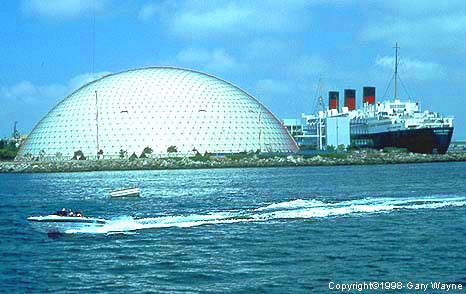
To end on a somewhat amusing anecdote, growing up in Southern California my father always used to point out the massive hangar which houses the Spruce Goose because it resembles Mothra's egg from far away. We lived about 50-ish miles from Long Beach, and on a clear day it looked just like that giant egg was sitting by the shore, waiting to hatch. All these years later I still think that every time I see it while driving.