I am a lover of cinema, first and foremost; but, my tastes tend to lurk deep in the cluttered, nightmarish celluloid basement where evil dwells. Ghoulish and macabre pictures have always held my interest above all else. I grew up on a steady diet of Godzilla, Friday the 13th and any & every VHS tape to be found under the "Horror" banner at local video stores. Updates may not come frequently, but I'll at least do my best to be sure they're worthwhile.
Showing posts with label atomic breath. Show all posts
Saturday, February 8, 2014
GODZILLA-THON #21 - Godzilla vs. SpaceGodzilla (1994)
After Toho decided not to kill off Godzilla for his "40th Anniversary" film, the series continued on to what was actually the Big G's 40th Anniversary film proper: Godzilla vs. SpaceGodzilla. Let the weirdness of that title soak in for a minute before realizing this isn't the series jumping the shark. In fact, high and lows all taken into account there hasn't been a single Godzilla film that truly jumped the shark. Godzilla eats the shark. SpaceGodzilla sounds like a horribly ridiculous idea, but then you think back to the sixth entry - Invasion of Astro-Monster - to be reminded that Godzilla (and Rodan) was taken literally into space to fight King Ghidorah on a barren, rocky planet with what is presumably a hostile atmosphere. Then, suddenly, this idea of a Space Godzilla doesn't sound so out there. Oddly enough, this was a concept that producer Tomoyuki Tanaka had been kicking around since the '70s! Though I haven't really touched upon it yet, most fans are probably aware that Godzilla has had lots of potential adventures drawn up in the conceptual stage of development, with many, many possible foes never leaving the drawing board. Some manage to get resurrected down the line, like Megalon. SpaceGodzilla is actually a pretty rad villain, with an imposing final form once he's out of Super Mega Crystal Mode. This entry also features a couple of returns - last year's Baby Godzilla is growing up so fast that he's now Little Godzilla; and the robot Moguera, who hadn't been glimpsed since 1957's The Mysterians makes a triumphant return looking a bit more contemporary.
Despite the roster of big hitters, the film itself is unusually disengaging for Godzilla. Some Godzilla cells make their way into space - either via Mothra after her battle with Godzilla in Godzilla vs. Mothra: Battle for Earth, or from Biollante, who is now presumably just floating around in the cosmos - finding their way to a black hole, where intense levels of radiation transform them into... SpaceGodzilla! Which, really, is just a giant wad of crystals with a little Godzilla somewhere near the center. It's an eye-catching look. Meanwhile on Earth, the Japanese Self Defense Forces (JSDF) are trying to attach a transmitter to Godzilla's head so that Miki Saegusa can control his mind. It fails, but soon after the JSDF learns from the Cosmos (remember those little twins princesses?) that SpaceGodzilla is approaching and only Godzilla can stop it now that Mothra is on a space adventure. When SpaceG lands on Birth Island, attracted to the radiation there, it begins to attack Little G. Big G shows up soon after, but SpaceG manages to knock him out before imprisoning Little G in a crystal cage thing. Godzilla reawakens and is unable to free his son, so he sets off for the mainland to fight SpaceG. He arrives to find that SpaceG is using a building from the Fukuoka Nuclear Plant (geez, never thought that name would be universally known, right?) to siphon energy. Godzilla and SpaceG have a massive battle, one that comes to include Moguera when the giant robot is sent to aid Big G. It helps G gain the upper hand, at which point he then blasts the ever-lovin' shit out of SpaceG with his fancy new Spiral Fire Ray, totally annihilating his black hole brother.
Let's talk about what this film gets right, because I honestly don't even feel like taking a lot of time to address the wrong. The design of SpaceG is very inventive, looking very much like an otherworldly version of Big G. Unlike Biollante, SpaceG is infused with many more direct elements of G's signature look, making him look like a true cosmic clone. His space-faring crystalline form is wholly outrageous, with these unnecessarily massive crystals somehow helping him fly through the universe. Once he lands and transforms, that's when we get a good look at his mobile form. Kawakita went with a menacing appearance, with these large shoulder crystals giving the creature a serious bulk to throw around. The face is very similar to Big G, but there are some extra deadly teeth surrounding the mouth. SpaceG also has some powerful special powers that make him quite the adversary. He's also got some psychic abilities, like being able to move Little G with only his mind-ray-thing, but it's not a power he overuses. The battles against Godzilla are fierce, and it really seems like things could end in a stalemate until Moguera comes along to give G the edge.
I've never been the biggest fan of Moguera because it's just a robot with no personality. It's like getting excited when the Super X-III debuts in the next film, Godzilla vs. Destoroyah. I like the monsters, not the mechs. Still, I will admit to always liking the Moguera design, which is a bit like the endoskeleton for a mechanized penguin or something. Robots have a history of going down hard in just about every Big G film, and while Moguera is no exception he definitely gets some good blows in there and makes a mark in the climactic fight. The fight against SpaceG in space is kinda cornball, even for this series, but the events at the film's end prove its inclusion in the film wasn't a total waste. Interestingly enough, it was originally supposed to be Mechagodzilla (whose remains were used to construct Moguera here) who teams up with Godzilla to fight and defeat SpaceGodzilla. Now that would have been an awesome showdown. Toho, apparently, felt that MechaG was too strong, so the fight would've seemed uneven. To that I say: writing. Write it so that everyone is evenly matched then! Geez, how hard would that have been? Well, actually, looking back at how Toho has notoriously ignored needed script rewrites and given incorrect abilities to other monsters, it's not a big surprise.
Baby Godzilla has grown up into an anime version of Minya, now called Little Godzilla. He is undeniably cute, but he'd probably be more at home in an anime series than a Godzilla film. He just looks too cutesy and his eyes are friggin' huge. Still, he isn't annoying and his peril at the hands of SpaceG gives Big G even more incentive to pound his celestial copy's body into the ground. Little G spends most of the film stuck in a crystal prison, so it's not like he's all over the movie, trying to ruin it with his adorable face and funny mannerisms. Unlike Minya, this is a baby that has an arc over the final three films of the Heisei series, growing and maturing under his father's watchful eye, paving the way for a major moment before the series' close.
You know the drill by now - new film, new suit. Even if it appears to look just like the old suit. Godzilla's new digs, dubbed MogeGoji, was a little bit bulkier than the previous suit, with wider shoulders and clear proof that Godzilla does not skip leg day at the gym. Gone was the pronounced ribbing on the neck, but the face remained virtually unchanged from before. One major change that suit actor Kenpachiro Satsuma surely must have loved was the new cooling system that finally allowed the person inside to feel slightly more comfortable.
That's the good. The bad is the film's plot, which is barely there and entirely uninteresting. Something about JSDF trying to once again control Godzilla via Miki's weak-ass brain waves. Why? Alien mind control I can accept, but humans have blown it practically every time. Just give it up. Even when it does work, it doesn't seem like Miki is actually controlling G's movements all that much. And, again, it's not an interesting storyline. The monster activity is frequent and fun to watch, but everything else in between lags. So far, most of the Heisei films have been punctuated by some stellar monster battles with a dearth of engaging plot lines. I've never felt as invested in any Heisei film as I did in any single Showa era production. Maybe that's because Showa ruled my childhood. The Heisei films are still a great deal of fun more often than not, but aside from Gojira (1984) none have really sucked me in with a solid premise.
Remember earlier how I mentioned that Akira Ifukube handled all of the Heisei scoring duties from Godzilla vs. King Ghidorah (1991) onward with one exception? Well, this film is that exception. Takayuki Hattori takes over scoring duties here, delivering the cheesiest, lamest, cringe-worthy score of the series yet. Not all of it is outright terrible, with some cues carrying a Masaru Satoh influence, though more often than not what we get is real Mickey Mouse kind of stuff. It sounds like the soundtrack to a cheesy fantasy videogame. The music never reaches the level fans have come to expect after hearing so much stellar work from Ifukube and Satoh. It simply exists alongside the picture, keeping the pace. Music should take on more of a life than it does here. I'm actually listening to the soundtrack now as I type this and it is just horribly lame in many places. In others, it's simply serviceable.
Godzilla's next film of the Heisei series would be his last. The time had come to die. Literally. Toho even used the tagline "Godzilla Dies" for the next entry, which is one of the best in the series - Godzilla vs. Destoroyah (1995).
Monday, January 6, 2014
GODZILLA-THON #5 - Ghidorah, The Three-Headed Monster (1964)
What's this? Another Godzilla film in 1964? Yep. King Kong can't be the only monster to get two films in one year (King Kong and it's sequel Son of Kong hit in '33... and they were stop-motion!). Toho, seeing flashes of dollar signs after King Kong vs. Godzilla proved to be a huge international success, jumped right into production on another entry in the Godzilla series after he finished battling Mothra just a few months earlier. This entry, Ghidorah, the Three-Headed Monster, would be significant for a number of reasons, featuring many firsts not seen in a Big G picture up until now. Chief among those would be the introduction of Ghidorah (renamed "Ghidrah" for U.S. audiences because...?), the eponymous flying dragon that would go on to become Godzilla's most formidable foe. In fact, Ghidorah proved to be so popular as a villain that he (it?) even appeared in non-Godzilla properties, such as Rebirth of Mothra (1996) and one of its sequels. This was also the first entry to feature Godzilla taking on multiple monsters, as he winds up fighting Rodan, larva Mothra, and King Ghidorah, though eventually everyone just decides to gang up on Ghidorah and beat his ass back into space. The entry was the first time use a central plot focused on aliens infiltrating Earth for nefarious, nebulous purposes. Alien races would go on to be used in numerous sequels in the series, being employed frequently right up through Toho's (currently) final Godzilla film, Godzilla: Final Wars (2004). And, as a minor first that would be capitalized upon later, Godzilla is less the villain and more an anti-hero who begrudgingly helps the Earth by teaming up to defeat Ghidorah. From here on out, virtually every film in the series would have Godzilla in this role, with only a few exceptions. These firsts weren't just important because they introduced characters and themes that would recur throughout the series' history; they also were the reason why many fans consider this film one of the best Toho produced during the Showa period.
Although the canon of the series got progressively more muddled as time went on, the early entries maintained a timeline that tended to follow each sequel respectfully. At the end of the last picture, Godzilla, having just been the target of a Mothra larva bukkake fest, was vanquished to the sea. Here, that exactly where he rises from before scuttling with Rodan and destroying an ocean liner. The human element to the plot focuses on a Martian (or Venusian, depending on which cut you're watching) princess who is the target of an assassination plot by men wearing garish mid-century outfits. The princess publicly makes bold predictions, correcting prophesying that Rodan would rise from a crater neat Mt. Aso, and Godzilla would rise from the sea. Oh, and there's also a last-minute mention of a cosmic creature named King Ghidorah that decimated her people on Mars and now he's landed on Earth in the form of a meteoric egg getting ready to hatch, oh, right about now.
The story for most Godzilla sequels is practically latent, since the real reason everyone watches these is for the monster porn. There have been at least a dozen highly memorable allies and villains across G's long career, and this film puts together some of the top talent by including fan favorites Rodan (whose name is actually Radon, a contraction of pteranodon) and Mothra - both of which had solo outings years prior - along with King Ghidorah, a then-new kaiju that quickly rose up the ranks to be the fans' favorite adversary for all benevolent monsters. As usual, the action is sporadic until the film has around 15 minutes left, at which point it becomes a full-on kaiju slugfest with Godzilla, Rodan, and Mothra (in larva stage) teamed up to pummel Ghidorah. Shockingly, the only time Godzilla ever uses his atomic breath is during a skirmish with Rodan, never on Ghidorah. Instead, he just chucks a lot of rocks at him. Come to think of it, he does that to Rodan, too. And he did it to Mothra in the last film. The guy has atomic breath that can fuck everything in its path up... and he throws rocks. Still, there's really nothing more enjoyable (to me) than watching all these glorious Golden Age characters, brought to life by men in suits, duking it out.
As usual, changes were made to the existing Godzilla suit, dubbed Mosugoji by fans, though this time around they were relatively minor, leading to this new suit to be dubbed Mosugoji II. The head piece had become damaged during the last film, meaning effects supervisor Eiji Tsuburaya had to reinforce the mouth and rebuild the sculpt a bit. The result is on-par with Mothra vs. Godzilla in terms of quality, delivering one of the best looks G has ever enjoyed. As a point of trivia, there is one scene where the old suit is used: just as Godzilla makes his entrance from the depths of the ocean. Toho preferred to use older suits for any water or effects shots, when possible, so the old suit makes a quick (and literal) pop-up before being retired for the new one.
The version of this film I grew up watching as a kid was, unsurprisingly, the American edit. If you bought it on VHS back in the '80s, that was all you had available to watch. And do you think a 6-year-old kid knew, or cared, either way? Exactly. Plus, despite the fact that AIP butchered Akira Ifukube's score, removing nearly all of it from their version of the picture, they did a fair amount of judicious editing by removing some of the subplot material. Subplot meaning anything not featuring Godzilla. The resulting version runs around eight minutes shorter than Toho's cut, which, really, is the best version to watch. Also, I can't confirm it now but it sounds like they used a newer dub for the English cut, and not an old AIP dub track that at least holds some kitsch factor. New dubs sound like shit on these old films. Classic Media's DVD contains both versions of the film, and unsurprisingly the Japanese edit not only looks and sounds better, but you're getting the full picture to boot.
Ghidorah, the Three-Headed Monster went on to become one of the most lauded entries in the series, even garnering a few accolades from American critics, who are never an easy sell with these movies. Godzilla had begun his turn to defender of the Earth and... :shudder:... friend to children everywhere. Eiji Tsuburaya said he enjoyed making these pictures so kids could enjoy them, a philosophy producer Tomoyuki Tanaka also favored, so it was bound to happen eventually. Not that he ever got too cuddly or anything, Godzilla's Revenge aside. But before the series was to move on to other foes for the Big G to conquer, there was still one more bout with Ghidorah on the table...
Friday, July 26, 2013
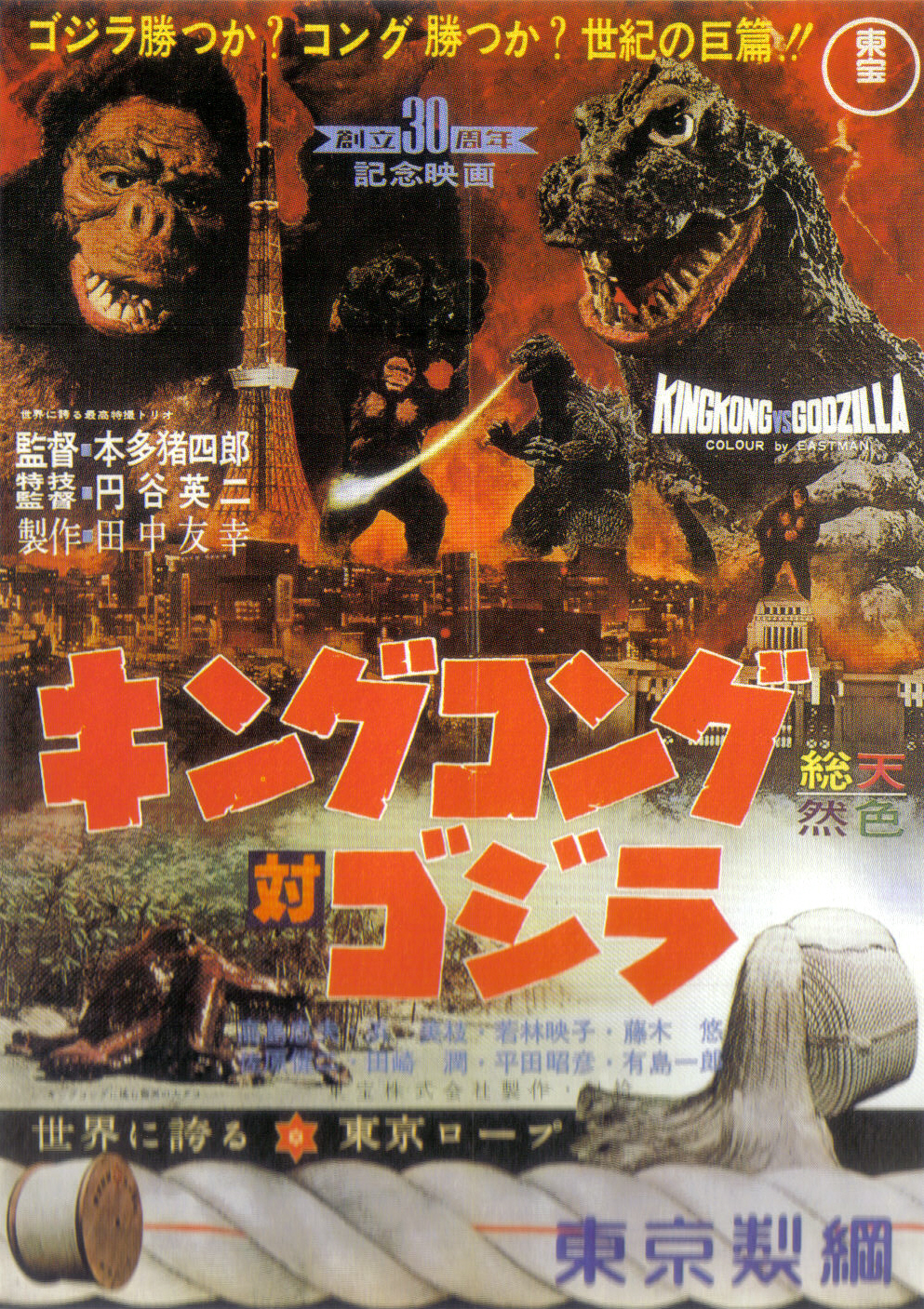
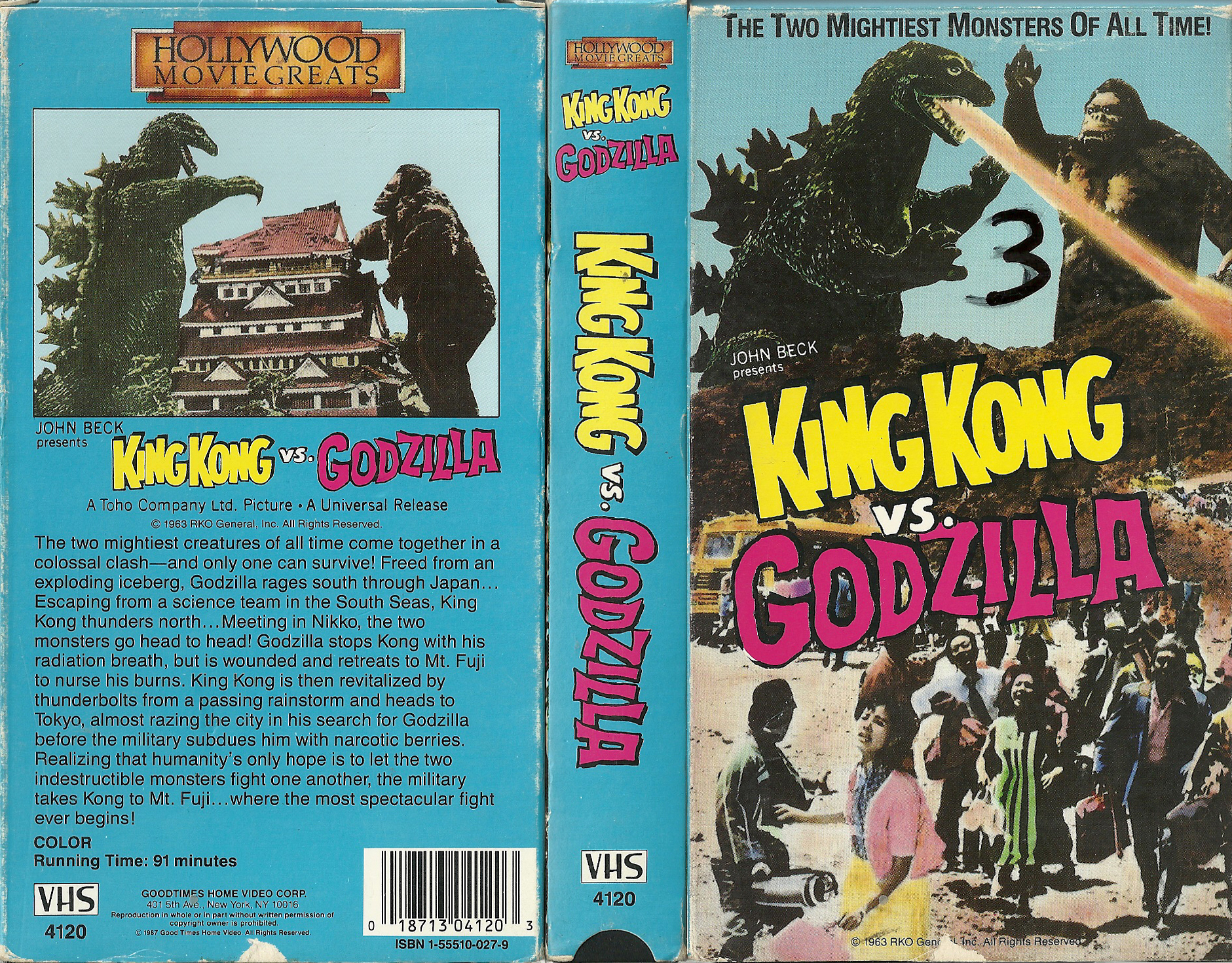
GODZILLA-THON #3 - King Kong vs. Godzilla (1962)
When we last saw our favorite grey-skinned (he's not green, people!) monster, he was en route to becoming a Godzilla popsicle after a lengthy, drawn-out mountainous bombing covered him in ice, which is where he remained for 7 years until Toho decided to revive him for a match against the ultra popular American monster, King Kong. Oddly enough, the Big G wasn't Kong's originally intended adversary. It was going to be... Frankenstein's monster? Yep. The film started out as an idea by stop-motion pioneer Willis O'Brien - the man responsible for bringing Kong to life in his 1933 debut - who wanted to pit Kong against a giant-sized Frankenstein's monster. RKO, the company that owned the character, was all for it... except for the fact that they were no longer a production company. So, one of O'Brien's business buddies decided to do him a solid and shop it overseas, eventually earning the interest of Toho who saw it as a potential vehicle for Godzilla. Unfortunately for O'Brien, his "buddy" cut him out of the deal and took the project to Japan on his own. Although he gets no credit, the only reason this film exists is because of his original concept.
This was one of my favorite movies as a kid, no question. Pitting my two most favorite monsters against each other was genius to my 6-year-old brain. Who cares if the scale on Kong is ridiculously off. He's what, 25, maybe 30 feet tall max? And here he's sprouted to over 100 feet because... he eats red berries on Farrow Island? Yep. There are red berries - which look an awful lot like lychee fruit dyed red - on a remote island in the South Pacific. Kong eats these berries, the juice has made him huge. There is also a large octopus on the island, almost as big as Kong, and it too enjoys drinking the juice from these berries. There are natives on this island as well. They eat these berries. They are normal-sized humans. The things you don't think about when you're young, right? I guess the berry juice magic only works on animals.
With few exceptions, Godzilla films have never been known for their intricate plotting or strong scripts. This isn't an exception to that rule, but the conceit behind getting these two together works pretty damn well. Godzilla, fresh from his cryo-slumber in an ice casket, is awake and rightfully pissed off. And what does G do when he's mad? Yep, time to smash the crap out of Japan. Japan, understandably, does not want this. They figure the best way to combat a big beast is with an equally large beast, so they ship Kong's furry ass over to Japan in order to have him fight Godzilla. The method by which they get the two together is wholly improbable - giant balloons would not lift a 3000-ton ape. Laughable as it is, he sure knows how to make an entrance.
That's the thing here, too - this is the first Godzilla film aimed towards a broader audience. Special effects supervisor Eiji Tsuburaya wanted to make both monsters more family friendly. Don't forget, Godzilla - and to a lesser degree, Kong - was still considered a villain in 1962. By making both monsters slightly more anthropomorphic they seemed less scary to small children. That's why they do things like playing hot potato with a massive boulder. The Godzilla suit was once again redesigned, this time with no ears, three toes on each foot instead of four, and his dorsal fins were enlarged. Many fans consider this to be one of the best suits the series has seen, a distinction I tend to agree with. He looks like more like a dinosaur, and I was a dino-obsessed kid. The Kong suit is, uh... well, frankly, it looks like shit. Half the time. The suit used for longer shots has a more furrowed brow and recessed eyes, giving it a more "hardened" look. The close-up suit just flat out blows. His teeth look like they're all about to exit his mouth in different directions, the eyes are bugged out making him look like a pug/ape hybrid; it's just a terrible design through and through, which is surprising given that Tsuburaya was such a major fan of Kong's 1933 debut. I'll admit that there is a little bit of charm to the guy ape's mug, however, he is unquestionably the ugliest Kong ever committed to film. Yes, even uglier than female Kong and her big third-world ape titties in King Kong Lives.
Despite the constantly-told apocryphal tale, there are NOT two endings for the film. A popular rumor started by Spacemen magazine in the '60s claimed that if you saw the film in Japan, Godzilla would win; but viewing it in American would yield a victory for Kong. Not so. In both versions Kong is the winner, although, really, it's pretty ambiguous. It's a satisfying ending for fans of both monsters because neither can claim true victory - they both end the film alive and slightly bruised. King Kong was much more popular internationally than Godzilla at this time, so it was always intended for him to win the bout. This film did get Toho to thinking that pitting there was something to this pitting-Godzilla-against-monsters thing, which ultimately led to the series continuing on as he faced a roster of current and new Toho creations.
This was one of my favorite movies as a kid, no question. Pitting my two most favorite monsters against each other was genius to my 6-year-old brain. Who cares if the scale on Kong is ridiculously off. He's what, 25, maybe 30 feet tall max? And here he's sprouted to over 100 feet because... he eats red berries on Farrow Island? Yep. There are red berries - which look an awful lot like lychee fruit dyed red - on a remote island in the South Pacific. Kong eats these berries, the juice has made him huge. There is also a large octopus on the island, almost as big as Kong, and it too enjoys drinking the juice from these berries. There are natives on this island as well. They eat these berries. They are normal-sized humans. The things you don't think about when you're young, right? I guess the berry juice magic only works on animals.
With few exceptions, Godzilla films have never been known for their intricate plotting or strong scripts. This isn't an exception to that rule, but the conceit behind getting these two together works pretty damn well. Godzilla, fresh from his cryo-slumber in an ice casket, is awake and rightfully pissed off. And what does G do when he's mad? Yep, time to smash the crap out of Japan. Japan, understandably, does not want this. They figure the best way to combat a big beast is with an equally large beast, so they ship Kong's furry ass over to Japan in order to have him fight Godzilla. The method by which they get the two together is wholly improbable - giant balloons would not lift a 3000-ton ape. Laughable as it is, he sure knows how to make an entrance.
That's the thing here, too - this is the first Godzilla film aimed towards a broader audience. Special effects supervisor Eiji Tsuburaya wanted to make both monsters more family friendly. Don't forget, Godzilla - and to a lesser degree, Kong - was still considered a villain in 1962. By making both monsters slightly more anthropomorphic they seemed less scary to small children. That's why they do things like playing hot potato with a massive boulder. The Godzilla suit was once again redesigned, this time with no ears, three toes on each foot instead of four, and his dorsal fins were enlarged. Many fans consider this to be one of the best suits the series has seen, a distinction I tend to agree with. He looks like more like a dinosaur, and I was a dino-obsessed kid. The Kong suit is, uh... well, frankly, it looks like shit. Half the time. The suit used for longer shots has a more furrowed brow and recessed eyes, giving it a more "hardened" look. The close-up suit just flat out blows. His teeth look like they're all about to exit his mouth in different directions, the eyes are bugged out making him look like a pug/ape hybrid; it's just a terrible design through and through, which is surprising given that Tsuburaya was such a major fan of Kong's 1933 debut. I'll admit that there is a little bit of charm to the guy ape's mug, however, he is unquestionably the ugliest Kong ever committed to film. Yes, even uglier than female Kong and her big third-world ape titties in King Kong Lives.
"Break these chains... of love!"
As with almost every Godzilla film up to this point, King Kong vs. Godzilla had an American version that cut out many scenes and changed some of the film sequences around. They inserted the character of Eric Carter (played by a good looking son of a bitch named Michael Keith), a U.N. reporter who would call on his colleagues around the world to get updates on Godzilla and Kong's respective paths of destruction. Having seen both versions of the film, I've gotta say that I love the U.S. version. And, yes, that would still be the case if I could get these damn rose-tinted glasses off. For one thing, the concept of using a world reporter at the U.N. gives the film a more global, epic feel. I also have a hard-on for vintage '60s Americana news reports and space exploration videos. All of the footage shot with Carter feels like you're watching an old forgotten broadcast. Much of Akira Ifukube's score was replaced by stock library cues that had been used in older films, this was in an effort to give the music a more "Westernized" feel.
The film does have quite a few distinctions to its name. It was the first time that either Godzilla or King Kong were shot widescreen (the film was done in scope 2.35:1 ratio) and in color. Additionally, the film remains the most-attended Godzilla film of all-time, with over 12 million admissions in Japan. My first experience watching it came from the old Goodtimes VHS, a tape that I still own because I think it's important to retain some Luddite qualities so you can appreciate what once was every now and then.
Wednesday, July 24, 2013
GODZILLA-THON #2 - Godzilla Raids Again (1955)
Godzilla's second foray into theaters occurred immediately following his debut. Toho, eager as any Western Hollywood studio, wanted to capitalize on the success of Godzilla's popularity, so this sequel went into production for release in 1955. That might sound ambitious for the '50s - long before the '80s heyday of popping out horror sequels quicker than a child gestates - but then I'd be quick to point out that RKO shot and released Son of Kong in the same year (1933) that the original came out! And they had to do stop-motion animation, too! So, getting Haruo Nakajima to hop inside their rubber suit once again and stomp miniatures wasn't such an impossible task. But, this being a sequel and all, the stakes had to be raised. Unfortunately, director Inoshiro Honda declined to return - can't blame the guy for wanting to go out on a high note - and composer Akira Ifukube also was unavailable. In their place, director Motoyoshi Oda (who was up to that point mainly known for a Japanese film influenced by The Invisible Man called Tomei Ningen) took over the reigns, while score composition was handled by then-new composer Masaru Satoh. This was actually the first score he ever recorded for a film. He would later gain recognition for his work with Akira Kurosawa.
Enter Anguirus. Or Angillas. Or Anguilas. Of all the monsters in Toho's roster, Anguirus seems to have the most "AKA"s. Toho says Anguirus, so that's what I call him. This spiky Ankylosaurus-looking beast was introduced initially as Godzilla's foe, though later films would see him often aligning with Godzilla, creating one of the most badass tag teams since Hulk Hogan and The Ultimate Warrior decided to join forces.
One quick note on the American version of Godzilla Raids Again... The original intention was for an American distributor, AB-PT productions, to film completely new footage around all of the existing monster scenes. This new film, to be titled The Volcano Monsters, would have shrunk the scale of Godzilla and Anguirus to dinosaur size. Additionally, Godzilla was not going to be shown breathing fire, and Toho even sent over monster suits for the production. Thankfully, the production company went out of business the following year, effectively cancelling the entire production. As bad as it sounds, some part of me is morbidly curious to know how this project would have looked fully realized. The film still got messed with to hilarious results, though. The American version re-christened Godzilla as Gigantis - giving the film its name, Gigantis, the Fire Monster - and he was even given Anguirus' roar! Apparently the distributors were stupid enough to think audiences wouldn't notice Godzilla being passed off as an entirely new monster. The only silver lining to this version - and it's minor - is George Takei, he of Star Trek fame, provided dubbing for one of the actors.
Enter Anguirus. Or Angillas. Or Anguilas. Of all the monsters in Toho's roster, Anguirus seems to have the most "AKA"s. Toho says Anguirus, so that's what I call him. This spiky Ankylosaurus-looking beast was introduced initially as Godzilla's foe, though later films would see him often aligning with Godzilla, creating one of the most badass tag teams since Hulk Hogan and The Ultimate Warrior decided to join forces.
The film doesn't offer a whole lot in the way of plot, or even characters we feel much for. Certainly not after Gojira offered up a top-notch cast of memorable characters - Serizawa has a friggin' eye patch, who doesn't remember that? The only returning cast member, other than Haruo Nakajima as Godzilla, is Takashi Shimura returning as Prof. Yamane. He's not here to do much more than remind people how much Godzilla fucked up Japan before, and that this is likely the first Godzilla's relative who is now awake and pissed off. Only this time, instead of smashing the crap out of fishing villages and eating virgin sacrifices he's focused on battling Anguirus. Which, I suppose, still means that half of Japan is gonna get annihilated. The two of them do more or less use the harbors of Japan as makeshift wrestling mats.
As for the human element, it's far less engaging this time around. We spend most of the film with two pilots who are tasked with hunting for schools of fish from the air. They first spot Godzilla and Anguirus already embroiled in a heated battle on some remote island before the monsters both fail to notice the impending cliff and into the drink they go. One of the pilots recognized Godzilla, though, so finally the Japanese can make preparations to ward off the beast.
Oh, man, they do such a good job, too. Although he was ignored in the first film, the army listens to Prof. Yamane this time and prepare a series of flares designed to lure G away from the coastal cities. After all, like a large, scaly moth the Big Guy is drawn to lights, so a few well-placed flares and he'll be out of here in no t-
Fuck. A group of convicts just engineered the easiest prison truck escape ever, hijacked a gasoline truck (the most logical of vehicles to employ during a high speed chase), and lost complete control of it, slamming into a refinery that just happens to be right by the coast.
Aaaaaaannnnnddddd now Godzilla is coming back to obliterate everything. So is Anguirus, who apparently can't resist the urge to add some theatricality to his rematch by fighting next to the massive fire. Bad move. Doesn't he know Godzilla breathes fire? He finds out, but only after Godzilla bites through his neck and kicks his dying ass into a drainage ditch. Then Anguirus gets blasted with the famous atomic breath, effectively burning him to death. Don't feel too bad, he gets to make up for losing later in the series by appearing in several pictures.
"C'mon, just one hug..."
The Godzilla suit underwent some minor cosmetic changes for this entry. As everyone should already know, the suit quite literally has been altered in one way or another for every single film in the series. This time around Godzilla has a more dinosaur-like head and his ears seem a bit more pronounced. This is the closest the suit has ever looked to the original, as the next film - King Kong vs. Godzilla - saw a major makeover for the Big Guy. Once again, Haruo Nakajima donned the rubber casket, though modifications had been made to ensure a modicum of comfort over the previous design.
So, how do they off Godzilla this time? You can't kill him again - not because they couldn't write a way to kill him, but think about the sequel potential! They had to just put him on ice, literally. Our two ace pilots - Tsukioka and Kobayashi - spend almost 15 minutes bombing him on an icy island with the intent of covering him with enough ice so that he can't escape. This is not taking into consideration the fact that he's a massive, powerful lizard that can likely just stomp his way out. And, you know, he does breathe fire! But, sure, whatever. Gotta wrap the film up somehow, right? Anyway, these two guys drop more bombs than a WWII fighter pilot before this terrible ice plan finally works, rendering our titular monster a kaiju-sicle.
"I'll, uh, just be polite and stand here while you guys do your thing."
And that's how he stayed for 7 long years, until another monster King by the name of Kong came knocking at his door.
One quick note on the American version of Godzilla Raids Again... The original intention was for an American distributor, AB-PT productions, to film completely new footage around all of the existing monster scenes. This new film, to be titled The Volcano Monsters, would have shrunk the scale of Godzilla and Anguirus to dinosaur size. Additionally, Godzilla was not going to be shown breathing fire, and Toho even sent over monster suits for the production. Thankfully, the production company went out of business the following year, effectively cancelling the entire production. As bad as it sounds, some part of me is morbidly curious to know how this project would have looked fully realized. The film still got messed with to hilarious results, though. The American version re-christened Godzilla as Gigantis - giving the film its name, Gigantis, the Fire Monster - and he was even given Anguirus' roar! Apparently the distributors were stupid enough to think audiences wouldn't notice Godzilla being passed off as an entirely new monster. The only silver lining to this version - and it's minor - is George Takei, he of Star Trek fame, provided dubbing for one of the actors.
"Watch out, it's Godzilla... and he looks fabulous!"
Subscribe to:
Posts (Atom)