Showing posts with label movie. Show all posts

Saturday, August 3, 2013

The ABCs Of Death (2012) Blu-ray review


Here's a review I just wrote for DVD Compare. I didn't reformat it for this blog, partially out of laziness and partially because I don't mind the format we use there.


The Film:

Innovation in horror is a great thing. Now, I’m not saying that what the brains behind “The ABCs of Death” (2012) have done is entirely novel since horror directors have been brought together several times before to helm segments within a feature, but the idea of using the letters of the alphabet? Pretty damn genius. It sets a firm template for the film’s narrative (in some sense) while also allowing the chosen directors to play in the sandbox however they see fit. The results of that laissez-faire approach, however, have yielded extremely mixed results. And, really, how could it not? You’ve got 26 (!) different directors, many of whom are playing for a foreign team, and they’ve been given free reign over their short film aside from two strict guidelines: they have to pick a word that begins with their selected letter of the alphabet, and someone has got to die. That’s really all there is to it, and the on-screen results will certainly show that these filmmakers truly came up with whatever they wanted. They employ a variety of shooting cameras, mediums, artistic styles, and writing all in the name of death. Out of a hefty roster of talent, only a fraction managed to craft a short film worthy of your time, though. I’d have to say maybe four or five segments elevate the picture; the rest are utterly forgettable. Rather than recapping the entire alphabet, this review will highlight the few bright spots amongst this gloomy canvas.

“D is for Dogfight” is interesting for its subversion of a typical backroom street fight. As the title suggests, man and dog collide in a makeshift ring surrounded by sketchy thug types. But like many of these shorts, there’s a clever enough twist at the end to make the segment interesting after the excitement of the premise’s opening wears off.

“F is for Fart” was, for me, the highlight of this film. Maybe that says something about how scatological humor only seems to exponentially increase in enjoyment as you age. Regardless, this short manages to cram in so much of the Bizarre Japan that the country has become known for that it almost begs for a feature-length film to be made. Alright, maybe not quite that far but if your idea of entertainment isn’t Japanese school girls inhaling deadly flatulence and getting sucked into each other’s butts, well then what does amuse you? Director Noboru Iguchi, who also helmed the extremely fun “Dead Sushi” (2012), is absolutely a director to keep an eye on if only to see how absurd and insane his next project turns out. He’s got a filmography that boasts both theatrical films and adult videos, and his work certainly does a great deal to meld the two.

“K is for Klutz” is a traditionally animated short about one woman’s adorable little turd that refuses to be flushed down the bowl. The animation style is reminiscent of something from the ‘80s, but only in regards to character design and color use. Going with animation took things outside the box; it was a good call.

“Q is for Quack” gets meta with director Adam Wingard and producer Simon Barrett trying in vain the come up with something for their chosen letter in the film. They decide the most shocking thing to do would be a live death on screen. Not a person, though; an animal, since “nobody gives a shit about animals!” Needing a “q” animal, they select a duck for its ability to quack. As expected, the simple task of shooting a caged, helpless duck in the desert goes awry with amusingly tragic results.

“T is for Toilet” was directed by Lee Hardcastle. Never heard of him? Not a shock. Lee won entry into the film thanks to a contest, and he happened to deliver one of the bright, shining moments of the film. Going even further outside the box, Hardcastle did his entry using stop-motion animation and clay puppets. The plot concerns a young boy who has a blood-drenched nightmare about using the toilet for the first time. When he wakes up, he finds out if there’s really anything to fear from the porcelain altar. This is crudely done, but so very effective thanks to the cascade of blood, vibrant colors, and his inventive designs and effective methods for how a toilet would kill an entire family.

“X is for XXL” wasn’t one of the best segments, but fans of director Xavier Gens’ over-reliance on gore might like this disturbing entry about a woman who goes to great lengths for the perfect body.

“Y is for Youngbuck” is an odd entry from director Jason Eisener. It blends elements of revenge and pedophilia into something that Todd Solondz might have done if he were more bloodthirsty in his filmmaking. Come to think of it, based on his currently-short filmography, Eisener seems to enjoy using revenge as a template. No qualms here; it’s one of the best motivations in film. This short retains his style and the perverse sense of humor that has pervaded his earlier efforts.

Outside of these recommended selections, the rest of the film ranges from decent to terrible. Some of these directors clearly made the most with their limited time and budget, turning in a piece that shone in the final film. Others, however, seemed to have no ability to condense their ideas for a limited runtime and deliver a clear, concise selection. The best segments threw all caution to the wind, just letting their crazy ideas fly wild. The worst got off to a bad start and never recovered. “The ABCs of Death” promises at the end that there will be a sequel and, to that, I say this entry should be mandatory viewing for any director getting involved so that the deficiencies of this are not repeated.

Video:

The only constant here is the film sporting a 1.78:1 1080p/24fps AVC MPEG-4 encoded image. Outside of that, we’ve got 26 films done by 26 directors using (almost) 26 different methods of capturing their ideas. As expected, every single one of these segments ranges in quality. The films were shot using digital cameras, stop-motion animation, traditional animation, a GoPro helmet cam, and probably more than a few different film stocks and speeds. As such, it would be nearly impossible to assign an overall rating to something that is constantly changing. Still, it would also be right to assume that each film has been faithfully reproduced here for the high definition that the medium of Blu-ray provides. As a general observation, most films exhibited a good amount of detail in addition to strong color reproduction. But, again, everything varies from film to film.

Audio:

As with the video, such is also the case for the film’s English DTS-HD Master Audio 5.1 surround sound track (48kHz/24-bit). There aren’t any real problems to address here; all of the segments have a robust track that makes full use of their original fidelity. Some films make better use of the soundfield than others. Overall everything sounds as it should. Bass levels are warm and powerful; dialogue is even across all 26 segments.

Subtitles are included in English SDH and Spanish.

Extras:

As you might expect for a film with 26 different directors, there’s a wealth of bonus material here since nearly everyone tried to put together something for this Blu-ray. There are commentaries, featurettes, deleted scenes, interviews, trailers, photo galleries, and more.

The filmmaker commentary features participants for all 26 of the film’s segments, with some shorts having more than one active participant involved. As such, these commentaries all vary in their usefulness. Most are simply the directors trying to explain what they were going for and how it was achieved under the gun, so to speak. They’re informative, but sitting through this again can be a chore if you didn’t like it.

Up next, a host of featurettes for many of the short films:

“A is for Apocalypse: Oil Burns Visual Effects” (1080/60p) is a featurette that runs for 1 minute and 10 seconds, providing a behind the scenes look at how they fried a guy’s face.

“B is for Bigfoot: Making Of” (1080p) is a featurette that runs for 2 minutes and 56 seconds.

“C is for Cycle: Deleted Scenes” (1080p) runs for 3 minutes and 24 seconds.

“D is for Dogfight: Making Of” (1080p) is a featurette that runs for 6 minutes and 57 seconds.

“F is for Fart: Behind the Scenes” (1080/60p) is a featurette that runs for 9 minutes and 43 seconds.

“H is for Hydro-Electric Diffusion” contains a few different pieces:

- “Behind the Scenes” (1080p) runs for 6 minutes and 40 seconds.
- “The Making of Bertie the Bulldog & Frau Scheisse” (1080p) runs for 4 minutes and 47 seconds.
- “Finished Short vs. Behind the Scenes” (1080p) runs for 6 minutes and 44 seconds.

“I is for Ingrown: Making Of” (1080p) is a featurette that runs for 6 minutes and 43 seconds.

“J is for Jidai-Geki: Behind the Scenes” (1080/60p) is a featurette that runs for 6 minutes and 30 seconds.

“P is for Pressure” contains two interviews (1080p):

- “Writer/Director Simon Rumley” runs for 9 minutes and 3 seconds.
- “Producer/Director of Photography Milton Cam” runs for 9 minutes and 45 seconds.

“R is for Removed: Behind the Scenes Photo Gallery” (1080p) contains 71 images.

“T is for Toilet: Behind the Scenes” (1080p) runs for 3 minutes and 4 seconds.

“V is for Vagitus” contains the following:

- “Deleted scene with optional commentary” (1080p) runs for 37 seconds.
- “Behind the Scenes” (1080p) runs for 13 minutes and 32 seconds.
- “Animatics” (1080p) runs for 5 minutes and 1 second.

“W is for WTF!” contains the following (1080p):

- “Behind the Scenes” runs for 7 minutes and 44 seconds.
- “Bonus Flubs!” (1080p) runs for 3 minutes and 1 second.
- “Star-Beast Outtakes” (1080p) runs for 2 minutes and 19 seconds.

“Z is for Zetsumetsu: Behind the Scenes” (1080/60p) runs for 11 minutes and 7 seconds.

“AXS TV: A Look at The ABCs of Death” (1080/60p) is a featurette that runs for 4 minutes and 16 seconds. As you might surmise from the runtime, this is a brief overview of the film, its concept, and some of the minds behind it.

A few trailers for the film are included (1080p):

- “Faux educational film trailer” runs for 1 minute and 43 seconds.
- “Red band” runs for 1 minute and 27 seconds.
- “Green band” runs for 1 minute and 24 seconds.

There is a BD-Live link that (shockingly) will take you to some actual content relevant to the film. Here, viewers can watch some of the contest submission winners who made short films of their own based upon a pre-selected letter.

The disc also includes trailers for the following releases (1080p):

- John Dies at the End” runs for 2 minutes and 23 seconds.
- “Kiss of the Damned” runs for 2 minutes and 27 seconds.
- “The Sorcerer & the White Snake” runs for 1 minute and 39 seconds.
- “AXS TV promo” runs for 33 seconds.

Finally, the disc is also enabled with a bookmarks feature.

Packaging:

The single disc comes housed in an amaray keepcase.

Overall:

The conceit behind the film is ingenious, but the end results are a mixed bag… and that’s being generous. A few good segments can’t help a two hour film with so much dead weight; however, I will say that the brevity of each film made the task of watching it go by rather painlessly. Even a slow, meandering, pointless short lasts around five minutes. The anticipation of seeing what’s coming up next helps considerably, too. Worth a watch, but probably not a purchase.

The Film: C-
Video: B
Audio: B
Extras: A-
Overall: C+

Thursday, August 1, 2013

Trick 'r Treat (2007)

Here's one I wrote about 5 years ago, but I love this film so much I wanted to get this out there...


Ah, Halloween… my favorite time of the year. It isn't so much the festivities taking place that excites me as it's the feeling in the air once October comes. That palpable sensation you get seeing jack-o-lanterns grimly lit faces, kids trick-or-treating in the streets and the aesthetics of fall surrounding you slowly giving way to winter. I think it must hold a special place in everyone, if for nothing else but purely nostalgic reasons. Michael Dougherty is certainly one of those people, as is evidenced by his incredible horror anthology Trick 'r Treat. For a holiday that revels in films of a horrific nature, there sure are a scant few of them that take place on the actual day itself. Dougherty's film is the celluloid embodiment of that je ne sais quoi that has made Halloween such an alluring holiday for generations of kids (and adults) alike.

As I said, Trick 'r Treat is a horror anthology which interweaves tales that all take place on Halloween night, similar to such genre classics as Creepshow and Tales from the Darkside. A costumed couple learns to respect tradition… the hard way, a group of girls head out into the woods for a "howling" good party, the local school principal has a (literal) taste for blood, four kids attempting to pull off a holiday "trick" end up becoming "treats", and a cantankerous old man gets a visit from a holiday visitor looking to settle a decades-old grudge.

To say any more than that would spoil the fun in watching the film, as these stories are best digested when viewed on an empty mind. The twists are less predictable than most horror films manage these days; half the fun is wondering just where the hell these characters are going to end up. The one constant throughout the film is a costumed, pint-sized little guy named Sam, who does his best to remind people why they should take great care in adhering to the traditions set forth hundreds of years ago for All Hallows Eve. The film is richly seeped in tradition, reminding the audience of just why we celebrate the fabled holiday in the first place. It manages to be effectively creepy and blood-soaked, yet it never goes over-the-top with gratuitous gore. There is also a very obvious helping of black comedy strewn throughout the film, which thankfully never gives way to the self-parody so many horror films feel the need in which to indulge.

I think the most impressive aspect of this film is the incredible attention that has been paid to detail. Every single shot of the film is beautifully framed and composed, often looking more like a cryptic painting than a frame of film. The austere trappings of Mr. Kreeg's dark house, the ghostly palette of the rock quarry, the incredible shape-shifting sequence around a roaring fire in the woods… everything here is gorgeous. That aesthetic, married with the spot-on performances and realistic dialogue, give the film an organic feel that never relies on cheese or parody to break tension. The cinematography by Glen MacPherson (who also shot this year's incredibly brutal Rambo) is so lush it manages to make you feel like you're a part of the celebration. For someone who is as big a fan of the Halloween holiday as I am, this was especially important to see done right. Too often when a film actually does take place on the holiday it lacks the depth that is presented here.

For such a large ensemble cast, there isn't any one performance that stands out above the rest – everyone here is perfectly cast. I even enjoyed Anna Paquin as the "virgin" of the female group, and she's not always someone I'm crazy about. Perhaps my favorite role is that of Mr. Kreeg, played superbly by veteran character actor Brian Cox. His look was inspired directly by my favorite director, John Carpenter, and there are a couple of well-placed nods to his work that were highly amusing. Also providing great support throughout the film is newcomer Quinn Lord who plays Sam, the little sack-headed minion who "stitches" the film's stories together.

Ok, now here's the biggest problem with the film; the 800 lb. gorilla in the room: there is NO set distribution deal lined up. I was lucky enough to see it at the sold-out opening night screening held at Grauman's Chinese Theater for Screamfest 2008. During the post-film Q&A session Mr. Dougherty informed us that he had no idea what the future held for this film. It was set to be released in Oct. 2007 (?!?), then it was pushed back to Feb. 2008, Oct. 2008 and, finally, has been placed on the shelf indefinitely. I'm thankful that Dougherty got some good studio money to make the film to his exact specifications, but, for the love of all things evil, someone at Warner Bros. needs to get this thing out to the masses! I heard rumblings of a direct-to-DVD release date sometime next year, to which I can only say that would be a travesty for something this genuine and unique. I suppose therein lies some of the problem; since this is generally uncharted territory, the studios are clueless as to how they can market the thing. I can understand some of their hesitation (since a good majority of the film features children either killing or being killed), but there's just no excuse to not give this thing some kind of release – and with an October 2008 release out of the question I don't when they could give it a proper release. This is a film that needs to be seen during the month of October, but it's looking like 2009 is the next likely candidate if that were the case. I just don't want to see this film become the cinematic equivalent to the eternally-gestating Guns N' Roses opus Chinese Democracy (which, oddly enough, actually has a release date… for now).

So, obviously I highly recommend the film, there's just one problem: how do you see it? Unless you happen to live in NY and can catch the upcoming screening I really couldn't tell you. I'd hate to have to wait another year until Oct. 2009 for this to get a proper release, but it's been in the can for so long at this point I think any kind of a proper theatrical release, regardless of when, is merited. I'm sure it'll pop up at the occasional film festival throughout the year; I just hope it doesn't get unceremoniously dumped onto DVD without having the benefit of being screened proper for audiences hungry for good, original horror. This is the kind of film you'll find yourself screening for friends every year on Halloween, becoming as much of a tradition as those the film champions. Everyone knows I'm a rabid horror fan through and through, and I've seen more than my share of shitty flicks – this is absolutely one of the best in recent memory. Do yourself a favor and try your best to catch it if you can.


Saturday, July 27, 2013

Only God Forgives (2013)


I just got through watching Only God Forgives, director Nicolas Winding Refn's hotly anticipated follow-up to Drive, which happened to be my favorite film of 2011. And my brain is swirling in a neon-drenched pool of deep thoughts. Drive 2, this sure as fuck was not. That may be why so many critics and filmgoers alike have been bashing the film. It reportedly was met with a chorus of boos when it debuted at Cannes, although I also hear it got a standing ovation at the same time so that proves nothing. Then, when I went to rent it on VUDU tonight I see that it only has 1 1/2 stars. I don't let this kind of negativity dissuade me because every film is a subjective experience. I'm sure Refn's earlier film Valhalla Rising would have been universally skewered had it followed up Drive. Coincidentally enough, some reviews have compared Valhalla to Only God Forgives due to a deliberate pacing coupled with a lack of on-screen dialogue.

It's true. Ryan Gosling only has 22 lines in the film, but his words aren't important here. Not so much as his actions, at least. There's a ton of symbolism at play here, more than I could have ever hoped to catch the first time around. The film's plot sees Gosling, at the behest of his domineering, belittling mother, seeking revenge against a Thai cop, Chang (also known as the Angel of Vengeance), who is responsible for his brother's death. He doesn't seem eager to carry out this act of retribution, though, because his brother died at the hands of the man whose daughter he raped and killed. Not exactly grounds for a sympathy revenge kill. But Gosling's mom, played here by a particularly venomous Kristin Scott Thomas, is a stone-cold woman who uses her sons as instruments for her drug empire. Gosling's character, Julian, has got some real deep-seeded mommy issues. This is Oedipus complex to the max, with plenty of Freudian symbolism here to keep psychology buffs busy.

Refn places the onus more on the film's mis-en-scene than he does the actual writing of the scenes. So many of the shots look like stylized neon paintings come to life. This is where the film likely lost many viewers - people are often turned off when they face a challenge at the movies. I'm not saying this is true of all filmgoers, but the vast majority of Joe Six Packs couldn't hope to get through this and not proclaim it a piece of shit once the credits began rolling. This is cerebral cinema, though it could be easily dismissed as pretentious garbage by those who refuse to seek deeper meaning in the films they watch. Refn is not one to shoot something because it looks pretty (but it does); there's always something else bubbling just beneath the surface. As evidenced with Valhalla Rising, he can make a nearly-silent film compelling through the use of symbolism, quality acting, and imagery. Only God Forgives is steeped in allegory, perhaps moreso than any of his films yet.

While this is ostensibly a vehicle for Ryan Gosling, the real star of the show is Chang, played here by Vithaya Pansringarm, who also does all of his own singing. The dude is a real double threat. Chang seems to represent "God" in the film; all of his actions are the work of a man who judges men before meting out their just punishment. Then, afterwards, he loves to sing karaoke. Gosling and his family are "dirty". They run a drug ring in Chang's town. Julian's brother, Billy, beats and rapes a 16-year-old girl at the beginning. His mother is a manipulative whore who runs the drug ring with her sons. Hell, even Julian, despite being an outsider within his own family, has dirty hands. The only difference being that Julian wants his hands to be clean, but he's powerless as long as his mother is in the picture. Enter Chang. It would truly take an academic paper to dissect every nuance here and explain its meaning, but suffice it to say that Chang is God here, and as the film's title suggests, he is the only one who can absolve Julian of his crimes. Really, there's some powerful stuff going on in this picture.

Just as in Drive, the film's other star is unseen - that would be composer Cliff Martinez, who has managed to possibly top his work on that previous film. Similar to his work on Drive the score here is hypnotic, lulling viewers into a state of complacency that often winds up being shattered by a burst of on-screen ultra-violence. I've been listening to it intermittently for the better part of two weeks now and it's certainly one of the best film scores this year. In particular, his cue during Chang & Julian's big fight is a gothic synth nightmare that elevates the scene tremendously. Also highlighting the score: Chang's karaoke! Now, I don't have a clue what he's saying because I don't speak Thai, but there's something charming about his voice. He has a good singing cadence. Really, though, this is one of the best soundtracks of the year. Ominous, foreboding, electric.... Martinez is quickly becoming one of my favorite composers.

Only God Forgives is a challenging film. If you enjoy that sort of thing, then it comes highly recommended. Sometimes I think that people will dismiss a smart film as boring crap for no other reason than they couldn't understand it. These are the same people who would just as easily dismiss a true classic of cinema like David Lynch's  Mulholland Dr., a film that I consider to be one of the all-time greats. Initial viewings of this film are probably going to leave even the most ardent cinephiles scratching their head. Give it time. Let the film soak in. Consider the deeper meaning behind it all. The words and images you see on screen hold the key to unlocking its true nature. Subsequent viewings will yield these rewards. Movies are not all made to be equal, with some requiring much more effort on the part of the audience than simply showing up. Only God Forgives may seem like a shallow pool of neon sludge, however, that is just the surface layer. We can always go deeper.

ETA: Re-watched this for a second time because I had it on the mind all night. Yep, definitely my favorite film of the year. Everything works for me, on every level. Understanding what the film is going for, and what to look for, makes it such a clearer picture. And, man, that fucking score!


Friday, July 26, 2013

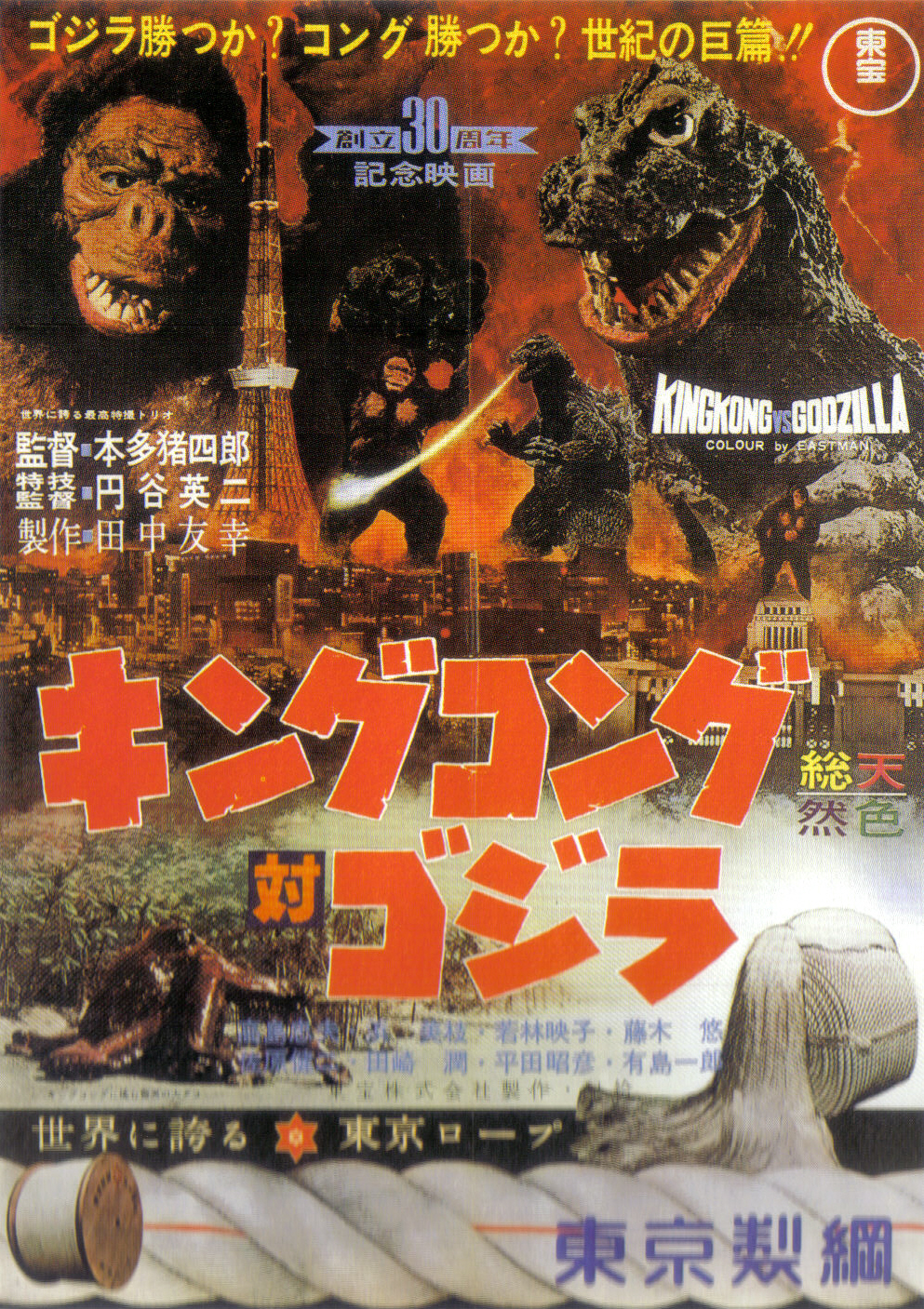
GODZILLA-THON #3 - King Kong vs. Godzilla (1962)

When we last saw our favorite grey-skinned (he's not green, people!) monster, he was en route to becoming a Godzilla popsicle after a lengthy, drawn-out mountainous bombing covered him in ice, which is where he remained for 7 years until Toho decided to revive him for a match against the ultra popular American monster, King Kong. Oddly enough, the Big G wasn't Kong's originally intended adversary. It was going to be... Frankenstein's monster? Yep. The film started out as an idea by stop-motion pioneer Willis O'Brien - the man responsible for bringing Kong to life in his 1933 debut - who wanted to pit Kong against a giant-sized Frankenstein's monster. RKO, the company that owned the character, was all for it... except for the fact that they were no longer a production company. So, one of O'Brien's business buddies decided to do him a solid and shop it overseas, eventually earning the interest of Toho who saw it as a potential vehicle for Godzilla. Unfortunately for O'Brien, his "buddy" cut him out of the deal and took the project to Japan on his own. Although he gets no credit, the only reason this film exists is because of his original concept.


This was one of my favorite movies as a kid, no question. Pitting my two most favorite monsters against each other was genius to my 6-year-old brain. Who cares if the scale on Kong is ridiculously off. He's what, 25, maybe 30 feet tall max? And here he's sprouted to over 100 feet because... he eats red berries on Farrow Island? Yep. There are red berries - which look an awful lot like lychee fruit dyed red - on a remote island in the South Pacific. Kong eats these berries, the juice has made him huge. There is also a large octopus on the island, almost as big as Kong, and it too enjoys drinking the juice from these berries. There are natives on this island as well. They eat these berries. They are normal-sized humans. The things you don't think about when you're young, right? I guess the berry juice magic only works on animals.

With few exceptions, Godzilla films have never been known for their intricate plotting or strong scripts. This isn't an exception to that rule, but the conceit behind getting these two together works pretty damn well. Godzilla, fresh from his cryo-slumber in an ice casket, is awake and rightfully pissed off. And what does G do when he's mad? Yep, time to smash the crap out of Japan. Japan, understandably, does not want this. They figure the best way to combat a big beast is with an equally large beast, so they ship Kong's furry ass over to Japan in order to have him fight Godzilla. The method by which they get the two together is wholly improbable - giant balloons would not lift a 3000-ton ape. Laughable as it is, he sure knows how to make an entrance.

That's the thing here, too - this is the first Godzilla film aimed towards a broader audience. Special effects supervisor Eiji Tsuburaya wanted to make both monsters more family friendly. Don't forget, Godzilla - and to a lesser degree, Kong - was still considered a villain in 1962. By making both monsters slightly more anthropomorphic they seemed less scary to small children. That's why they do things like playing hot potato with a massive boulder. The Godzilla suit was once again redesigned, this time with no ears, three toes on each foot instead of four, and his dorsal fins were enlarged. Many fans consider this to be one of the best suits the series has seen, a distinction I tend to agree with. He looks like more like a dinosaur, and I was a dino-obsessed kid. The Kong suit is, uh... well, frankly, it looks like shit. Half the time. The suit used for longer shots has a more furrowed brow and recessed eyes, giving it a more "hardened" look. The close-up suit just flat out blows. His teeth look like they're all about to exit his mouth in different directions, the eyes are bugged out making him look like a pug/ape hybrid; it's just a terrible design through and through, which is surprising given that Tsuburaya was such a major fan of Kong's 1933 debut. I'll admit that there is a little bit of charm to the guy ape's mug, however, he is unquestionably the ugliest Kong ever committed to film. Yes, even uglier than female Kong and her big third-world ape titties in King Kong Lives.

"Break these chains... of love!"
As with almost every Godzilla film up to this point, King Kong vs. Godzilla had an American version that cut out many scenes and changed some of the film sequences around. They inserted the character of Eric Carter (played by a good looking son of a bitch named Michael Keith), a U.N. reporter who would call on his colleagues around the world to get updates on Godzilla and Kong's respective paths of destruction. Having seen both versions of the film, I've gotta say that I love the U.S. version. And, yes, that would still be the case if I could get these damn rose-tinted glasses off. For one thing, the concept of using a world reporter at the U.N. gives the film a more global, epic feel. I also have a hard-on for vintage '60s Americana news reports and space exploration videos. All of the footage shot with Carter feels like you're watching an old forgotten broadcast. Much of Akira Ifukube's score was replaced by stock library cues that had been used in older films, this was in an effort to give the music a more "Westernized" feel.
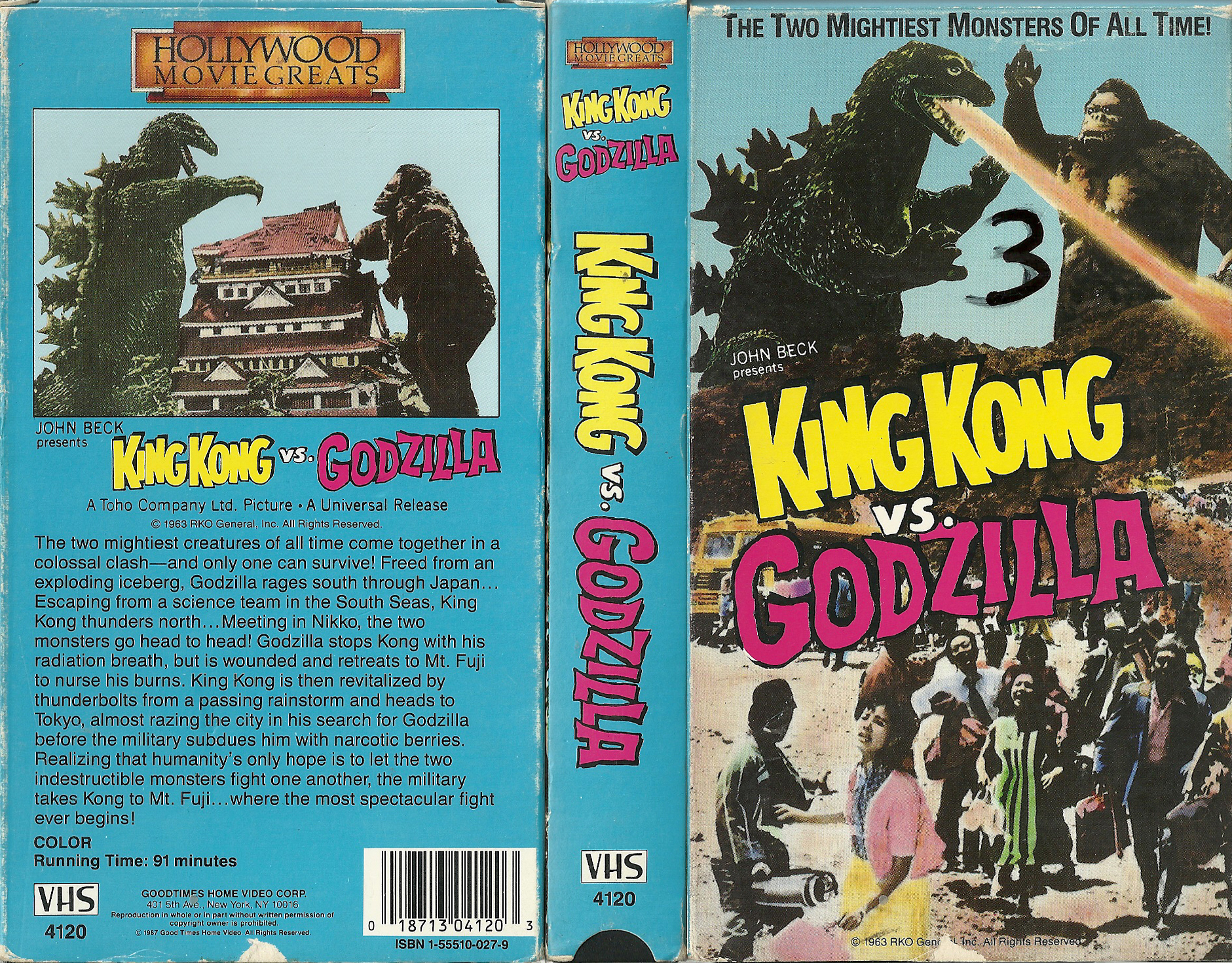
The film does have quite a few distinctions to its name. It was the first time that either Godzilla or King Kong were shot widescreen (the film was done in scope 2.35:1 ratio) and in color. Additionally, the film remains the most-attended Godzilla film of all-time, with over 12 million admissions in Japan. My first experience watching it came from the old Goodtimes VHS, a tape that I still own because I think it's important to retain some Luddite qualities so you can appreciate what once was every now and then. 


Despite the constantly-told apocryphal tale, there are NOT two endings for the film. A popular rumor started by Spacemen magazine in the '60s claimed that if you saw the film in Japan, Godzilla would win; but viewing it in American would yield a victory for Kong. Not so. In both versions Kong is the winner, although, really, it's pretty ambiguous. It's a satisfying ending for fans of both monsters because neither can claim true victory - they both end the film alive and slightly bruised. King Kong was much more popular internationally than Godzilla at this time, so it was always intended for him to win the bout. This film did get Toho to thinking that pitting there was something to this pitting-Godzilla-against-monsters thing, which ultimately led to the series continuing on as he faced a roster of current and new Toho creations.


Wednesday, July 24, 2013

GODZILLA-THON #2 - Godzilla Raids Again (1955)

Godzilla's second foray into theaters occurred immediately following his debut. Toho, eager as any Western Hollywood studio, wanted to capitalize on the success of Godzilla's popularity, so this sequel went into production for release in 1955. That might sound ambitious for the '50s - long before the '80s heyday of popping out horror sequels quicker than a child gestates - but then I'd be quick to point out that RKO shot and released Son of Kong in the same year (1933) that the original came out! And they had to do stop-motion animation, too! So, getting Haruo Nakajima to hop inside their rubber suit once again and stomp miniatures wasn't such an impossible task. But, this being a sequel and all, the stakes had to be raised. Unfortunately, director Inoshiro Honda declined to return - can't blame the guy for wanting to go out on a high note - and composer Akira Ifukube also was unavailable. In their place, director Motoyoshi Oda (who was up to that point mainly known for a Japanese film influenced by The Invisible Man called Tomei Ningen) took over the reigns, while score composition was handled by then-new composer Masaru Satoh. This was actually the first score he ever recorded for a film. He would later gain recognition for his work with Akira Kurosawa.


Enter Anguirus. Or Angillas. Or Anguilas. Of all the monsters in Toho's roster, Anguirus seems to have the most "AKA"s. Toho says Anguirus, so that's what I call him. This spiky Ankylosaurus-looking beast was introduced initially as Godzilla's foe, though later films would see him often aligning with Godzilla, creating one of the most badass tag teams since Hulk Hogan and The Ultimate Warrior decided to join forces.

The film doesn't offer a whole lot in the way of plot, or even characters we feel much for. Certainly not after Gojira offered up a top-notch cast of memorable characters - Serizawa has a friggin' eye patch, who doesn't remember that? The only returning cast member, other than Haruo Nakajima as Godzilla, is Takashi Shimura returning as Prof. Yamane. He's not here to do much more than remind people how much Godzilla fucked up Japan before, and that this is likely the first Godzilla's relative who is now awake and pissed off. Only this time, instead of smashing the crap out of fishing villages and eating virgin sacrifices he's focused on battling Anguirus. Which, I suppose, still means that half of Japan is gonna get annihilated. The two of them do more or less use the harbors of Japan as makeshift wrestling mats. 

As for the human element, it's far less engaging this time around. We spend most of the film with two pilots who are tasked with hunting for schools of fish from the air. They first spot Godzilla and Anguirus already embroiled in a heated battle on some remote island before the monsters both fail to notice the impending cliff and into the drink they go. One of the pilots recognized Godzilla, though, so finally the Japanese can make preparations to ward off the beast. 

Oh, man, they do such a good job, too. Although he was ignored in the first film, the army listens to Prof. Yamane this time and prepare a series of flares designed to lure G away from the coastal cities. After all, like a large, scaly moth the Big Guy is drawn to lights, so a few well-placed flares and he'll be out of here in no t-

Fuck. A group of convicts just engineered the easiest prison truck escape ever, hijacked a gasoline truck (the most logical of vehicles to employ during a high speed chase), and lost complete control of it, slamming into a refinery that just happens to be right by the coast. 

Aaaaaaannnnnddddd now Godzilla is coming back to obliterate everything. So is Anguirus, who apparently can't resist the urge to add some theatricality to his rematch by fighting next to the massive fire. Bad move. Doesn't he know Godzilla breathes fire? He finds out, but only after Godzilla bites through his neck and kicks his dying ass into a drainage ditch. Then Anguirus gets blasted with the famous atomic breath, effectively burning him to death. Don't feel too bad, he gets to make up for losing later in the series by appearing in several pictures.

"C'mon, just one hug..."
The Godzilla suit underwent some minor cosmetic changes for this entry. As everyone should already know, the suit quite literally has been altered in one way or another for every single film in the series. This time around Godzilla has a more dinosaur-like head and his ears seem a bit more pronounced. This is the closest the suit has ever looked to the original, as the next film - King Kong vs. Godzilla - saw a major makeover for the Big Guy. Once again, Haruo Nakajima donned the rubber casket, though modifications had been made to ensure a modicum of comfort over the previous design.  

So, how do they off Godzilla this time? You can't kill him again - not because they couldn't write a way to kill him, but think about the sequel potential! They had to just put him on ice, literally. Our two ace pilots - Tsukioka and Kobayashi - spend almost 15 minutes bombing him on an icy island with the intent of covering him with enough ice so that he can't escape. This is not taking into consideration the fact that he's a massive, powerful lizard that can likely just stomp his way out. And, you know, he does breathe fire! But, sure, whatever. Gotta wrap the film up somehow, right? Anyway, these two guys drop more bombs than a WWII fighter pilot before this terrible ice plan finally works, rendering our titular monster a kaiju-sicle.
"I'll, uh, just be polite and stand here while you guys do your thing."

And that's how he stayed for 7 long years, until another monster King by the name of Kong came knocking at his door.

One quick note on the American version of Godzilla Raids Again... The original intention was for an American distributor, AB-PT productions, to film completely new footage around all of the existing monster scenes. This new film, to be titled The Volcano Monsters, would have shrunk the scale of Godzilla and Anguirus to dinosaur size. Additionally, Godzilla was not going to be shown breathing fire, and Toho even sent over monster suits for the production. Thankfully, the production company went out of business the following year, effectively cancelling the entire production. As bad as it sounds, some part of me is morbidly curious to know how this project would have looked fully realized. The film still got messed with to hilarious results, though. The American version re-christened Godzilla as Gigantis - giving the film its name, Gigantis, the Fire Monster - and he was even given Anguirus' roar! Apparently the distributors were stupid enough to think audiences wouldn't notice Godzilla being passed off as an entirely new monster. The only silver lining to this version - and it's minor - is George Takei, he of Star Trek fame, provided dubbing for one of the actors. 

"Watch out, it's Godzilla... and he looks fabulous!"